
TL;DR:
- Well-structured commercial contracts prevent disputes and ensure enforceability across different jurisdictions.
- Effective negotiation and precise drafting are essential for risk allocation and long-term business success.
- Ongoing compliance and legal support reduce legal risks and improve contract performance.
Commercial contracts are widely assumed to be formalities; documents you sign, file, and forget. That assumption is costly. Across Europe and particularly in Bosnia and Herzegovina, poorly structured agreements are among the leading causes of business disputes, cash flow disruption, and failed partnerships. The legal frameworks governing these contracts are layered, jurisdiction-specific, and capable of producing very different outcomes depending on how terms are drafted, negotiated, and managed. This guide provides business leaders with a clear, practical framework for understanding commercial contracts, from their essential components through to negotiation, compliance, and dispute resolution.
Table of Contents
- What are commercial contracts and why do they matter?
- Building clear, enforceable commercial contracts
- How to negotiate commercial contracts for better outcomes
- Contract compliance, arbitration, and risk management
- A fresh perspective: What most leaders overlook in commercial contracts
- How expert legal support ensures contract success
- Frequently asked questions
Key Takeaways
| Point | Details |
|---|---|
| Clarity reduces disputes | Unclear contract terms are a leading cause of litigation in Bosnia and Europe. |
| Negotiation is strategic | Preparing your BATNA and knowing regional norms can improve your negotiation outcomes. |
| Compliance is critical | Every EU contract should avoid unfair clauses to prevent regulatory issues. |
| Context matters | Templates and generic advice often fail to capture important local or sector specifics. |
| Legal support adds value | Expert guidance ensures your contracts are enforceable and work for your business goals. |
What are commercial contracts and why do they matter?
A commercial contract is a legally binding agreement between two or more parties for a commercial purpose. This typically includes the sale of goods, provision of services, licensing arrangements, supply chain agreements, joint ventures, and distribution deals. Unlike personal contracts, commercial contracts are entered into by businesses and are governed by commercial law, not consumer protection law. The distinction matters because consumer law often provides stronger protections, whereas commercial contracts are largely governed by the principle that parties negotiate freely and are bound by what they agree.
Every enforceable commercial contract shares a set of core components:
- Offer and acceptance: One party proposes defined terms; the other accepts them without material alteration.
- Consideration: Each party provides something of value, whether payment, services, or a promise to act.
- Legal capacity: Both parties must be legally capable of entering into contracts, i.e., they must be of age and of sound mind, and in the case of companies, authorised to contract.
- Lawful object: The subject matter must not be illegal or contrary to public policy.
- Clarity of terms: The rights, obligations, timelines, and remedies must be sufficiently defined to be enforceable.
When any of these elements is absent or ambiguous, the contract becomes vulnerable to challenge. Clarity is not merely a drafting preference; it is an enforceability requirement.
For businesses doing business in Bosnia, the stakes around contract quality are particularly high. The legal environment is shaped by both entity-level legislation and inherited Yugoslav-era commercial codes, which means contractual obligations can be interpreted differently depending on whether a dispute arises in the Federation of Bosnia and Herzegovina or Republika Srpska. Cross-border deals add yet another layer, since EU-based counterparties may expect contracts to reflect EU standards, while BiH law governs locally.
Ambiguity in contracts is not a minor inconvenience. Vague pricing structures, undefined delivery timelines, or missing termination clauses generate the conditions for litigation. Commercial law fundamentals make clear that well-drafted agreements are the first line of defence against disputes.
Arbitration in Bosnia and Herzegovina is available under UNCITRAL-based laws at the entity level, but remains underutilised due to legislative shortcomings, meaning most commercial disputes end up in the court system where they are slower and more expensive to resolve.
This reality reinforces the case for precision at the drafting stage. Getting the contract right from the outset is significantly less costly than litigating its meaning later.
Building clear, enforceable commercial contracts
Drafting an enforceable commercial contract requires more than copying a standard template. It demands deliberate legal structuring aligned to the specific transaction, the parties involved, and the jurisdiction governing performance and disputes.
The following steps represent a practical sequence for building sound commercial agreements:
- Define the scope precisely. Vague descriptions of services or deliverables are among the most common sources of dispute. State exactly what is being provided, by when, at what standard, and to whom.
- Set clear payment terms. Specify amounts, currency, invoicing procedures, payment deadlines, and consequences for late payment, including interest rates where applicable.
- Allocate risk explicitly. Identify who bears the risk of loss, delay, or failure at each stage of performance. For goods, cross-border contract guidance recommends using Incoterms to remove ambiguity in international supply chains.
- Draft termination and exit provisions. Specify the conditions under which each party may exit, the notice required, and the financial consequences of early termination.
- Include dispute resolution mechanisms. Decide in advance whether disputes go to arbitration or court, under which law, and in which jurisdiction.
- Address force majeure and contingencies. Define what constitutes an unforeseeable event, what obligations are suspended, and how parties restart performance after a disruption.
Ambiguity takes two forms in contract law: patent ambiguity, which is visible on the face of the contract, and latent ambiguity, which only emerges when the contract is applied to real circumstances. Ambiguous terms lead to litigation precisely because latent ambiguity is difficult to anticipate. For example, a contract that specifies "prompt delivery" without defining what "prompt" means in days or hours has introduced latent ambiguity into what appears to be a clear term.
Verbal contracts present a related challenge. They are legally binding in Bosnia and Herzegovina in most commercial contexts, but the evidentiary burden of proving their terms is substantial. Without written confirmation, email trails, or witness testimony, verbal agreements frequently fail in court. The practical advice is straightforward: always document commercial arrangements in writing, even when the relationship is longstanding.
In BiH employment-adjacent contexts, non-compete clauses require careful handling. Post-termination non-competes are enforceable, but only where reasonable compensation is provided to the restricted party. Courts have struck down non-competes drafted without consideration, rendering them unenforceable precisely when the business most needs them.
Pro Tip: Use plain language wherever possible. Contracts written in accessible terms reduce misunderstandings, speed up counterparty review, and are more likely to be read in full by both parties before signing.
How to negotiate commercial contracts for better outcomes
Negotiation is where the real value of a commercial contract is determined. A well-negotiated agreement protects business interests, allocates risk fairly, and leaves less to chance than a hastily signed standard-form document. The approach to negotiation, however, varies significantly depending on the counterparty, the transaction type, and the cultural context.
Two broad negotiation styles are relevant here:
| Strategy | Description | Best applied when |
|---|---|---|
| Distributive | Win-lose; one party gains more at the other's expense | One-off transactions, commodity deals |
| Cooperative | Win-win; both parties seek mutual value creation | Long-term relationships, joint ventures |
In most B2B contexts across Europe and BiH, a cooperative approach produces more sustainable outcomes. Counterparties who feel treated fairly in negotiation are more likely to perform their obligations and less likely to pursue aggressive dispute strategies later.
The foundation of effective contract negotiation is preparation. Specifically:
- Identify your BATNA. Your Best Alternative to a Negotiated Agreement is your walk-away point. Knowing it prevents you from accepting terms worse than your alternatives.
- Build leverage layers. Beyond your primary BATNA, identify secondary options. Multiple alternatives give you negotiating flexibility across different clauses.
- Research the counterparty. Understand their constraints, priorities, and past contractual behaviour. This informs which concessions matter to them and which are low-cost for you.
- Bundle trade-offs. Rather than negotiating each clause in isolation, bundle multiple issues. Conceding on payment terms while gaining on liability caps is often a net positive.
Specific clauses to scrutinise during negotiation include limitation of liability provisions, indemnification obligations, intellectual property ownership, and confidentiality scope. These are frequently buried in boilerplate language but carry significant financial consequences.
For context on international negotiation, understanding the business culture of your counterparty is not optional. In some European markets, direct negotiation is expected; in others, relationship-building precedes any substantive discussion of terms. Misreading these signals can signal bad faith before a word of the contract has been discussed.
Pro Tip: Engage a legal expert before the negotiation phase, not after. A lawyer who reviews a draft after you have already agreed to headline terms has limited room to improve the outcome.
Contract compliance, arbitration, and risk management
Signing a commercial contract is the beginning of a compliance obligation, not the end of a legal process. Businesses that treat execution as the finish line often find themselves in breach through inaction, whether because they miss a notice deadline, fail to maintain required insurance, or overlook a renewal term.
Contract lifecycle management (CLM) refers to the systematic oversight of obligations from execution through to termination or renewal. Studies indicate that investing in CLM delivers 8 to 12% savings in procurement spending by reducing errors, penalties, and missed renegotiation windows. For large organisations with multiple active agreements, CLM software is increasingly standard.

The compliance challenge is particularly acute in the European Union, where consumer and commercial contract law is augmented by sector-specific regulation. Research found that 100% of reviewed EU Terms of Service contracts contained at least one unfair clause, with foreign-headquartered companies showing worse outcomes. This signals that many businesses, including sophisticated ones, are operating with contracts that carry latent legal risk.
Common unfair or problematic clauses to identify and renegotiate include:
| Clause type | Risk | Recommended approach |
|---|---|---|
| Unilateral variation rights | Allows counterparty to change terms without consent | Require mutual written agreement for any variation |
| Asymmetric termination rights | One party can exit freely; the other cannot | Balance exit rights and notice periods |
| Unlimited liability | Exposes one party to disproportionate financial risk | Negotiate caps tied to contract value |
| Automatic renewal without notice | Locks parties into agreements unintentionally | Insert minimum notice periods for non-renewal |
On dispute resolution, businesses in Bosnia and Herzegovina have a choice between litigation in cantonal or entity courts, and arbitration. As noted, arbitration under UNCITRAL-based rules is available but underused, despite offering speed, confidentiality, and enforcement advantages compared to court proceedings. For international commercial contracts specifically, including an arbitration clause with a designated seat and rules at the drafting stage is advisable.
Proactive legal advice is consistently more cost-effective than reactive dispute management; the cost of preventing a dispute through careful drafting is a fraction of the cost of resolving one.
Building a compliance process does not require a large legal team. A basic contract register, obligation calendars, and defined review periods for key agreements go a long way toward reducing risk exposure in any organisation.
A fresh perspective: What most leaders overlook in commercial contracts
The most common error in commercial contracting is not a drafting mistake. It is the assumption that a downloaded template, reviewed once before signing, constitutes adequate legal protection. Templates are starting points. They are not substitutes for context-specific legal analysis, and they do not account for the specific risks, relationships, or regulatory requirements of a given deal.
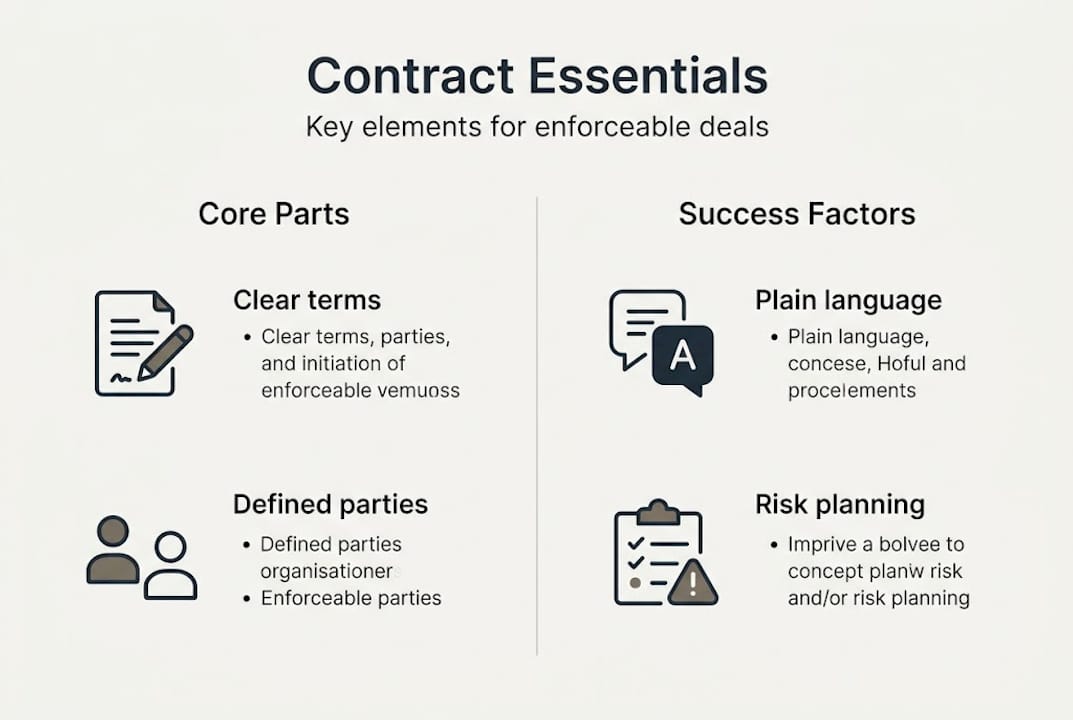
The second underestimated factor is cultural. Negotiation success across Europe depends heavily on cultural awareness; direct negotiation styles typical in Northern Europe can undermine trust-building in relationship-oriented markets in the Western Balkans and beyond. A contract negotiated without cultural intelligence often reflects the priorities of only one party. The outcome may be signed but rarely performs as intended.
In BiH specifically, the low uptake of arbitration represents a missed opportunity. Arbitration is private, enforceable under the New York Convention in over 170 countries, and typically faster than court litigation. Yet most businesses default to courts because arbitration clauses were never included in their contracts. The role of legal advisors in correcting this gap is substantial. Advisors who understand both local practice and international standards can insert the right clauses at the right time.
Finally, plan for real-world risk scenarios, not theoretical best cases. A contract that assumes performance will go smoothly is a contract that is unprepared for business reality.
How expert legal support ensures contract success
Navigating commercial contracts across Bosnia and Herzegovina and European markets requires more than legal knowledge; it requires the judgment to apply that knowledge to specific transactions, relationships, and risk profiles. Understanding corporate law essentials provides a strong foundation, but every deal demands tailored review.
Vucic.legal provides targeted legal services for business leaders operating in BiH and across borders, covering contract drafting and review, negotiation support, compliance structuring, and dispute management. Whether you are entering a new supply agreement, structuring a joint venture, or managing an existing contract portfolio, access to expert advice at each stage reduces risk and produces better commercial outcomes. For businesses involved in international transactions, dedicated international contract law support ensures your agreements are enforceable, balanced, and aligned with the laws that govern them.
Frequently asked questions
Are verbal commercial contracts valid in Bosnia and Herzegovina?
Yes, verbal contracts are binding in most commercial contexts, but they are significantly harder to prove and enforce without written documentation or corroborating evidence.
What are the most common causes of contract disputes in Bosnia and Herzegovina?
Ambiguous terms leading to litigation are the primary driver, alongside missing clauses on payment, termination, and responsibility allocation in poorly structured agreements.
How does arbitration work in Bosnia and Herzegovina for commercial contracts?
Arbitration is available under UNCITRAL-based rules at the entity level and can resolve commercial disputes confidentially, but it requires a written arbitration clause and remains underutilised due to gaps in the legislative framework.
Why is contract compliance especially important in the EU?
Research shows that 100% of reviewed EU contracts contained at least one unfair clause, meaning compliance review is essential to avoid financial penalties, regulatory exposure, and reputational damage.
Does having a template contract protect my business?
Templates provide a useful starting point but cannot replace tailored legal advice, particularly in cross-border, regulated, or high-value transactions where specific risks and jurisdiction-level requirements must be addressed individually.