
TL;DR:
- Bosnia and Herzegovina’s 2026 reforms mandate indefinite contracts as default, formal remote work regulation, and minimum four-week paid leave.
- Employers managing staff across both entities must navigate separate laws, inspections, and compliance obligations.
- Ongoing proactive management, accurate documentation, and tailored legal support are essential for compliance and risk mitigation.
The 2026 legislative cycle has introduced some of the most substantial reforms to employment law in Bosnia and Herzegovina in over a decade. Business owners and HR leaders operating in the Federation of Bosnia and Herzegovina (FBiH) are now navigating a Draft Labour Law that repositions indefinite contracts as the default, formalises remote work arrangements, and guarantees a minimum of four weeks paid annual leave. For organisations operating across both entities, the stakes of non-compliance have never been higher. This guide offers a clear, structured path for meeting every obligation, avoiding costly inspections, and building a legally sound workforce.
Table of Contents
- Understanding core employment law obligations
- Step-by-step: Implementing compliant employment contracts
- Managing payroll, leave, and working hours
- Ongoing compliance: Inspections, training, and risk management
- What most guides miss about employment law compliance in BiH
- Unlock effortless compliance with expert legal support
- Frequently asked questions
Key Takeaways
| Point | Details |
|---|---|
| Indefinite contracts now standard | The 2026 law establishes indefinite employment contracts as the default for businesses. |
| Prepare for dual-entity rules | Understand differences between FBiH and RS to minimise legal risks during inspections. |
| Compliant contracts are critical | All employment relationships must be supported by written contracts reflecting new legislative requirements. |
| Ongoing audits prevent penalties | Routine audits and HR training on entity differences help companies stay compliant and avoid costly fines. |
Understanding core employment law obligations
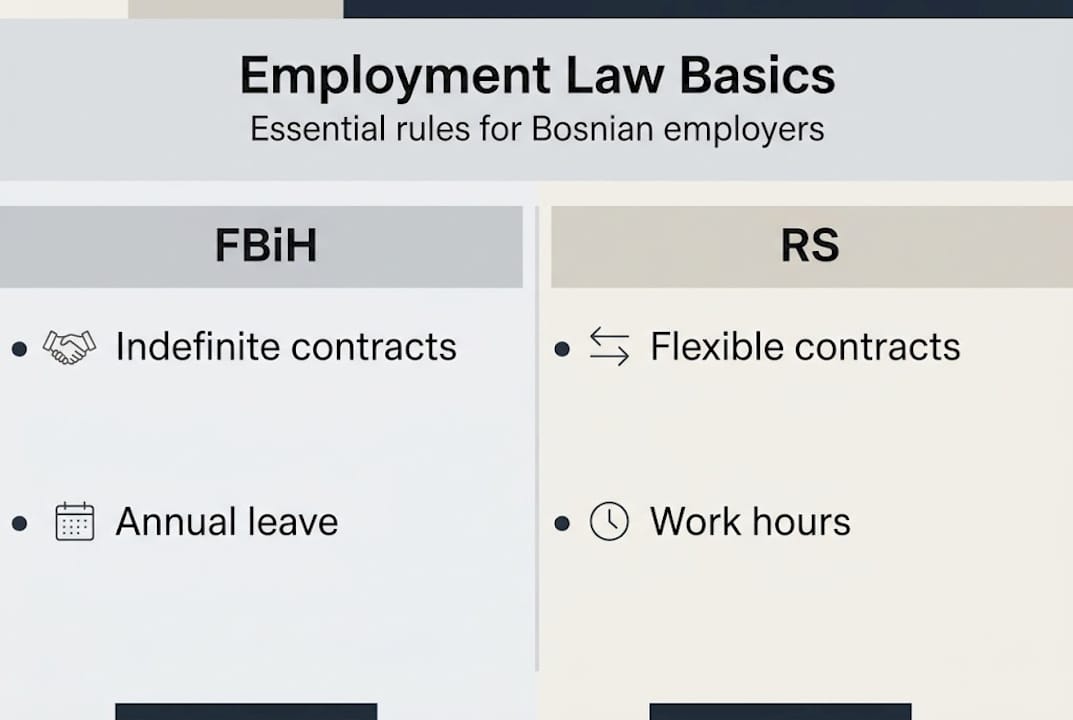
Bosnia and Herzegovina operates under a dual-entity legal framework, and this structural reality shapes every aspect of employment compliance. The FBiH and Republika Srpska (RS) each maintain separate labour legislation, meaning that an employer with staff registered in both entities is effectively subject to two distinct regulatory regimes. Understanding which rules apply, and where they diverge, is the essential first step.
Written employment contracts are mandatory under both FBiH and RS law. These contracts must be executed before work commences and must specify the key terms of the employment relationship, including role, remuneration, working hours, and leave entitlement. Failure to provide a written contract exposes the employer to fines and adverse findings during inspections. Many businesses, particularly smaller enterprises and startups, make the error of relying on verbal understandings or informal arrangements, which carry no legal standing in either entity.
Beyond contracts, the compliance methodology recommended by the ILO requires employers to maintain detailed records, conduct periodic internal audits, and ensure HR personnel are trained on the precise differences between FBiH and RS obligations. This dual-entity training is frequently overlooked, particularly where a single HR team manages staff across both entities.
Key differences: FBiH vs RS employment rules
| Obligation | FBiH | RS |
|---|---|---|
| Default contract type | Indefinite (2026 reform) | Fixed or indefinite, negotiable |
| Remote work provisions | Formally regulated from 2026 | Limited specific regulation |
| Minimum annual leave | 4 weeks (2026 reform) | 20 working days |
| Inspectorate authority | Federal and Cantonal Inspectorates | RS Labour Inspectorate |
| Collective bargaining coverage | Broader sectoral agreements | Entity-level agreements |
The inspectorate structure matters significantly. The FBiH operates through both Federal and Cantonal inspectorates, creating a layered oversight mechanism. The RS Labour Inspectorate operates centrally. In practice, unannounced inspections are conducted by both, and inspectors have broad powers to demand records, interview employees, and issue fines on the spot.
Key obligations that apply across both entities include:
- Registering employees with the relevant pension and health insurance funds before work begins
- Issuing written decisions for all changes to employment terms
- Maintaining payroll records accessible for audit
- Documenting working hours, including overtime authorisations
- Ensuring disciplinary procedures follow entity-specific procedural requirements
Pro Tip: If your business employs workers in both FBiH and RS, consider engaging employment law guidance for startups early. Establishing correct structures from the outset is significantly less costly than correcting deficiencies under inspection pressure.
For a systematic review of your current obligations, the 2026 compliance checklist provides a structured audit framework tailored to the current legislative landscape.
Step-by-step: Implementing compliant employment contracts
After clarifying obligations, the next practical challenge is drafting and executing contracts that satisfy the 2026 legal requirements. A poorly drafted contract is not simply a technical deficiency; it can invalidate key terms, expose the business to retroactive claims, and trigger scrutiny during inspections.
Steps for drafting a compliant contract
- Determine the applicable entity law. Confirm whether the employee will be registered under FBiH or RS rules, as this determines which statutory minimum terms apply.
- Select the correct contract type. Under the 2026 FBiH Draft Labour Law, indefinite contracts are now the default. Fixed-term contracts are subject to stricter conditions and cannot be used to circumvent permanent employment rights.
- Include all mandatory particulars. These include: full name and details of both parties, commencement date, job title and description, place of work, remuneration structure, working hours, annual leave entitlement, notice periods, and probationary terms where applicable.
- Address remote and hybrid work specifically. The 2026 reforms formally regulate remote work arrangements. If an employee works remotely or in a hybrid capacity, the contract must specify the working location, equipment responsibilities, and the conditions governing the right to disconnect.
- Review the contract against collective agreement obligations. Where a collective agreement applies to the sector or enterprise, contractual terms must not fall below those minima. Ignoring applicable collective agreements is a common and costly oversight.
- Obtain signatures before the start date. The contract must be executed and provided to the employee prior to their first working day, not retrospectively.
Indefinite vs fixed-term contracts: a practical comparison
| Criterion | Indefinite contract | Fixed-term contract |
|---|---|---|
| Default status under 2026 FBiH law | Yes | No, restricted use |
| Maximum permitted duration | Not applicable | Defined by law and circumstance |
| Right to renewal | Continuous | Subject to conditions and caps |
| Termination procedures | Full statutory protections | End of term or cause-specific |
| Use case | Standard, ongoing employment | Project-based, seasonal, or temporary needs |
"The shift to indefinite contracts as the default represents a material change in how businesses must plan their workforce. Fixed-term arrangements that were previously routine now require explicit legal justification."
A particularly important practical point concerns remote work clauses. Many businesses adopted informal work-from-home arrangements during and after 2020 but never formalised these in writing. Under the 2026 reforms, this gap creates direct legal exposure. Each remote worker must have a contract or addendum that explicitly addresses their working conditions, equipment provision, reimbursement of costs, and disconnect rights.
Pro Tip: Maintain separate, standardised contract templates for FBiH and RS employees. Where the business has operations in both entities, having entity-specific templates reviewed annually against legislative updates prevents cumulative gaps. For further detail on contract construction in cross-border scenarios, the guide to international contract drafting provides a useful complement to entity-specific knowledge.
Managing payroll, leave, and working hours
With contracts in place, consistent operational compliance becomes the focus. Three areas demand particular attention: payroll accuracy, leave entitlements, and working hours tracking.

Minimum wage compliance in the FBiH is governed by annual government decree, issued after consultation with the Social Council. The BIH Federation Fact Sheet 2025 confirms that minimum wage adjustments follow this annual cycle, meaning employers must actively monitor each year's decree rather than assuming prior year rates remain valid. A failure to update payroll systems to reflect the current minimum wage is among the most straightforward violations inspectors identify.
Annual leave: the 2026 standard
The Draft Labour Law's four-week minimum for annual leave represents an upward shift from prior practice in some sectors. Key points for HR administration include:
- Annual leave entitlement accrues from the date of commencement
- Employees cannot be required to waive their leave entitlement
- Leave must be scheduled in a manner that allows employees to use their full entitlement within the calendar year
- Unused leave carryover provisions are governed by entity law and must be reflected in employment contracts
- Employees are entitled to leave pay calculated at their regular remuneration rate
Working hours must be formally tracked for all employees, including those working remotely. The 2026 reforms introduce the right to disconnect, meaning employees cannot be routinely expected to respond to work communications outside their contracted hours without formal overtime recognition.
"The right to disconnect is not simply an employee wellbeing measure. It is a directly enforceable legal right, and the burden of demonstrating compliance sits with the employer."
Critical compliance reminders for payroll and hours management:
- Overtime must be authorised in advance and compensated at the statutory enhanced rate
- Night and weekend work attract separate premium rates in both entities
- Part-time employees must receive proportional leave and benefits
- Payroll records must be retained for a minimum statutory period and be accessible during inspections
- Contributions to pension, health, and unemployment funds must be remitted on schedule to avoid accumulating arrears
A practical system that many businesses find effective is the integration of an automated time-tracking solution with the payroll function, generating a continuous audit trail. This approach reduces the administrative burden of producing records during inspections while also providing management with visibility over labour cost patterns.
Ongoing compliance: Inspections, training, and risk management
Operational compliance requires ongoing vigilance to avoid penalties. The compliance framework for BiH employers is not a one-time implementation exercise but a continuous process of monitoring, training, and corrective action.
Steps for remaining inspection-ready
- Conduct internal audits on a quarterly basis. Review contract files, payroll records, leave records, and insurance registration data. Identify and correct deficiencies before external inspectors do.
- Maintain an up-to-date policy documentation file. This should include the internal rulebook (pravilnik o radu), collective agreement applications, and all written decisions affecting individual employment relationships.
- Verify social contribution registrations. Confirm that every employee is registered with the appropriate pension and health insurance institutions. Missing or delayed registrations are a priority inspection target.
- Review and update contracts annually. Where legislation changes, existing contracts may require addenda to remain compliant. This is particularly relevant following the 2026 reforms.
- Log and respond to any inspector correspondence promptly. Inspectors may issue written requests for documentation outside of on-site visits. A failure to respond within stipulated timeframes can escalate to formal proceedings.
HR and management training priorities
The ILO labour inspection profile for Bosnia and Herzegovina identifies written contracts, payroll records, and social insurance documentation as the primary focus of inspection activity. HR managers and line supervisors must understand what inspectors expect and where the most common deficiencies arise.
Training should cover:
- The differences between FBiH and RS procedural rules
- Correct handling of disciplinary and grievance processes
- Proper documentation of leave requests and approvals
- Working hours recording obligations, including for remote staff
- The statutory protections afforded to specific employee categories, such as pregnant employees and employees with disabilities
Pro Tip: Establish a compliance calendar that tracks key regulatory dates, including minimum wage decree publication, social contribution payment deadlines, and annual leave scheduling requirements. Assign responsibility to a named individual for each item to prevent oversight.
Risk management for non-compliance involves prompt self-correction where deficiencies are identified. In both entities, inspectors hold discretion to issue remediation notices prior to financial penalties in certain circumstances. Businesses that demonstrate active steps to correct deficiencies typically receive more favourable treatment during inspections than those that appear unaware of their obligations. For businesses operating with cross-border compliance requirements, the dual-entity framework adds a layer of complexity that benefits from specialist legal oversight.
What most guides miss about employment law compliance in BiH
Most compliance guides focus on the procedural minimum: what the law requires, what documents to keep, and how to avoid fines. This is necessary but insufficient. The businesses that experience the fewest disruptions are those that treat compliance not as a legal obligation to be managed reactively but as a foundational element of their operational model.
Bosnia and Herzegovina's dual-entity structure creates a compliance environment that genuinely rewards investment in institutional knowledge. The divergence between FBiH and RS rules is not merely technical. It reflects different regulatory philosophies, different inspector approaches, and different risks in practice. A business that understands this divergence deeply, rather than applying a single-framework approach to both entities, gains a material operational advantage.
There is also a talent dimension that most guides ignore. Employees in BiH are increasingly aware of their statutory rights, particularly younger workers entering roles in technology and services sectors. Organisations that can demonstrate fair, transparent, and legally sound employment practices attract and retain better people. This is a commercial argument for compliance, not just a legal one.
The value of proactive legal guidance lies precisely here: responding to regulatory changes before they become enforcement problems, building systems that evolve with the law, and developing internal capacity rather than scrambling when inspectors arrive.
Unlock effortless compliance with expert legal support
Navigating the dual-entity employment framework in Bosnia and Herzegovina, alongside the 2026 legislative reforms, requires more than reading the law. It requires structured implementation, tailored documentation, and ongoing monitoring.
Vucic.legal works directly with business owners and HR leaders to review employment structures, update contracts, and build inspection-ready compliance systems. Whether you are establishing a new workforce in BiH or auditing an existing one, access to the firm's legal services for businesses provides the targeted expertise to manage risk at every stage. The compliance checklist for 2026 is a practical starting point for any business seeking to assess its current position quickly and accurately.
Frequently asked questions
What are the most significant employment law changes in 2026 for Bosnia and Herzegovina?
The main changes under the FBiH Draft Labour Law are indefinite employment contracts as default, formal regulation of remote work and the right to disconnect, a four-week minimum annual leave guarantee, and stricter conditions on fixed-term contract use.
How often does the minimum wage in Bosnia and Herzegovina change?
Minimum wage adjustments are issued annually via government decree following consultation with the Social Council, requiring employers to actively monitor and update payroll systems each year.
What documentation do inspectors check during an employment law audit?
Inspectors primarily review written employment contracts, payroll and leave records, social insurance registrations, and evidence of compliance with both FBiH and RS entity laws, including internal rulebooks.
Do remote workers have the same rights as onsite staff in Bosnia and Herzegovina?
Yes, under the 2026 FBiH reforms, remote workers must receive the same leave entitlements, working hours protections, and contractual safeguards as employees working at a fixed business location.