
TL;DR:
- Legal strategy aligns business goals with proactive governance, compliance, and risk management.
- Outcome-based legal advice predicts results better than reputation alone, driving growth.
- Structured legal frameworks support international expansion, dispute prevention, and sustainable development.
Most business leaders view legal counsel as a safeguard against risk rather than a driver of commercial performance. This assumption is costly. Legal strategy, when applied correctly, determines the speed of market entry, the strength of governance structures, and the resilience of business models under regulatory pressure. Choosing a law firm based on prestige alone may feel prudent, but outcome-based rankings predict results 10% more accurately than reputation metrics. That gap compounds over years of corporate decisions. For leaders building growth-oriented companies, understanding how legal strategy operates across governance, compliance, expansion, and disputes is not optional. It is a competitive necessity.
Table of Contents
- Understanding legal strategy and its business impact
- Building strategic legal frameworks for governance and compliance
- Legal strategy for international growth and market entry
- Legal strategy in dispute avoidance and resolution
- Why most leaders underestimate legal strategy's power: Lessons from the front line
- Expert legal strategy for dynamic leaders
- Frequently asked questions
Key Takeaways
| Point | Details |
|---|---|
| Legal strategy enables growth | Proactive legal work helps businesses scale, not just avoid problems. |
| Compliance is only the start | Strategic frameworks provide the flexibility needed for complex growth. |
| International rules vary | Custom legal plans are essential when entering new markets abroad. |
| Dispute reduction protects value | Well-designed legal strategy catches risks and solves conflicts early. |
Understanding legal strategy and its business impact
Legal strategy is frequently mischaracterised as a reactive function, something activated when a contract dispute arises or a regulator intervenes. In practice, legal strategy is a proactive discipline that aligns legal resources, structures, and decisions with the business's long-term commercial goals. It shapes how a company is organised, how assets are protected, how obligations are managed, and how risks are anticipated rather than absorbed.
For growth-oriented companies, the difference between reactive and proactive legal thinking is measurable. A business that structures its governance frameworks in year one avoids costly restructuring in year three. A company that maps its regulatory obligations before entering a new market avoids fines and reputational damage that can stall momentum entirely.
Legal strategy in a business context covers several distinct but interconnected roles:
- Governance structuring: Establishing decision-making authority, shareholder rights, and director obligations in a legally sound framework.
- Value creation through IP: Ensuring intellectual property is correctly registered, held in optimal structures, and licensed to extract commercial value.
- Regulatory positioning: Anticipating legislative changes that affect the business model and preparing in advance.
- Transaction readiness: Maintaining documentation and corporate hygiene to support M&A, investment rounds, and joint ventures.
- Dispute prevention: Designing contracts and policies that reduce ambiguity and, therefore, the probability of conflict.
A common misconception is that legal strategy belongs only to large corporations with dedicated in-house teams. In reality, growth-stage companies benefit most from early strategic legal input because their decisions carry disproportionate long-term consequences. A shareholder agreement drafted poorly at the seed stage can fracture a company at series B.
Evidence increasingly supports selecting legal advisors based on demonstrated results rather than brand recognition. Research analysing 60,540 lawsuits found that prestige-based rankings of law firms correlate poorly with case outcomes, while outcome-based rankings predict performance significantly better. This matters because outcome-focused advisors are structurally incentivised to understand your specific business context, not just deploy standard approaches.
"Strategic legal thinking is not about eliminating uncertainty. It is about ensuring that uncertainty is quantified, allocated, and managed in ways that preserve commercial momentum."
Pro Tip: When evaluating legal advisors, ask for examples of how they have structured a similar business or resolved a comparable challenge. Outcome evidence matters more than firm size or profile.
Understanding that legal advice drives growth is the first step. Translating that understanding into structured frameworks is where the real work begins.
Building strategic legal frameworks for governance and compliance
Once leadership teams understand what legal strategy encompasses, the practical next question is how to convert it into operational frameworks. For governance and compliance, this means moving beyond policies on paper to systems that are embedded in daily decision-making and company culture.
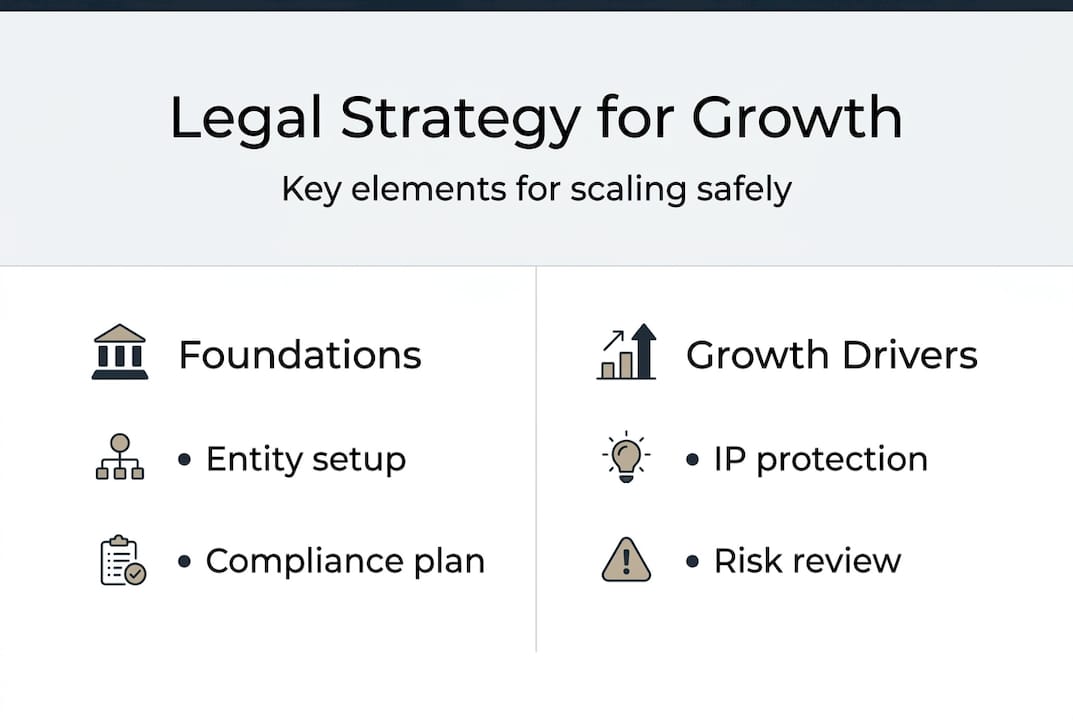
A legal framework for business governance typically includes several foundational elements. It begins with the correct choice of legal entity, whether a limited liability company, joint stock company, or branch structure, and whether a holding arrangement is appropriate. Each choice carries implications for liability, taxation, and investor appetite. Getting this right at the outset reduces friction across every future transaction.
A well-constructed governance framework includes the following components:
- Shareholders' agreements and articles of association: These documents define voting rights, dividend entitlements, transfer restrictions, and dispute resolution mechanisms. Ambiguity in these documents is a recurring source of costly disputes in growth companies.
- Director and officer responsibility matrices: Clear documentation of who holds authority for which decisions protects individuals and ensures accountability is traceable.
- Compliance calendars: A structured schedule of reporting obligations, regulatory filings, and audit requirements specific to the jurisdictions in which the company operates.
- Contract management systems: Centralised storage, version control, and review protocols for all material agreements, including supplier contracts, customer terms, and employment arrangements.
- Data governance and privacy policies: Documented procedures for handling personal data, particularly relevant for companies operating across borders or in regulated sectors.
Compliance is not a static requirement. Regulatory environments change, and growth companies operating across multiple jurisdictions face compounding complexity. International expansion requires managing multi-entity structures, adapting to localised compliance requirements, and handling conflicting obligations across regulatory regimes including data privacy and tax.
Embedding compliance into daily operations requires more than appointing a compliance officer. It requires training, audit cycles, and a culture in which legal considerations are raised early in commercial discussions rather than after decisions have been made.
Pro Tip: Schedule a quarterly legal review meeting with your advisory team. Use it to assess changes in applicable regulations, review pending contracts, and identify structural issues before they become material risks.
For leaders building across borders, accessing strategic legal frameworks that are adapted to specific jurisdictions is essential. Relying on generic international templates often creates compliance gaps that only surface during due diligence or regulatory inspection. Legal compliance is most effective when it is customised, not copied.
Legal strategy for international growth and market entry
International expansion is one of the most legally complex phases a business can navigate. The commercial logic may be straightforward, but the legal execution requires careful planning across entity structuring, regulatory compliance, tax positioning, and intellectual property protection.

The first consideration for market entry is entity structure. Establishing a subsidiary provides limited liability and a local legal presence, which is often required to bid for contracts or access certain regulated markets. A branch office may be faster to set up but typically does not provide liability separation and may expose the parent entity to local regulatory obligations. A joint venture with a local partner can accelerate market access but requires detailed governance documentation to manage control and exit rights.
Intellectual property strategy is closely linked to entity structure. Many expanding companies choose to hold IP assets in a separate holding company, often in a jurisdiction that offers favourable tax treatment and strong IP protection. Licensing arrangements between the holding entity and operational subsidiaries then determine how value flows through the group.
| Legal consideration | EU market entry | Non-EU market entry |
|---|---|---|
| Data privacy framework | GDPR compliance mandatory | Local data laws vary widely |
| Entity structure options | Subsidiary, branch, SE | Subsidiary, JV, representative office |
| IP protection | EU trade mark registration available | Jurisdiction-specific filings required |
| Tax framework | EU directives apply | Bilateral tax treaties critical |
| Regulatory approval | Sector-specific EU regulation | Often country-by-country |
Handling conflicting regulatory obligations is one of the most practically demanding aspects of international expansion. A company processing personal data in the EU must comply with GDPR regardless of where its headquarters sits. Multi-entity structures, IP holding companies, localised compliance programmes, and management of conflicting data privacy and tax obligations are standard features of any credible cross-border legal strategy.
Key best practices for cross-border legal structuring include:
- Conducting jurisdiction-specific legal due diligence before committing to a market entry structure.
- Appointing local legal counsel who understand the regulatory nuances that external advisors may miss.
- Building exit provisions into joint venture and partnership agreements from the outset.
- Mapping all data flows to determine which jurisdictions' data laws apply and in what sequence.
For companies expanding into global markets, particularly those entering Bosnia and Herzegovina and the broader Western Balkans region, understanding the interaction between domestic law, EU accession frameworks, and international treaties is especially important. Companies in this position benefit significantly from reviewing an EU compliance guide that addresses the nuances of operating in pre-accession markets aligned with European standards.
Legal strategy in dispute avoidance and resolution
International expansion inevitably introduces new legal counterparties, new contractual obligations, and new jurisdictional exposures. Each of these creates the potential for disputes. Strategic legal planning significantly reduces the frequency and cost of conflict, but it also determines how efficiently disputes are resolved when they do arise.
The most effective disputes strategy is prevention. This begins with contract drafting. Contracts that define obligations with precision, establish clear performance benchmarks, and include structured escalation clauses remove the ambiguity that fuels most commercial disputes. A well-drafted force majeure clause, for example, can determine whether a business sustains or litigates a significant contract disruption.
Internal protocols for early conflict detection are equally important. Many disputes escalate because operational teams do not recognise early warning signs as legal risks, or because there is no mechanism for escalating concerns to legal counsel before they compound. Structured dispute management approaches include:
- Contract monitoring processes: Regular review of key contractual milestones and counterparty performance to identify potential breaches before they become formal disputes.
- Pre-litigation negotiation protocols: Internal authorisation frameworks that require attempts at negotiated resolution before any formal claim is initiated.
- Jurisdiction and governing law clauses: Ensuring that contracts specify the forum and law for dispute resolution, preventing costly arguments about where a dispute should be heard.
- Mediation and arbitration preferences: For cross-border disputes, international arbitration often provides a more neutral and enforceable resolution mechanism than domestic litigation.
The choice of legal representation in disputes matters significantly. Research across 60,540 lawsuits demonstrates that prestige-based selection of law firms does not reliably produce better outcomes. Outcome-based selection, which considers track records in directly relevant dispute types and markets, consistently outperforms.
| Dispute resolution method | Speed | Cost | Enforceability | Confidentiality |
|---|---|---|---|---|
| Negotiation | Fast | Low | Contractual only | High |
| Mediation | Moderate | Low to medium | Contractual only | High |
| Arbitration | Moderate | Medium to high | International treaties | High |
| Litigation | Slow | High | Jurisdictional | Low |
"The cost of a poorly structured contract is rarely visible at signing. It becomes visible when performance obligations diverge and there is no agreed mechanism to resolve the difference."
Understanding how to manage legal disputes proactively, rather than reactively, is a competitive differentiator for scaling companies. Leaders who treat dispute avoidance as an operational discipline rather than a legal formality consistently report lower legal expenditure and better commercial relationships. Addressing the broader legal risks in scaling requires the same degree of forward-looking planning.
Why most leaders underestimate legal strategy's power: Lessons from the front line
There is a persistent pattern in how growth-stage companies engage with legal strategy. Leadership teams invest heavily in commercial, financial, and operational planning, yet legal input is typically introduced at the point of execution rather than at the point of decision. This sequencing is where value is consistently lost.
The conventional view is that legal work is about documentation and compliance checklists. This framing is limiting. Legal strategy, applied early, can reveal market entry structures that competitors have not considered, identify IP assets that have not yet been formally protected, and surface regulatory risks that would otherwise absorb capital at the worst possible moment.
The teams that outperform tend to share one characteristic: legal counsel is present when strategic decisions are being formed, not when they are being formalised. This does not require a large in-house team. It requires a trusted external advisor who understands both the legal landscape and the commercial context.
Reading legal insights from practitioners operating across complex jurisdictions consistently reinforces this point. The businesses that scale efficiently treat legal strategy as a board-level discipline, not a transactional service. That shift in perspective is where competitive advantage is created.
Expert legal strategy for dynamic leaders
Translating legal insight into commercial action requires advisors who understand both the regulatory environment and the operational realities of growth-oriented businesses.

Vucic.legal provides strategic legal services across corporate law, cross-border transactions, compliance, M&A, and dispute management, with particular expertise in Bosnia and Herzegovina and the broader European market. Whether you are structuring for international expansion, preparing for investment, or navigating a complex regulatory challenge, the firm's approach prioritises precision, confidentiality, and practical outcomes. Explore the full range of strategic legal services available, or review the corporate law for leaders guide to deepen your understanding before your next strategic decision.
Frequently asked questions
How does legal strategy differ from basic legal compliance?
Legal strategy involves proactive planning aligned with commercial growth objectives, structuring entities, protecting assets, and positioning the business ahead of regulatory change. Compliance focuses narrowly on meeting existing legal requirements within current operational parameters.
Why do outcome-based approaches outperform law firm prestige in legal work?
Outcome-based rankings analysed across 60,540 lawsuits predict legal performance 10% more accurately than prestige-based selection, indicating that demonstrated results in relevant contexts are a more reliable indicator of future performance than institutional reputation.
What is the role of legal strategy in international expansion?
Legal strategy manages multi-entity structures, IP holding arrangements, localised compliance programmes, and the navigation of conflicting regulatory obligations across data privacy and tax regimes to enable structured and compliant cross-border operations.
How can a company reduce legal disputes through strategy?
By implementing precisely drafted contracts, structured escalation protocols, and jurisdiction-specific dispute resolution clauses, businesses can identify and address potential conflicts before they escalate into formal legal proceedings, reducing both cost and commercial disruption.