
TL;DR:
- Properly drafted contracts in Bosnia ensure enforceability and prevent costly disputes.
- Key elements include clear parties, subject matter, payment terms, and legal clauses.
- Expert legal review and compliance checks are vital for high-value, complex, or cross-border agreements.
A poorly drafted contract is not merely an administrative inconvenience. For businesses operating in Bosnia and Herzegovina, unclear or incomplete agreements can trigger costly disputes, regulatory penalties, and reputational damage that far outweigh the cost of getting things right from the start. Every transaction, whether a simple service arrangement or a complex commercial deal, carries legal exposure if its terms are not documented correctly. This guide walks through the essential requirements, step-by-step drafting process, risk controls, and expert strategies that Bosnian business owners and managers need to produce enforceable, compliant contracts with confidence.
Table of Contents
- Key requirements before you draft a contract
- Step-by-step process for drafting a compliant contract
- Managing contract risks: arbitration, amendments, and compliance checks
- Expert tips and common pitfalls for Bosnian businesses
- Why most Bosnian contracts fall short: a legal insider's view
- Expert legal support for your contracts
- Frequently asked questions
Key Takeaways
| Point | Details |
|---|---|
| Written form is essential | Contracts must be in writing with all mandatory details for legal validity. |
| Electronic signatures allowed | Digital contracts require a qualified electronic signature to be enforceable in Bosnia and Herzegovina. |
| Changes need mutual agreement | You cannot unilaterally change a contract; use a written, signed annex for amendments. |
| Professional advice prevents mistakes | Always seek legal review for high-value or complex deals to ensure regulatory compliance and protection. |
Key requirements before you draft a contract
Having set the stakes, let us address what you must have in place before you even start drafting. The first and most important step is understanding what makes a contract legally valid under Bosnian law. Validity depends not only on what is written, but on how and by whom it is signed, and whether the appropriate form has been used.
Under the legal guide to doing business framework in Bosnia and Herzegovina, contracts derive their enforceability from the Law on Obligations, which sets out the foundational rules for all civil and commercial agreements. Before a single clause is written, you must confirm that the contract type requires a written form. Many do. Verbal agreements may have limited enforceability in commercial settings, so written documentation is the safe standard for any business transaction of significance.
For employment agreements specifically, employment law compliance is a mandatory foundation. Employment contracts must be in writing, covering parties' details, start date, job title or description, workplace, duration, working hours, salary and benefits, leave entitlements, notice periods, and any applicable collective agreements. Missing any of these elements creates grounds for a legal challenge.
The rise of digital business has introduced additional considerations. Electronic contracts are valid only when a qualified electronic signature is used to satisfy written form requirements. A simple typed name or a scanned signature does not meet the legal threshold. This is a common oversight, particularly in fast-moving technology or service businesses where deals are often concluded by email.
Below is a summary of the key elements required across common contract types:
| Contract type | Written form required | Key elements |
|---|---|---|
| Employment contract | Yes | Parties, job description, salary, working hours, leave, notice |
| Service agreement | Recommended | Parties, scope, fees, duration, termination |
| Lease agreement | Yes | Parties, property details, rent, duration, registration |
| Commercial sale | Recommended | Parties, goods, price, delivery, warranties |
| Loan agreement | Yes | Parties, amount, interest, repayment schedule |
Core elements that every contract should contain, regardless of type, include:
- Full legal names and registration details of all parties
- Clear description of the subject matter, whether services, goods, or rights
- Payment terms, including amounts, schedules, and currencies
- Start date and duration, including any renewal provisions
- Obligations and rights for each party
- Conditions for termination and the consequences that follow
- Reference to applicable law and jurisdiction
Pro Tip: Before finalising any contract, always check whether a mandatory collective agreement applies to your sector. In Bosnia and Herzegovina, collective agreements in industries such as construction, trade, and public services can impose additional minimum terms that must be incorporated into individual employment contracts by law.
Step-by-step process for drafting a compliant contract
With those requirements covered, let us map the actual drafting process step by step. Drafting a contract is not simply a matter of filling in a template. It requires a logical, methodical approach that anticipates risk, reflects the actual agreement between parties, and satisfies legal standards.
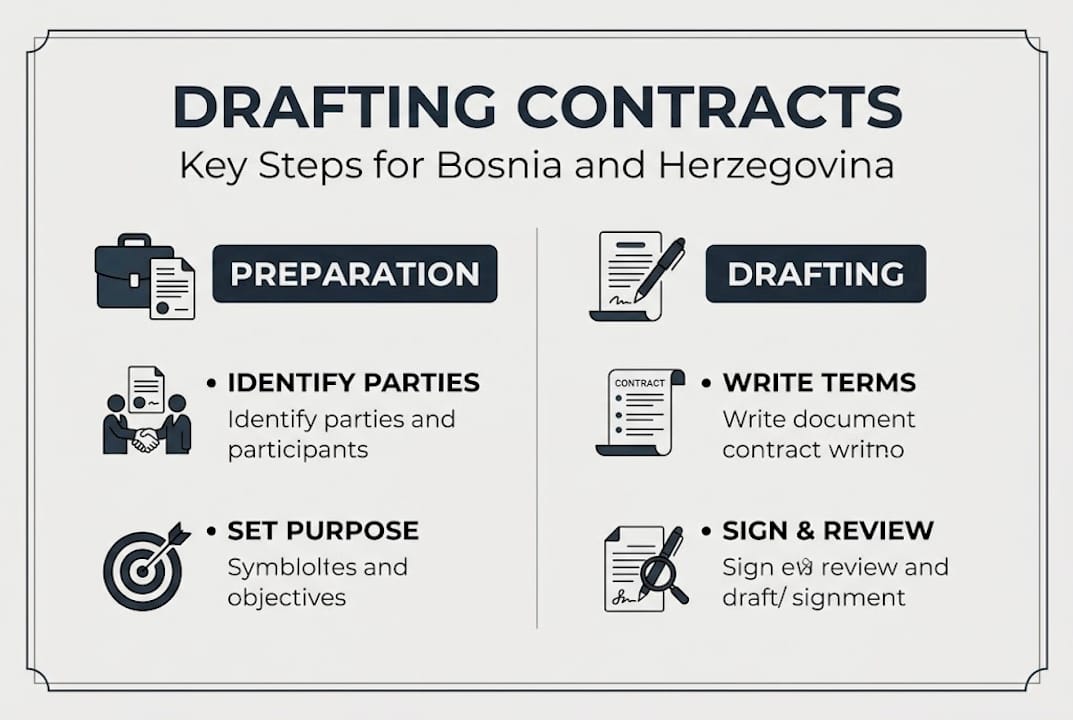
Step 1: Define the purpose and parties clearly. Start with the exact legal names, registered addresses, and identification numbers of all parties. Ambiguity about who is bound by the contract is one of the most common and easily avoided mistakes. For companies, include the company registration number and entity type.
Step 2: Describe the subject matter precisely. Vague descriptions of services or goods are the most frequent source of disputes. If the contract concerns software development, specify the deliverables, acceptance criteria, timelines, and version specifications. If it concerns goods, specify quantity, quality standards, and packaging requirements.
Step 3: Set out rights and obligations in plain language. Each party should have clearly listed responsibilities. Avoid legal jargon where plain language achieves the same result. Enforceability does not depend on complex wording. It depends on clarity.

Step 4: Address payment and pricing terms. Specify the currency, payment method, schedule, and consequences of late payment. In cross-border contracts, also address value added tax treatment and any applicable currency conversion provisions.
Step 5: Include provisions for termination. Define both the conditions under which either party may terminate the contract and the notice period required. Specify whether termination triggers any financial consequences, such as penalties or outstanding payment obligations.
Step 6: Add an amendment clause. Under Bosnian law, contract modifications require a written annex signed by all parties. Unilateral changes are not permitted. Include this requirement explicitly in the contract to prevent misunderstandings later.
A contract without a formal amendment clause is an open invitation to dispute. When both parties understand from the outset that any change must be documented in writing, the risk of conflicting interpretations drops significantly.
Step 7: Insert a dispute resolution clause. For the international contract law guide perspective, this clause is particularly critical in cross-border agreements. Specify whether disputes will be resolved by courts or arbitration, identify the governing law, and name the jurisdiction.
Pro Tip: For contracts involving foreign parties or assets in multiple jurisdictions, insert a governing law clause that explicitly names Bosnian law or another agreed legal system. Without it, courts may need to determine the applicable law independently, adding cost and uncertainty to any future dispute.
Managing contract risks: arbitration, amendments, and compliance checks
Once a contract is in place, you will need a proactive approach to avoid pitfalls and legal risks. Signing a contract is not the end of the legal process. It is the beginning of an ongoing compliance obligation.
Dispute resolution: courts versus arbitration. Choosing how disputes will be resolved is one of the most strategically important decisions in contract drafting. Litigation through Bosnian courts can be slow and costly. Arbitration, by contrast, often provides a faster and more confidential resolution process, particularly for commercial disputes.
Arbitration agreements must be in writing and signed by all parties. Commercial disputes are eligible for arbitration under Bosnian law, which is based on the UNCITRAL Model Law. Parties may also choose their own governing law, giving businesses significant flexibility in structuring cross-border agreements.
Despite these advantages, arbitration remains underused among small and medium-sized enterprises in Bosnia and Herzegovina. Many business owners default to standard court jurisdiction clauses without considering whether arbitration better serves their interests. This is particularly worth reconsidering for contracts with international counterparties, where court proceedings in different jurisdictions can multiply costs rapidly.
The following table compares the two primary dispute resolution routes:
| Factor | Court litigation | Arbitration |
|---|---|---|
| Speed | Slower, often multi-year | Generally faster |
| Cost | Lower initial filing, potentially higher overall | Higher initial cost, often lower overall |
| Confidentiality | Public proceedings | Private and confidential |
| Enforceability abroad | Depends on bilateral treaties | Enforced via New York Convention |
| Choice of law | Limited | Flexible, parties may choose |
For proactive risk management, consider the following measures:
- Schedule annual compliance reviews of all active contracts, particularly in sectors with frequent regulatory changes such as financial services, telecommunications, and real estate
- Maintain a contract registry that records key dates including renewal deadlines, termination notice windows, and review milestones
- Ensure that all amendments are executed as separate written annexes and stored alongside the original agreement
- Monitor legislative updates through reputable legal publications and adapt existing contracts where new obligations arise
- For managing legal disputes, engage counsel early rather than waiting until a dispute becomes formal proceedings
Statutory compliance is not a one-time exercise. Regulatory conditions in Bosnia and Herzegovina evolve, particularly in the areas of labour law, data protection, and commercial regulation. A contract that was fully compliant at signing may require revision within a year or two.
Expert tips and common pitfalls for Bosnian businesses
Now that you know the process and risk controls, consider what even well-managed businesses sometimes miss. Several recurring errors appear consistently in Bosnian business contracting, many of which are avoidable with proper legal awareness.
Misclassifying the employment relationship. One of the most consequential mistakes is treating an employee as an independent contractor or vice versa. Misclassification risks include significant financial exposure, including unpaid social contributions, tax liabilities, and retrospective employment claims. The difference between an employment contract and a service agreement is not purely a matter of labelling. It is determined by the substance of the working relationship, specifically control, exclusivity, and integration into the business.
Failing to register lease agreements. In Bosnia and Herzegovina, unregistered lease agreements carry legal risk, particularly in commercial real estate. Registration provides enforceability against third parties and protects both landlord and tenant in the event of a sale or other change of ownership. Many businesses skip this step to save time, only to face complications later.
Relying on generic or AI-generated templates for complex deals. Template contracts have a legitimate role in business operations, particularly for routine, low-value transactions. However, avoid AI drafts for high-value or complex contracts without professional review. AI tools cannot account for local regulatory nuances, sector-specific collective agreements, or entity-specific risk profiles. The Law on Obligations should be the primary reference, not a generic online template.
Overlooking state property restrictions. If a contract involves the use or lease of state property, additional restrictions and approval requirements apply. Many business owners are unaware of these limitations until a transaction is already in progress, at which point the delays and compliance gaps become costly.
Always consult local counsel for compliance in cross-entity deals. The intersection of entity law, regulatory requirements, and sector-specific rules creates complexity that cannot be addressed reliably through standard documentation alone.
Practical steps for avoiding these pitfalls include:
- Review the nature of every working relationship before drafting, not after
- Engage a property lawyer for any lease or real estate-related contract
- Use the Law on Obligations as a primary reference when checking contract validity
- Consult the doing business in Bosnia guide for a structured overview of the regulatory environment
- Never alter a contract unilaterally after signing, regardless of informal agreement
Pro Tip: Set calendar reminders for annual reviews of all major contracts, including employment agreements, supplier contracts, and leases. Reviewing contracts proactively, rather than reactively, gives you time to renegotiate terms, address compliance gaps, and avoid automatic renewals on unfavourable conditions.
Why most Bosnian contracts fall short: a legal insider's view
Looking deeper at the Bosnian business landscape reveals a consistent pattern that most guides do not address directly. The majority of contract problems do not arise from ignorance. They arise from overconfidence and template misuse.
Business owners who have operated successfully for years often assume that a contract used in a previous deal can be adapted with minimal changes for a new one. This assumption is risky. Bosnian law contains nuances, and local legal grey zones exist in areas such as mixed-entity transactions and cross-border asset transfers, where standard clauses simply do not provide adequate protection.
Customising boilerplate without legal oversight risks invalidity if sector-specific compliance details are skipped. The solution is not to find a perfect, universal contract template, because no such document exists. The real approach is to layer expert legal review onto a clear, logical foundation. This means building the contract logically, clause by clause, then having it reviewed against current regulatory standards by counsel familiar with commercial law as it applies in Bosnia and Herzegovina.
Local counsel brings knowledge of how courts interpret specific clauses, what regulatory bodies look for in compliance audits, and where legislative gaps create exposure. This is the layer that distinguishes a contract that holds up under pressure from one that falls apart at the first challenge.
Expert legal support for your contracts
No template can replace bespoke legal support when the stakes are high. Whether you are finalising an employment agreement, structuring a commercial partnership, or preparing for a cross-border transaction, precise documentation is the foundation of legal protection.
Vucic.legal offers legal services for business owners and managers across Bosnia and Herzegovina and beyond, providing tailored contract review, drafting assistance, and strategic compliance advice. For those seeking a broader foundation, the resource on corporate law essentials offers structured guidance relevant to leaders navigating complex commercial environments. Connecting with experienced counsel early is the most effective way to protect your business interests and ensure every agreement you sign is built to last.
Frequently asked questions
What makes a contract legally enforceable in Bosnia and Herzegovina?
A contract is enforceable when it is in writing, signed by all parties, and contains all required details including parties' names, clear terms, and, for certain contract types, a qualified electronic signature to satisfy the written form requirement under Bosnian law.
Can a contract be changed after signing?
Contract modifications require a written annex signed by all parties. Unilateral changes are not legally permitted, regardless of any informal agreement or verbal understanding between the parties.
Is an electronic contract legally binding?
Yes, provided that a qualified electronic signature is used to meet the written form requirements established under Bosnian legislation. A basic email confirmation or scanned document does not meet this threshold.
Do I need legal review for every contract?
Professional legal review is essential for high-value or complex contracts, particularly cross-entity deals or sector-specific agreements. For simple, low-value arrangements, a standard template may suffice, but avoid AI drafts without thorough professional review when stakes are significant.