
TL;DR:
- Europe's regulatory landscape is highly fragmented, with layered EU, national, and sector-specific laws creating complex obligations. Businesses expanding cross-border face operational hurdles due to differing registration, tax, employment, and licensing rules across Member States. Emerging reforms like the 28th regime and Digital Omnibus Package aim to harmonize procedures and reduce compliance burdens in 2026.
Europe presents a deceptively fragmented regulatory environment. Businesses and legal professionals who assume a single EU legal framework governs all commercial activity across the continent frequently encounter the legal complexities in Europe that undermine compliance strategies and delay market entry. The reality is that EU regulations, national laws, and sector-specific directives operate in layered combination, creating obligations that differ materially from one Member State to the next. This guide examines the foundational frameworks, current challenges, and emerging reforms that any company or adviser operating across European jurisdictions needs to understand in 2026.
Table of Contents
- Key takeaways
- The legal complexities in Europe that businesses face most
- Legal fragmentation and cross-border compliance
- Reforms targeting European legal system issues
- Regulatory enforcement and compliance risk
- Strategic legal approaches for cross-border operations
- Insights on managing European legal complexity
- How Vucic supports your European legal strategy
- FAQ
Key takeaways
| Point | Details |
|---|---|
| EU law is not uniform | Regulations, directives, and national laws create overlapping obligations that vary significantly across Member States. |
| Fragmentation burdens SMEs | Differing incorporation rules, tax regimes, and contract laws impose disproportionate costs on smaller companies expanding cross-border. |
| Enforcement is dual-track | Under the Digital Services Act, compliance obligations depend on whether the European Commission or a national authority supervises your platform. |
| Reform is under way | The proposed 28th regime and Digital Omnibus Package aim to reduce administrative burdens and harmonise key areas of company and digital law. |
| Early legal planning is critical | Companies entering European markets benefit substantially from specialist legal counsel before, not after, regulatory obligations arise. |
The legal complexities in Europe that businesses face most
The EU legal framework operates on three primary levels: directly applicable regulations, directives that require national transposition, and the case law of the Court of Justice of the European Union. Each layer interacts with existing national law, and the result is rarely clean. A regulation like the General Data Protection Regulation applies uniformly in text, yet national supervisory authorities interpret and enforce it differently across Germany, France, Poland, and Ireland. The divergence in enforcement outcomes is well documented and practically significant.
Directives compound this further. Member States retain discretion in how they transpose directive requirements into domestic law, which produces what practitioners often call the mosaic effect. A company expanding from Bosnia and Herzegovina into multiple EU markets may find that its standard employment contracts, commercial terms, and data processing agreements require separate legal review in each jurisdiction. The complexity of European laws is not theoretical. It is transactional and operational.
Recent digital legislation has introduced an additional layer. The Digital Services Act, which came into full enforcement across all EU platforms in February 2024, established a pan-European regulatory model with shared enforcement between the European Commission and national Digital Services Coordinators. The AI Act and proposed GDPR amendments add further obligations, each with its own scope, timeline, and authority structure.
Pro Tip: Map every EU legal instrument relevant to your sector against the specific Member States where you operate. A regulation that applies uniformly in text can still produce different compliance obligations when national authorities exercise their enforcement discretion.
Understanding EU corporate law fundamentals before entering any new market remains one of the most practical steps a business can take to avoid costly remediation later.
Legal fragmentation and cross-border compliance
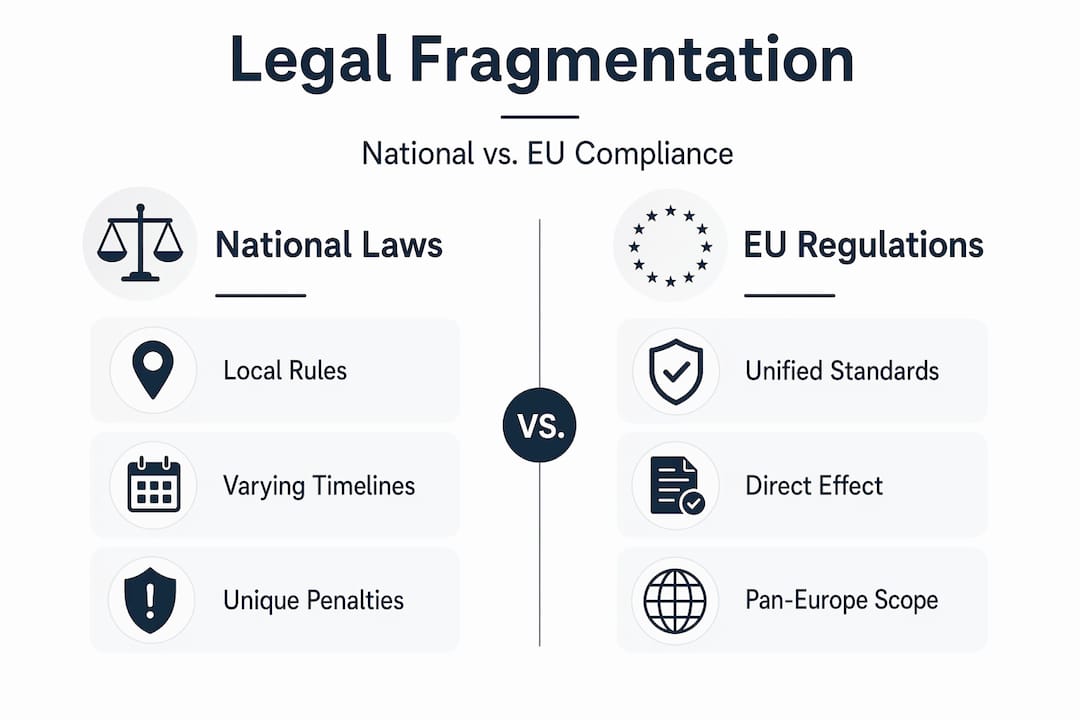
The challenge of understanding European regulations becomes most acute when a business attempts to operate across multiple Member States simultaneously. Company registration procedures, minimum capital requirements, shareholder rights, and withdrawal rights differ materially across jurisdictions. A Dutch private limited company and a Croatian equivalent may share a broadly similar structure, yet their governance obligations, director liability rules, and dissolution procedures diverge in ways that matter when disputes arise.
Legal fragmentation imposes significant operational and financial burdens on companies, especially SMEs, because different national incorporation rules and tax systems create a mosaic complexity affecting growth and capital movement. Start-ups seeking Series A investment from a pan-European fund, for instance, often face investor requests to reincorporate in jurisdictions perceived as more structurally favourable, such as the Netherlands or Luxembourg, regardless of where the business actually operates.
Brexit added a distinct dimension to cross-border legal complications. UK businesses that previously relied on EU passporting rights, mutual recognition of judgments, and harmonised contract frameworks now face a separate legal relationship with the EU requiring bilateral analysis. Legal professionals advising cross-border transactions involving UK and EU parties must now account for two distinct regulatory regimes where previously one sufficed.
The following practical challenges arise with particular frequency in cross-border European operations:
- Contract law divergence. Member States apply different default rules on formation, interpretation, and breach. Rome I and Rome II regulations provide choice-of-law frameworks, but careful drafting is still required to achieve predictable outcomes.
- Tax compliance fragmentation. VAT rules, permanent establishment thresholds, and transfer pricing requirements differ across jurisdictions, and EU harmonisation in this area remains incomplete.
- Employment law complexity. Posted workers, local hiring obligations, and works council requirements vary substantially and carry criminal as well as civil liability in several Member States.
- Regulatory licensing divergence. Financial services, pharmaceutical, and food sector operators face national licensing regimes that sit alongside EU-level authorisations, requiring parallel compliance tracks.
Pro Tip: When planning intra-EU expansion, conduct a jurisdiction comparison across at minimum three dimensions: company law structure, tax exposure, and sector-specific licensing. Identifying conflicts early reduces the cost of remediation by an order of magnitude.
Vucic's guide on European business growth law provides additional analysis on structuring cross-border operations across multiple national legal systems.
Reforms targeting European legal system issues
The most significant legislative development currently under discussion is the proposed 28th regime, formally described as the Unified European Company (S.EU). The proposal, developed in response to the European Law Institute consultation, aims to create a single harmonised EU corporate form sitting alongside existing national company forms. The 28th regime would enable digital registration within 48 hours with minimal capital requirements, using multilingual portals to remove language barriers for cross-border founders.
The table below summarises the key differences between the current position and what the proposed reforms would introduce:
| Feature | Current position | Under proposed reforms |
|---|---|---|
| Company registration timeline | Varies: 1 day to several weeks depending on Member State | 48-hour digital registration via unified EU portal |
| Capital requirements | Diverge significantly across jurisdictions | Minimal and harmonised across all 27 Member States |
| Cross-border scaling | Requires separate national procedures per jurisdiction | Single legal form operable across all Member States |
| Language access | National language requirements create barriers | Multilingual portal access from point of incorporation |
| Compliance reporting | Multiple national filings with different formats | Potential for consolidated reporting obligations |
The Digital Omnibus Package introduces parallel reforms in digital regulation. The package is designed to reduce administrative burdens by at least 25% across AI, GDPR, and cybersecurity compliance, with estimated savings of up to €5 billion by 2029. Critically, the package proposes a single-entry point for incident reporting under NIS2, GDPR, DORA, and the EU Digital Identity Regulation, eliminating duplicative filings across frameworks.
Compliance professionals should note that the AI Act operates on staggered timelines. Transparency obligations apply from August 2026, while watermarking obligations for AI-generated content are delayed until December 2026. National authorities, not the European Commission, are expected to enforce these requirements in most cases, meaning compliance strategies must account for national interpretation variance from the outset.
Regulatory enforcement and compliance risk
The European legal system issues companies encounter most acutely are those that arise at the enforcement stage. Understanding which authority supervises your business is not a procedural formality. It determines your compliance strategy, your audit obligations, and your exposure to investigation.

The DSA enforcement model draws a clear distinction: the European Commission directly supervises very large online platforms and very large online search engines, while national Digital Services Coordinators cover all other platforms within their Member States. A mid-sized e-commerce operator active across five EU markets may engage with five different national authorities rather than one. That is not a simplification.
Non-compliance with the DSA can result in fines of up to 6% of global annual turnover. The European Commission opened investigations in 2024 and 2025 into platforms including X's recommender systems and Shein's commercial practices, signalling that enforcement is active and not limited to the largest incumbents. DSA compliance has evolved from a one-time certification to an ongoing operational process, with the Commission's investigative activity confirming increased enforcement rigour.
The penalty frameworks across Europe's current digital and data legal instruments are worth examining together:
- GDPR: fines up to €20 million or 4% of global annual turnover, whichever is higher
- AI Act: fines up to €35 million or 7% of global turnover for prohibited AI practices
- DSA: fines up to 6% of global annual turnover; periodic penalty payments for ongoing non-compliance
- NIS2 Directive: fines up to €10 million or 2% of global turnover for essential entities
Mapping the regulatory authority responsible for each instrument, by jurisdiction and by company size, is the first step in building a compliance programme that reflects actual risk rather than a generic checklist.
Strategic legal approaches for cross-border operations
Companies that manage European legal challenges in Europe most effectively share one characteristic: they build legal analysis into commercial decision-making before regulatory obligations crystallise. Retrofitting compliance onto an existing operational structure is consistently more costly and disruptive than designing compliant structures from the outset.
Practical strategic approaches include the following:
- Jurisdiction selection at incorporation. Choosing the right Member State for holding company or operational entity formation requires analysis of corporate tax treatment, treaty networks, regulatory authority relationships, and available insolvency frameworks, not merely ease of registration.
- Contract law standardisation. Drafting master commercial agreements with explicit choice-of-law and jurisdiction clauses, referencing EU regulations where applicable, reduces the cost of managing disputes across multiple national courts.
- Regulatory technology adoption. Compliance monitoring tools that track regulatory updates across multiple EU jurisdictions can reduce the manual burden of staying current. AI-first legislative intelligence tools are gaining traction among legal and compliance teams managing multi-jurisdictional obligations.
- Legal partner selection. Engaging counsel with experience in both EU law and the specific national law of each target market provides coverage that general EU practice alone cannot deliver. For companies entering Bosnia and Herzegovina or the wider Western Balkans, a legal partner with simultaneous EU and domestic expertise is a material operational advantage.
- Proactive enforcement monitoring. Tracking active Commission investigations, national authority enforcement actions, and guidance updates from Data Protection Authorities provides early warning of emerging risk areas before formal proceedings begin.
Guidance on technology law compliance for legal and compliance teams provides additional frameworks for managing overlapping EU digital obligations.
Insights on managing European legal complexity
Working directly with clients across EU and Western Balkans jurisdictions over many years has confirmed, for me, that the most persistent source of compliance failure is not ignorance of the law. It is the assumption that European regulations function as a coherent, integrated system when they do not.
I have seen businesses enter three or four EU markets simultaneously, relying on a single legal opinion covering "EU law," only to discover that their contracts were unenforceable in two jurisdictions and their corporate structure triggered unexpected tax obligations in a third. The EU legal framework provides a common baseline, but the distance between that baseline and full operational compliance in any given Member State is significant and jurisdiction-specific.
The simplification initiatives under discussion, including the 28th regime and Digital Omnibus Package, deserve cautious optimism rather than uncritical enthusiasm. Every prior harmonisation effort in EU law has produced both simplification and new layers of interpretation. The 28th regime, if adopted, will create a genuinely useful vehicle for cross-border scaling. It will also produce a body of case law, national implementing rules, and regulatory guidance that companies will need to monitor continuously.
My recommendation to any business planning European expansion in 2026 is to treat legal planning as a commercial function, not a compliance checkbox. Engaging specialist legal counsel early, mapping every relevant authority for every relevant jurisdiction, and building regulatory monitoring into operational budgets separates companies that manage European complexity from those that are managed by it.
— Franjo
How Vucic supports your European legal strategy

For businesses confronting cross-border legal complications in European markets, or managing entry into Bosnia and Herzegovina alongside EU compliance obligations, specialist legal guidance is not optional. Vucic provides strategic legal advisory across corporate law, digital regulation, cross-border transactions, and data compliance, with direct experience across both EU frameworks and the Western Balkans regulatory environment.
Whether you are structuring a multi-jurisdictional holding company, assessing DSA or AI Act exposure, or preparing for cross-border M&A, Vucic's strategic legal services cover the full range of commercial and regulatory challenges that European expansion presents. For in-depth guidance on corporate structuring, Vucic's corporate law resource provides a practical starting point for leaders navigating EU and national company law requirements.
FAQ
What are the main legal complexities in Europe for businesses?
The principal legal challenges in Europe arise from the coexistence of EU regulations, directives, and 27 distinct national legal systems. Companies operating cross-border must comply with both EU-level instruments and varying national rules on company formation, taxation, employment, and sector-specific licensing.
How does the Digital Services Act affect compliance obligations?
The DSA applies across all EU platforms with enforcement shared between the European Commission and national Digital Services Coordinators since February 2024. The supervising authority depends on the platform's size and reach, which directly shapes the compliance programme a business must operate.
What is the proposed 28th regime and how does it help?
The 28th regime proposes a harmonised EU corporate form allowing companies to register digitally across all 27 Member States within 48 hours. Its primary benefit is removing the need to navigate separate national incorporation procedures for each target market.
What penalties apply for non-compliance with EU digital regulations?
Penalty exposure varies by instrument. GDPR fines reach up to 4% of global turnover, the AI Act up to 7% for prohibited practices, and the DSA up to 6% of global annual turnover. National authorities enforce most of these frameworks, meaning penalty risk varies by jurisdiction.
Why does legal fragmentation particularly affect SMEs?
Legal fragmentation imposes disproportionate burdens on SMEs because the cost of obtaining separate legal advice in each Member State scales relative to company size. Large corporations absorb multi-jurisdictional legal costs more readily; for smaller companies, those same costs can materially delay or prevent cross-border expansion.