
TL;DR:
- Bosnia's legal system is highly fragmented across FBiH, RS, and Brcko, complicating compliance for businesses.
Bosnia and Herzegovina presents a distinctive challenge for growth-oriented companies: legal fragmentation across multiple jurisdictions means that a single non-compliant step can carry disproportionate consequences. Operating across the Federation of Bosnia and Herzegovina (FBiH), Republika Srpska (RS), and Brcko District simultaneously demands more than legal awareness; it requires deliberate strategic leadership. This guide is designed for business leaders and compliance officers who recognise that robust compliance is not a cost to manage but a position to build from. It sets out a structured, practical path through Bosnia's regulatory complexity and explains how that path leads to competitive advantage.
Table of Contents
- Understanding Bosnia's fragmented compliance landscape
- Essential legal requirements and strategic prerequisites
- Step-by-step: Developing an effective compliance strategy
- Verification, monitoring and troubleshooting compliance
- Smart compliance: The leadership mindset for long-term advantage
- Connect with strategic legal expertise for business growth
- Frequently asked questions
Key Takeaways
| Point | Details |
|---|---|
| Jurisdiction matters most | Fragmented legal regimes require tailored compliance strategies in Bosnia and Herzegovina. |
| Compliance drives growth | Leaders who leverage compliance strategically gain market preference and investor confidence. |
| Monitor and verify | Regular audits and verification ensure compliance remains robust amid changing laws and risks. |
| EU reforms accelerate change | Ongoing EU-driven reforms are improving legal transparency and harmonisation for businesses. |
| ESG boosts reputation | Integrating ESG practices enhances trust and supports sustainable business growth even before law mandates. |
Understanding Bosnia's fragmented compliance landscape
Bosnia and Herzegovina's legal architecture is, by design, decentralised. The country operates under a state-level framework, two entity-level systems (FBiH and RS), and the separate Brcko District jurisdiction, each with independent legislative authority over commercial, tax, and employment matters. For a company operating in only one location, this may seem manageable. For growth-oriented businesses operating across jurisdictions, however, it creates a genuine and persistent compliance burden.
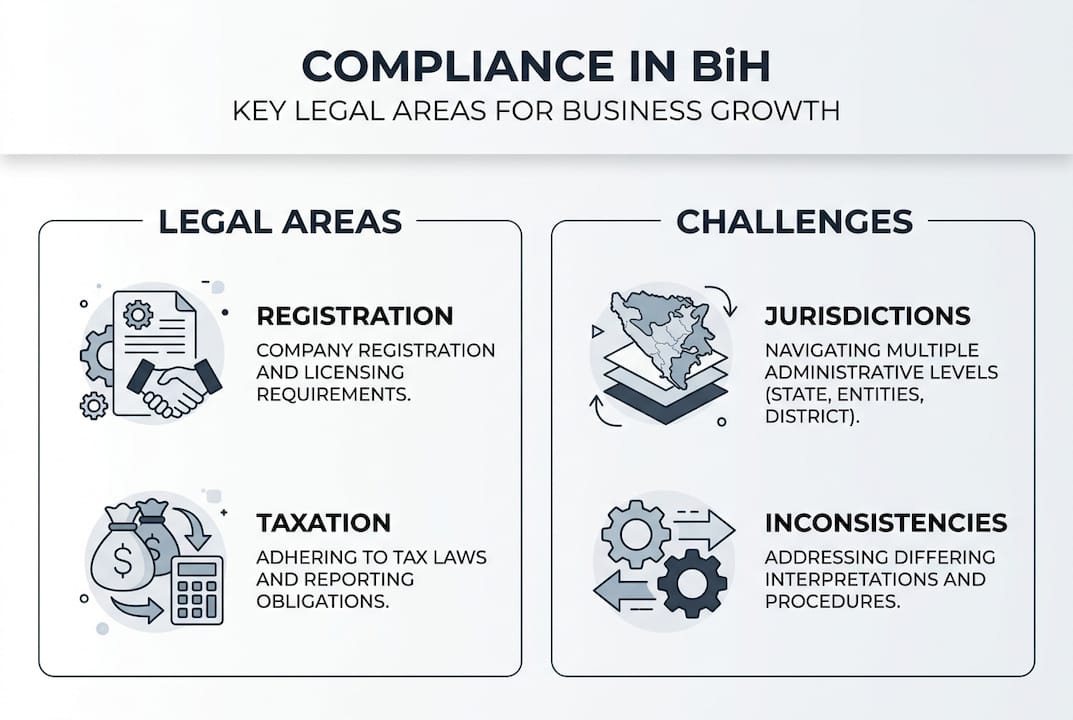
The legal framework across FBiH, RS, and Brcko introduces inconsistencies in corporate registration requirements, employment standards, inspection protocols, and taxation procedures. A company that has established compliant operations in RS cannot assume that those same policies, contracts, or fiscal procedures will satisfy requirements in FBiH. This is not a theoretical concern. Businesses regularly discover gaps when expanding across entity lines, often after enforcement action has already begun.
A clear example of this fragmentation appears in fiscalisation requirements, which govern how businesses record and report transactions. FBiH is implementing a new law effective August 2027, RS maintains its own fiscal cash register system, and Brcko District operates under a separate regime entirely. Three distinct systems, each with its own technical specifications and compliance timelines, demand that finance and operations teams maintain entity-specific workflows rather than a single harmonised process.
Leaders should understand the landscape through these key structural distinctions:
- FBiH operates under a cantonal structure with additional layers of regulation beneath entity level, relevant particularly for employment and business licensing.
- RS functions as a more centralised entity, with entity-level laws generally taking precedence with fewer cantonal variations.
- Brcko District maintains administrative independence and frequently issues its own version of legislation that parallels but does not replicate entity laws.
- State-level legislation governs areas such as indirect taxation (managed by the Indirect Taxation Authority), customs, and certain aspects of financial reporting.
The following table summarises key compliance differences across jurisdictions:
| Compliance area | FBiH | RS | Brcko District |
|---|---|---|---|
| Fiscalisation law | New law (eff. Aug 2027) | Fiscal cash registers | Separate regime |
| Employment law | Cantonal variations | Centralised entity law | District-specific |
| Business registration | FBiH company registry | RS company registry | Brcko registry |
| Data protection | State-level DPA 2025 applies | State-level DPA 2025 applies | State-level DPA 2025 applies |
Leaders preparing growth strategies should consult a doing business legal guide before committing operational resources across entity lines. A structured compliance checklist for BiH 2026 offers a reliable starting point for identifying jurisdiction-specific gaps before they create liability.
Essential legal requirements and strategic prerequisites
Before developing a compliance strategy, leaders must understand the non-negotiable legal requirements that apply across or within Bosnia's jurisdictions. These fall into four primary categories: data protection, fiscal compliance, anti-corruption obligations, and corporate governance.

Data protection has changed significantly. Bosnia's Data Protection Law (DPA 2025) is expected to come into full effect around October 2025 and aligns closely with GDPR principles. It introduces six legal bases for processing, mandatory Data Protection Impact Assessments (DPIAs) for high-risk processing activities, and a requirement to appoint a Data Protection Officer (DPO) in qualifying organisations. Fines range from BAM 10,000 to BAM 70,000 for breaches, with higher exposure for large-scale or sensitive data processing. Companies that have not yet reviewed their data flows, privacy policies, or vendor agreements against DPA 2025 are carrying a quantifiable risk.
Anti-corruption and corporate liability present a more nuanced challenge. Corporate liability currently lacks a compliance defence, meaning boards are not explicitly required by law to oversee corruption risk. BiH is also only partially compliant with FATF standards on anti-money laundering and financial transparency. For growth companies, this creates a structural governance gap: boards that assume legal minimum compliance is sufficient may expose the company to reputational and operational risk as EU accession scrutiny intensifies.
EU accession is an accelerating factor. Integrity checks became operational in June 2025, signalling that regulatory reform is progressing despite political complexity. Leaders who anticipate further harmonisation with EU norms and build those standards into their governance structures now will face significantly less disruption as reforms take hold.
The following numbered sequence describes the strategic prerequisites every compliance officer should address:
- Conduct a jurisdiction-specific gap analysis to identify where current operations diverge from legal requirements in each entity where the business operates.
- Review data processing activities against DPA 2025 requirements, including legal bases for processing, DPO appointment, and DPIA obligations.
- Establish board-level compliance ownership, even where law does not mandate it, by assigning specific governance responsibilities for corruption risk and regulatory monitoring.
- Audit fiscal compliance processes per entity, ensuring systems distinguish between FBiH, RS, and Brcko District fiscalisation rules.
- Integrate ESG considerations as a governance enhancement, particularly for companies seeking foreign investment or preparing for EU market entry.
A startup compliance checklist provides a useful framework for early-stage companies, whilst more established firms should reference corporate law essentials to ensure governance structures reflect current legal expectations.
Pro Tip: Always validate that your receipt and invoice formats comply with the specific fiscalisation requirements of each entity in which you operate. Using a uniform invoice template across FBiH, RS, and Brcko District is a common and costly mistake. Refer to the privacy policies guide for guidance on aligning public-facing documentation with current legal standards.
Step-by-step: Developing an effective compliance strategy
With the legal prerequisites understood, leaders are positioned to build a structured compliance strategy. The operative principle here is jurisdiction-first: every strategic decision must account for which entity or district the activity falls within before general policies are applied.
Step 1: Map operations to jurisdictions. Identify every activity, including sales, employment, data processing, and fiscal reporting, and assign it to the relevant jurisdiction. This mapping exercise is foundational. Without it, even well-intentioned compliance programmes will produce gaps.
Step 2: Conduct a gap analysis per jurisdiction. Compliance as a competitive edge begins with an honest assessment of where the business currently falls short. A thorough gap analysis compares existing policies, contracts, and processes against the applicable requirements in each jurisdiction. This process should be documented and reported to board level, not retained solely within the legal or compliance function.
Step 3: Establish board-level compliance ownership. This is a step many growth companies skip, often under resource pressure. The risk is significant. Without executive accountability, compliance gaps discovered during an audit or regulatory inspection can be attributed to systemic governance failure rather than isolated operational errors.
Important: Bosnia's current corporate liability framework does not explicitly require boards to oversee corruption risk. However, in the absence of a formal compliance defence, proactive board-level oversight is the most effective protection available against enforcement exposure.
Step 4: Integrate ESG into the governance framework. Environmental, Social, and Governance (ESG) standards are not yet mandatory under Bosnian law, but their strategic value is measurable. Average proactive transparency stands at 73.78% across the region, and whilst corruption pressure remains elevated, it is declining in some sectors. Companies that voluntarily exceed minimum standards in governance transparency position themselves more favourably with international investors and prospective partners.
Step 5: Build monitoring and review cycles into governance. A compliance strategy that is not reviewed is a compliance strategy that fails. Assign responsibility for quarterly reviews, with annual comprehensive audits involving external counsel. Track regulatory changes across all three jurisdictions systematically, because legislative timelines in BiH rarely align neatly across entities.
For practical support in implementing this structure, proactive legal advice for Bosnia provides a forward-looking framework for building compliance into business strategy rather than treating it reactively.
Pro Tip: When presenting compliance plans to boards or investors, frame the strategy in terms of risk reduction and market access rather than regulatory obligation. Companies that have adopted this approach have found it significantly easier to secure board-level resourcing for compliance functions. For additional guidance on repositioning legal credibility, brand authority strategies in adjacent industries offer instructive analogies.
Verification, monitoring and troubleshooting compliance
A compliance strategy delivers value only when it is actively verified and maintained. In Bosnia's environment, where corruption risks in the judiciary and public procurement remain high, and where the informal sector accounts for approximately one third of GDP, passive compliance management is a material risk.
Verification begins with structured internal audits. These should be conducted at least annually and should assess, by jurisdiction, whether current processes continue to meet applicable legal requirements. External audits add a layer of credibility that internal reviews cannot provide, particularly when the company is seeking foreign direct investment, entering acquisition discussions, or applying for regulatory licences.
Monitoring corruption and procurement risks requires a specific methodology. Companies engaging with public procurement processes in BiH must document their due diligence rigorously, maintain clear records of all interactions with public officials, and ensure that internal approval processes for procurement bids are transparent and multi-layer. Where internal resource is insufficient for ongoing monitoring, engaging specialised legal counsel to track regulatory and enforcement developments is a practical alternative.
The following table summarises verification actions and their recommended frequency:
| Verification activity | Frequency | Responsible party |
|---|---|---|
| Jurisdiction-specific compliance audit | Annual | External counsel |
| Fiscal documentation review (per entity) | Quarterly | Finance and legal |
| Data protection policy review | Bi-annual | DPO or legal counsel |
| Board-level compliance reporting | Quarterly | Compliance officer |
| Anti-corruption due diligence (procurement) | Per transaction | Legal and operations |
Common compliance pitfalls and their remedies include:
- Applying uniform policies across all entities without adapting for jurisdictional differences. Remedy: Maintain entity-specific policy annexes for FBiH, RS, and Brcko District.
- Failing to update fiscal systems in advance of legislative changes, such as FBiH's August 2027 fiscalisation deadline. Remedy: Build regulatory change alerts into the compliance calendar with a 12-month implementation buffer.
- Neglecting DPA 2025 compliance under the assumption that GDPR experience in other markets is sufficient. Remedy: Conduct a BiH-specific DPA gap analysis and appoint a qualified DPO.
- Insufficient board engagement on compliance matters. Remedy: Include compliance updates as a standing board agenda item, with measurable KPIs reported quarterly.
- Underestimating informal sector interactions and the reputational risk they carry. Remedy: Implement a clear third-party due diligence policy for all vendor and partner relationships.
Leaders seeking legal guidance for business growth will find that integrating verification into operational rhythms substantially reduces enforcement exposure. Teams managing rapid expansion should also consult employment law guidance for BiH to ensure that workforce growth across entities does not create unaddressed labour compliance gaps.
Smart compliance: The leadership mindset for long-term advantage
The conventional view positions compliance as a cost centre: a necessary overhead that reduces operational agility. This view is both outdated and strategically counterproductive, particularly in Bosnia's current regulatory environment.
Compliance as a strategic enabler means using regulatory strength as a signal of institutional credibility. Businesses that are visibly aligned with EU standards, that maintain transparent governance structures, and that can demonstrate a clean compliance record attract a different calibre of investor, partner, and talent than those that treat minimum compliance as the ceiling.
EU accession conditionality is functioning as a forcing mechanism for reform across BiH. Leaders who treat this as an external pressure miss the opportunity to build organisational advantage ahead of their competitors. The companies that will lead their sectors in five years are those building compliance infrastructure today, not those retrofitting it when enforcement deadlines arrive.
Pro Tip: Voluntary external audits, when shared with prospective investors or acquirers, carry substantially more credibility than self-reported compliance declarations. In an environment where strategic legal advice drives growth, positioning compliance as an asset in due diligence discussions is a demonstrable competitive advantage.
Connect with strategic legal expertise for business growth
Navigating Bosnia and Herzegovina's fragmented compliance landscape demands more than a checklist. It requires legal counsel that understands the operational realities of growth companies and provides pragmatic, jurisdiction-specific guidance without unnecessary complexity.
Vucic.legal offers business legal services designed for leaders who need actionable legal support across FBiH, RS, and Brcko District. From entity-specific compliance audits and fiscalisation advisory to anti-corruption governance and cross-border legal expertise, the firm's approach is built on precision and discretion. Leaders seeking a structured foundation can start with the commercial law guide, which contextualises Bosnia's requirements within the broader regional and European framework. Strategic compliance is not a one-time project. It is an ongoing partnership.
Frequently asked questions
What is the biggest compliance risk for growth businesses in Bosnia and Herzegovina?
Fragmented legal regimes across FBiH, RS, and Brcko create inconsistent rules for corporate registration, fiscal reporting, and employment, raising both operational and reputational risk for companies expanding across entity lines.
How can business leaders turn compliance into a strategic advantage?
By integrating ESG and transparency alongside jurisdiction-specific gap analyses, leaders signal institutional credibility to foreign investors and position their businesses favourably as EU accession reforms accelerate.
What are the penalties for non-compliance with Bosnia's data protection law?
Fines range from BAM 10,000 to BAM 70,000 for breaches under DPA 2025, with the highest exposure applying to organisations processing sensitive or large-scale personal data without a proper legal basis or DPO appointment.
How do EU-driven reforms impact legal compliance in Bosnia and Herzegovina?
EU accession drives regulatory reform across both entities and the Brcko District, including operational integrity checks that came into effect in June 2025 and ongoing harmonisation with EU legal standards that directly affect corporate governance and public procurement rules.
What is the role of ESG in legal compliance for Bosnian companies?
ESG integration, though classified as "soft law" under current BiH legislation, enhances governance transparency and makes firms more attractive to foreign investors and international partners who apply their own ESG due diligence standards to prospective investments.