
TL;DR:
- Companies should proactively incorporate well-structured ADR clauses to prevent costly disputes.
- Early dispute assessment and choosing appropriate resolution methods increase efficiency and preserve relationships.
- Mediation is the fastest, most cost-effective way to resolve disputes and maintain ongoing business ties.
Legal disputes arrive without warning. A contract disagreement with a key supplier, a shareholder conflict, or a cross-border claim can consume management time, drain financial reserves, and stall expansion plans at the worst possible moment. For growth-oriented companies operating in Bosnia and Herzegovina, the stakes are particularly high given the country's dual-entity legal structure and evolving regulatory environment. This article sets out practical frameworks, alternative dispute resolution options, and execution strategies to help decision-makers resolve conflicts efficiently, protect business relationships, and reduce the risk of costly, drawn-out litigation.
Table of Contents
- Understanding legal dispute management: Tools and frameworks
- Preparing for disputes: Contract clauses and early case assessment
- Executing dispute strategies: Negotiation, mediation, arbitration, litigation
- Verifying outcomes: Risks, enforcement, and relationship impact
- Our perspective: What most companies overlook in dispute management
- Strategic legal guidance: Take your next step
- Frequently asked questions
Key Takeaways
| Point | Details |
|---|---|
| ADR reduces risks | Using alternative dispute resolution methods like mediation and arbitration can lower costs and protect business relationships. |
| Early assessment is vital | Assessing disputes early helps weigh relationship value and costs, leading to better outcomes and faster solutions. |
| Contract clauses matter | Strong ADR clauses in contracts guide the dispute process and improve enforceability for growth companies in Bosnia and Herzegovina. |
| Verify results and risks | After resolving disputes, verify success, enforceability, and overall business impact to prevent future issues. |
Understanding legal dispute management: Tools and frameworks
Now that we have set the stage, let us explore the practical frameworks that enable effective dispute management. The starting point for any growth company is understanding the full spectrum of available tools before a dispute arises.
Key methodologies for managing legal disputes include early case assessment, structured negotiation, mediation, arbitration, and litigation as a last resort. Each method carries distinct advantages, cost profiles, and relationship implications. Selecting the right tool depends on the nature of the dispute, the value of the ongoing business relationship, and the enforceability requirements of any outcome.
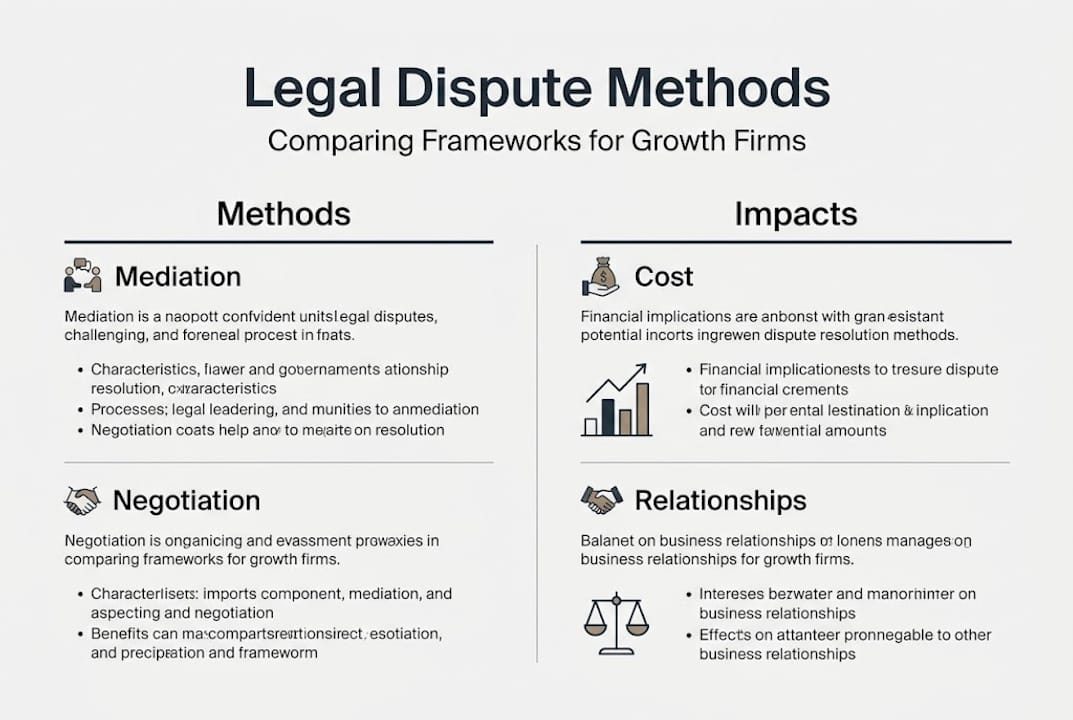
The table below compares the three primary resolution pathways across the dimensions most relevant to growth companies:
| Method | Typical duration | Relative cost | Relationship impact |
|---|---|---|---|
| Mediation | Weeks to 3 months | Low | Preserves relationship |
| Arbitration | 6 to 18 months | Medium to high | Neutral to moderate impact |
| Litigation | 1 to 5+ years | High | Often damages relationship |
For companies operating under the legal framework in Bosnia and Herzegovina, understanding which method aligns with local procedural rules is essential before any dispute crystallises.
Key prerequisites for utilising each method effectively include:
- Mediation: A written agreement to mediate, a neutral mediator acceptable to both parties, and willingness to negotiate in good faith.
- Arbitration: A valid arbitration clause in the underlying contract, agreement on the seat and rules, and access to qualified arbitrators.
- Litigation: Filing within applicable limitation periods, proper jurisdiction, and sufficient documentary evidence to support claims.
Pro Tip: Conducting an early case assessment within the first two to four weeks of a dispute significantly increases the likelihood of a cost-effective resolution. Identify the strength of your legal position, the realistic value of the claim, and the relationship implications before committing to any pathway.
Preparing for disputes: Contract clauses and early case assessment
With the frameworks understood, preparation becomes the foundation for strategic dispute management. Many growth companies invest heavily in commercial execution but underestimate the protective value of well-structured contracts.
For companies in Bosnia and Herzegovina, arbitration clauses in contracts that favour the Foreign Trade Court (FTC) in BiH or recognised international seats provide a measurable advantage. They allow parties to bypass congested court systems and select decision-makers with relevant commercial expertise.
A robust ADR clause should include the following elements:
- Scope: Clearly define which disputes fall within the clause, including pre-contractual and post-termination claims.
- Preferred method: Specify mediation first, followed by arbitration if mediation fails.
- Seat and rules: Identify the arbitral institution and applicable procedural rules.
- Language: Specify the language of proceedings to avoid procedural disputes.
- Governing law: Confirm the substantive law applicable to the contract.
- Time limits: Include timelines for initiating ADR proceedings to prevent delay tactics.
When choosing between the FTC BiH, the RS Chamber of Commerce, and international seats such as the ICC or Vienna International Arbitral Centre, consider the counterparty's jurisdiction, the value of the dispute, and the enforceability of any award. For cross-border transactions, guidance on doing business in Bosnia and cross-border legal advice can inform seat selection significantly.
Early case assessment should weigh the monetary value of the claim against the cost of proceedings, the importance of the ongoing commercial relationship, and the realistic timeline to resolution. A dispute worth 50,000 EUR may not justify 18 months of arbitration if a structured negotiation can achieve 80% recovery in six weeks.

Pro Tip: Monitor FTC BiH rule updates regularly. Recent procedural reforms have streamlined arbitration timelines, making domestic arbitration a more viable option for mid-value commercial disputes.
Executing dispute strategies: Negotiation, mediation, arbitration, litigation
After preparing, execution requires precision. Follow these steps for each resolution pathway.
Negotiation
- Define your minimum acceptable outcome and ideal settlement position.
- Identify the counterparty's likely priorities and constraints.
- Propose a structured dialogue with a clear agenda and timeline.
- Document all offers and counteroffers in writing.
- Confirm any agreed terms in a binding settlement agreement.
Mediation
- Agree on a qualified mediator with relevant commercial experience.
- Exchange position papers in advance of the session.
- Engage in joint and private sessions to explore creative solutions.
- Aim for a signed mediation agreement on the day.
Arbitration
- File a notice of arbitration per the agreed rules.
- Constitute the tribunal and agree on procedural timetable.
- Exchange pleadings, evidence, and expert reports.
- Attend the hearing and await the award.
Litigation
- File the claim within limitation periods.
- Serve proceedings correctly to avoid procedural challenges.
- Comply with court-ordered disclosure and evidence deadlines.
- Attend trial and enforce any judgment obtained.
The data below reflects current global benchmarks relevant to selecting the right pathway:
| Method | Average duration | Estimated cost range | Settlement rate |
|---|---|---|---|
| Negotiation | 2 to 8 weeks | Minimal | Variable |
| Mediation | 1 to 3 months | Low | 75 to 85% |
| Arbitration (ICC) | 12 to 26 months | Medium to high | Binding award |
| Litigation | 2 to 5+ years | High | Judgment |
Mediation settles 75 to 85% of cases and is typically 70% faster and less costly than arbitration or litigation. The ICC recorded 831 new arbitrations in 2024 covering USD 102 billion in disputes, with a median claim value of USD 5 million.
For companies seeking to build proactive legal practices, these benchmarks should inform dispute budgeting and risk provisioning from the outset.
Pro Tip: Mediation preserves commercial relationships and avoids the reputational exposure of public court proceedings. Even where arbitration is contractually mandated, consider proposing a mediation window before commencing formal proceedings.
Verifying outcomes: Risks, enforcement, and relationship impact
With strategies executed, verifying the outcome ensures lessons are applied and future risks are mitigated. A settlement or award is only as valuable as its enforceability and its wider impact on the business.
Criteria for verifying a successful dispute resolution outcome include:
- Settlement finality: Is the agreement legally binding and signed by authorised representatives?
- Enforceability: Can the award or judgment be enforced in the relevant jurisdiction, including under the New York Convention for arbitral awards?
- Cost recovery: What proportion of legal costs and claimed amounts has been recovered?
- Reputation: Has the process preserved or damaged the company's standing with clients, partners, and regulators?
- Relationship continuity: Is the commercial relationship with the counterparty viable post-resolution?
In Bosnia and Herzegovina, arbitration remains underutilised relative to its potential, largely due to a fragmented institutional framework, judicial preference for court proceedings, and residual enforceability concerns. This creates a practical gap that well-advised companies can exploit by selecting international arbitration seats where enforcement is more predictable.
Litigation provides legal precedent and a public record, but costs are rarely fully recoverable. In many BiH proceedings, successful parties recover only a fraction of actual legal expenditure, making litigation a strategically poor choice for disputes where cost efficiency matters.
For strategic legal decisions involving enforcement across entities or borders, understanding the role of a legal adviser in BiH is critical to selecting the right resolution pathway and verifying that outcomes are practically enforceable.
Risks to monitor post-resolution include precedent-setting effects on future disputes, the counterparty's financial capacity to honour a settlement, and any regulatory implications of the dispute's subject matter.
Our perspective: What most companies overlook in dispute management
Having explored the technical strategies, here is a candid perspective that companies rarely hear. Most growth companies in Bosnia and Herzegovina treat dispute management as a reactive function. Contracts are signed quickly, ADR clauses are copied from templates, and legal advisers are engaged only after a dispute has already escalated.
The reality is that the most effective dispute management happens before any conflict arises. A well-drafted ADR clause, tailored to the specific counterparty and jurisdiction, can reduce resolution time by months and costs by tens of thousands of euros. Contracts should be structured for both local enforceability and cross-border recognition from the outset.
Strategic early assessment is equally undervalued. Companies that involve legal advisers at the first sign of a commercial disagreement consistently achieve better outcomes than those who wait. The earlier the assessment, the more options remain available. Explore legal insights relevant to your sector to build a proactive dispute prevention posture rather than a reactive one.
Strategic legal guidance: Take your next step
If you are ready to advance your company's legal strategy, expert resources and services are available to support you.
Managing legal disputes effectively requires more than procedural knowledge. It requires a strategic adviser who understands the BiH legal environment, cross-border enforceability, and the commercial realities facing growth companies. Whether you need support structuring ADR clauses, selecting the right arbitration seat, or navigating an active dispute, our team is equipped to guide you. Review our corporate law guide for foundational context, explore our full range of legal services, or contact our cross-border legal team to discuss your specific situation.
Frequently asked questions
What is the fastest way to resolve legal disputes in Bosnia and Herzegovina?
Mediation is typically the fastest option, settling 75 to 85% of cases and being approximately 70% quicker and less costly than arbitration or litigation. It also preserves commercial relationships, which litigation rarely does.
Why is arbitration underutilised in Bosnia and Herzegovina?
Arbitration remains underutilised due to a fragmented institutional framework across entities, a judicial preference for court proceedings, and persistent enforceability concerns that deter parties from selecting domestic arbitral institutions.
What are the risks of litigation for growth companies?
Litigation is costly and time-consuming, with legal costs rarely fully recoverable. It also exposes companies to reputational risk and frequently damages commercial relationships that may otherwise have been preserved through mediation or negotiation.
How can strategic contract clauses help avoid legal disputes?
Well-drafted ADR clauses in contracts favouring recognised arbitral institutions or international seats enable faster, less costly resolution and reduce the risk of disputes escalating to full litigation, protecting both costs and business relationships.