
Legal advisory often gets painted as rigid and inflexible, a world where strict compliance trumps business sense. Yet this misconception ignores how pragmatic legal solutions balance regulatory requirements with real-world business needs. For companies operating across Bosnia and Herzegovina's multi-entity structure and the EU's complex regulatory landscape, nuanced approaches deliver compliance without sacrificing growth ambitions. This article explores methodologies, benefits, and practical applications of pragmatic legal advisory, showing how business leaders can navigate intricate regulations whilst pursuing strategic objectives.
Table of Contents
- Key Takeaways
- The need for pragmatic solutions in legal advisory
- Methodologies powering pragmatic legal advisory
- Balancing legalism and pragmatism: navigating EU and BiH nuances
- Applying pragmatic legal advisory to support growth and compliance
- Explore Franjo Vucic's strategic legal services
- Frequently asked questions
Key Takeaways
| Point | Details |
|---|---|
| Pragmatic compliance balance | Pragmatic legal advisory balances regulatory demands with real world business needs to support growth. |
| Risk based prioritisation | A risk based framework classifies legal obligations by business impact to focus resources on high risk areas. |
| Cross border coordination | Cross border operations require coordinated advisory across EU member states and BiH entities. |
| Automation driven outcomes | Automation speeds resolution of matters while reducing legal risk. |
| Growth oriented advisory | Effective advisory supports business growth within complex regulatory landscapes. |
The need for pragmatic solutions in legal advisory
The European Union's omnibus regulatory packages and Bosnia and Herzegovina's distinctive multi-entity governance create legal environments where traditional advisory approaches fall short. Pragmatic solutions balance strict compliance with practical business needs, recognising that rigid adherence to every technical requirement can stifle innovation and growth. Business decision-makers face a constant tension between meeting legal obligations and maintaining operational agility. When advisory focuses solely on avoiding regulatory violations, it ignores the commercial context that drives strategic decisions.
Consider the regulatory landscape facing a technology company expanding from Sarajevo into EU markets. Bosnia's Federation and Republika Srpska entities each maintain distinct regulatory frameworks, whilst EU directives introduce additional layers of compliance. A purely legalistic approach might recommend complete harmonisation across all jurisdictions, an expensive and time-consuming process that delays market entry. Pragmatic advisory instead identifies which regulations demand immediate alignment and which permit phased implementation, enabling the company to launch whilst managing compliance risk.
Multi-entity and cross-border regulations require coordinated advisory that understands both legal technicalities and business imperatives. Decision-makers benefit when legal advisory insights focus on balancing risk against opportunity rather than eliminating every potential liability. This approach acknowledges that business growth often involves calculated risks within acceptable legal boundaries.
Key considerations for pragmatic legal advisory include:
- Regulatory complexity varies significantly across EU member states and BiH entities
- Strict compliance can impose disproportionate costs on growing businesses
- Business objectives must inform legal strategy, not the reverse
- Cross-border operations demand coordinated rather than siloed advisory
- Growth ambitions require legal frameworks that enable rather than constrain
The shift towards pragmatic solutions reflects recognition that legal advisory should serve business strategy. When advisors understand commercial realities alongside regulatory requirements, they deliver guidance that protects companies whilst supporting expansion goals. This balance becomes particularly crucial in environments like Bosnia and Herzegovina, where EU alignment processes create evolving compliance landscapes that demand flexible, forward-looking legal approaches.
Methodologies powering pragmatic legal advisory
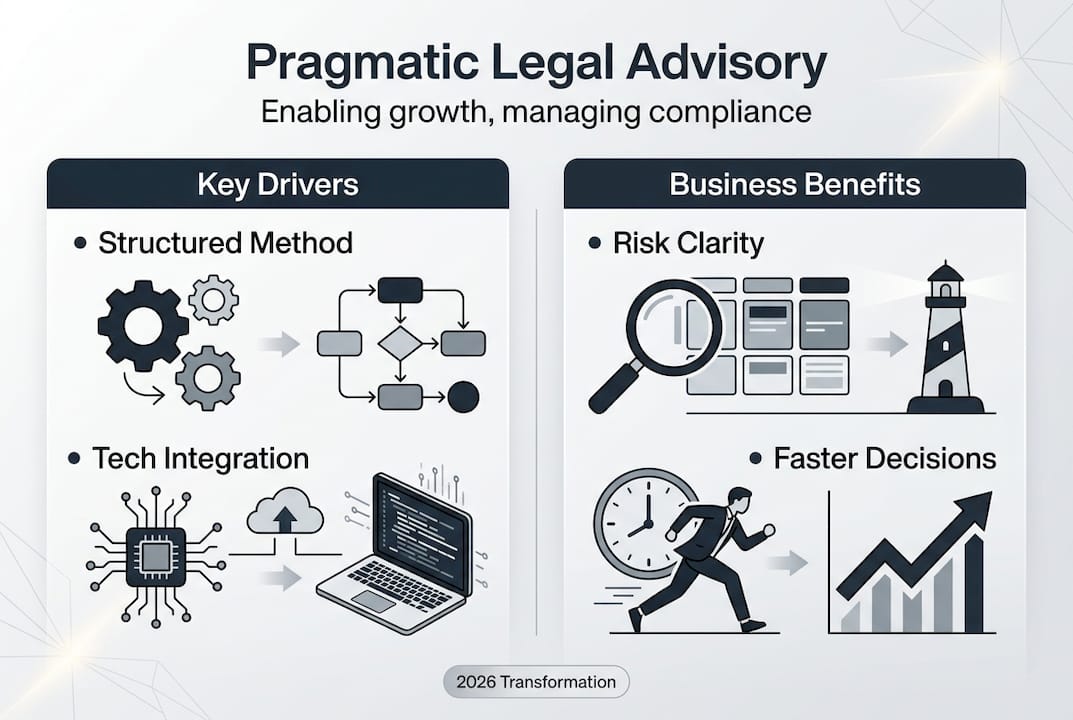
Effective pragmatic advisory relies on structured methodologies that prioritise business impact whilst maintaining compliance integrity. Risk-based frameworks classify legal obligations by potential business impact, allowing companies to allocate resources where they matter most. Instead of treating every regulatory requirement as equally critical, this approach distinguishes between high-risk areas demanding immediate attention and lower-risk items permitting deferred action. A manufacturing company entering EU markets might prioritise product safety directives over certain administrative reporting requirements, ensuring core compliance whilst managing implementation costs.
Cross-entity coordination addresses the multi-jurisdictional challenges inherent in BiH and EU operations. When businesses operate across Federation and Republika Srpska entities or multiple EU member states, inconsistent legal approaches create gaps and redundancies. Coordinated advisory establishes unified compliance frameworks that respect jurisdictional differences whilst maintaining operational consistency. This methodology proves particularly valuable for companies following the Bosnia and Herzegovina compliance checklist, where entity-specific requirements must align with broader business objectives.
Integrated legal and business teams enhance solution relevance by embedding advisors within operational decision-making. Rather than consulting legal counsel only when problems arise, this approach involves advisors throughout strategic planning. When legal perspectives inform business decisions from inception, companies avoid costly redesigns and regulatory conflicts. A technology firm developing data processing systems benefits when privacy advisors participate in architecture design, ensuring compliance becomes a feature rather than a constraint.

Technology integration through RegTech platforms automates routine compliance tasks, freeing advisors to focus on strategic guidance. Compliance automation speeds processing, reduces human error, and maintains audit trails that demonstrate regulatory adherence. Companies implementing these systems report faster case resolution, higher associate satisfaction, and fewer compliance incidents. The table below illustrates typical improvements:
| Metric | Traditional approach | Pragmatic methodology | Improvement |
|---|---|---|---|
| Case resolution time | 45 days average | 28 days average | 38% faster |
| Compliance incidents | 12 per quarter | 4 per quarter | 67% reduction |
| Associate satisfaction | 62% positive | 84% positive | 35% increase |
| Resource allocation efficiency | 58% optimal | 87% optimal | 50% improvement |
Pro Tip: Implement risk classification quarterly rather than annually. Regulatory environments change rapidly, particularly in EU alignment contexts. Regular reassessment ensures your compliance priorities reflect current business risks and regulatory developments, preventing resource misallocation on outdated concerns.
These methodologies transform legal advisory from reactive problem-solving into proactive business enablement. By combining risk intelligence, cross-entity coordination, integrated teams, and automation, pragmatic approaches deliver legal risk management that supports rather than hinders growth ambitions. The key lies in viewing compliance not as a checklist but as a strategic framework that protects business value whilst enabling expansion into complex regulatory environments.
Balancing legalism and pragmatism: navigating EU and BiH nuances
The tension between strict legal interpretation and pragmatic application becomes particularly visible in EU jurisprudence and BiH regulatory frameworks. Pure legalism demands absolute adherence to every regulatory provision regardless of business context or proportionality. Pragmatic approaches instead recognise that legal analysis requires contextual judgment, particularly where regulations permit discretionary interpretation. European Court of Justice Advocate General opinions frequently balance margin of discretion against EU law primacy, acknowledging that rigid application can produce absurd outcomes inconsistent with legislative intent.
Consider pseudonymised data definitions under GDPR-aligned frameworks. A strictly legalistic interpretation might classify any data theoretically linkable to individuals as personal data requiring full protection measures. Pragmatic definitions require case-by-case assessment of whether re-identification involves reasonable means, considering factors like cost, time, and available technology. A research database using sophisticated anonymisation techniques might qualify as pseudonymised even though theoretical re-identification remains possible, provided practical barriers make such efforts unreasonable. This nuanced approach enables legitimate data processing whilst maintaining privacy protections.
Bosnia and Herzegovina's regulatory evolution illustrates pragmatic balancing in action. The 2025 Personal Data Protection Law aligns BiH frameworks with GDPR principles, requiring data protection impact assessments for high-risk processing and imposing fines up to 4% of annual turnover. Yet implementation recognises that immediate full compliance may prove impossible for smaller enterprises. Pragmatic advisory helps companies prioritise critical protections like consent mechanisms and breach notification whilst developing phased plans for comprehensive alignment. This approach manages legal risk without forcing business closures due to compliance costs.
| Approach | Characteristics | Business impact | Risk profile |
|---|---|---|---|
| Pure legalism | Absolute rule adherence, no discretion | High compliance costs, delayed decisions | Minimal legal exposure, potential business stagnation |
| Pragmatic balancing | Risk-based prioritisation, contextual judgment | Optimised resource allocation, faster execution | Managed legal exposure, enabled growth |
| Regulatory arbitrage | Exploit loopholes, minimal compliance | Lowest immediate costs, competitive advantage | High legal exposure, reputational damage risk |
The business regulatory guide for Bosnia emphasises that pragmatic advisory occupies the middle ground between these extremes. It neither ignores legal requirements nor treats them as absolute constraints divorced from business reality. Instead, it applies professional judgment to identify which regulations demand strict adherence and which permit flexible implementation based on risk assessment and business context.
Pro Tip: When facing ambiguous regulatory language, document your interpretation rationale thoroughly. Regulators appreciate good-faith compliance efforts supported by reasoned analysis. Should disputes arise, contemporaneous documentation demonstrating pragmatic yet principled decision-making significantly strengthens your position, particularly in jurisdictions like BiH where regulatory guidance remains evolving.
Cross-border operations amplify these balancing challenges. A company operating across EU member states and BiH entities encounters varying interpretations of similar principles. Cross-border legal advisory must navigate these differences whilst maintaining operational consistency. Pragmatic approaches identify common compliance denominators that satisfy all jurisdictions whilst respecting local variations. This methodology proves essential for companies pursuing EU market access from BiH bases, where alignment with European standards must occur alongside satisfaction of domestic requirements.
The distinction between legalism and pragmatism ultimately reflects different advisory philosophies. Legalism prioritises theoretical correctness and risk elimination. Pragmatism prioritises business outcomes and risk management. For growth-oriented companies in complex regulatory environments, the latter approach delivers superior results by enabling strategic decisions within acceptable legal boundaries rather than paralysing action through excessive caution.
Applying pragmatic legal advisory to support growth and compliance
Business leaders seeking to leverage pragmatic legal advisory should implement structured approaches that balance regulatory demands with operational realities. Risk classification provides the foundation, categorising legal obligations by potential business impact and likelihood of regulatory scrutiny. High-risk items like data protection for sensitive personal information or product safety for consumer goods demand immediate, comprehensive compliance. Medium-risk areas might permit phased implementation aligned with business milestones. Low-risk technical requirements could follow simplified processes or deferred timelines, provided monitoring ensures changing circumstances don't elevate their priority.
RegTech tools automate compliance tasks that traditionally consumed significant advisory resources. Contract review platforms identify non-standard clauses requiring attention whilst approving routine agreements automatically. Regulatory monitoring systems track legal changes across relevant jurisdictions, alerting teams to new requirements affecting business operations. Compliance workflow software ensures consistent processes across entities and departments, maintaining audit trails that demonstrate adherence. These technologies don't replace professional judgment but free advisors to focus on strategic guidance rather than administrative tasks.
Cross-entity coordination ensures aligned risk mitigation across complex organisational structures. Companies operating in both Federation and Republika Srpska entities benefit from unified compliance frameworks that respect jurisdictional differences whilst avoiding duplicative efforts. Similarly, businesses with EU operations alongside BiH bases need coordinated approaches that satisfy both European directives and domestic regulations. This coordination prevents gaps where obligations fall between organisational units and eliminates redundancies where multiple teams address identical requirements.
Pragmatic compliance and growth checklist:
- Conduct quarterly risk assessments identifying high-impact legal obligations
- Implement RegTech automation for routine compliance monitoring and reporting
- Establish cross-entity coordination protocols for multi-jurisdictional operations
- Integrate legal advisors into strategic planning processes from project inception
- Document interpretation rationales for ambiguous regulatory requirements
- Develop phased compliance roadmaps aligning legal milestones with business objectives
- Monitor regulatory developments across all relevant jurisdictions systematically
- Train operational teams on compliance requirements affecting daily activities
Consider a software company expanding from Sarajevo into German and Austrian markets. Traditional advisory might recommend delaying launch until achieving complete GDPR compliance across all processing activities. Pragmatic guidance instead prioritises customer-facing data protection like consent mechanisms and privacy notices, enabling market entry whilst developing backend compliance in parallel. This approach manages legal risk through staged implementation rather than postponing revenue generation until theoretical perfection.
The table below illustrates resource allocation differences:
| Compliance area | Traditional priority | Pragmatic priority | Rationale |
|---|---|---|---|
| Customer consent mechanisms | High | High | Direct regulatory scrutiny, customer-facing |
| Privacy policy documentation | High | High | Legal requirement, reputational impact |
| Data processing agreements | High | Medium | Important but permits phased negotiation |
| Technical security measures | High | High | Risk mitigation, breach prevention |
| Internal audit procedures | Medium | Medium | Supports compliance but flexible timing |
| Vendor compliance verification | Medium | Low initially | Can phase with vendor relationships |
For BiH and EU business decision-makers, pragmatic advisory uses coordination, risk classification, and technology to navigate multi-jurisdictional regulations, enabling growth amid EU alignment pressures. The corporate law essential guide emphasises that successful companies treat compliance as a strategic enabler rather than an operational burden. By applying pragmatic methodologies, businesses transform regulatory complexity from a growth constraint into a competitive advantage, demonstrating to customers and partners their commitment to responsible operations.
Accessing strategic legal services that understand both regulatory technicalities and business imperatives proves crucial for companies navigating these challenges. The regulatory compliance checklist provides structured frameworks, but implementation requires judgment that balances legal obligations against commercial realities. Pragmatic advisory delivers this balance, supporting growth whilst managing the legal risks inherent in complex, multi-jurisdictional operations.
Explore Franjo Vucic's strategic legal services
Navigating Bosnia and Herzegovina's evolving regulatory landscape alongside EU compliance requirements demands legal expertise that understands both technical requirements and business realities. The insights explored throughout this article demonstrate how pragmatic approaches transform legal advisory from a compliance burden into a strategic growth enabler. When you're ready to apply these principles to your specific business challenges, strategic legal services tailored for multi-jurisdictional operations provide the guidance necessary to balance regulatory demands with commercial objectives.
Franjo Vucic offers specialised expertise in pragmatic legal solutions designed for companies operating across BiH entities and European markets. Whether you're managing cross-border transactions, navigating data protection requirements, or coordinating compliance across complex organisational structures, professional advisory that combines regulatory knowledge with business acumen delivers superior outcomes. The legal guide for Bosnia business and corporate law guide provide additional resources, but personalised guidance ensures your specific circumstances receive the nuanced attention they deserve. Strategic legal support transforms regulatory complexity from an obstacle into an advantage, positioning your business for sustainable growth within demanding legal environments.
Frequently asked questions
What is pragmatic legal advisory and why is it important?
Pragmatic legal advisory balances strict regulatory compliance with practical business needs, recognising that rigid adherence to every technical requirement can stifle growth and innovation. It proves particularly important in complex environments like Bosnia and Herzegovina's multi-entity structure and the EU's evolving regulatory landscape, where traditional approaches may impose disproportionate costs or delays. By applying risk-based methodologies and contextual judgment, pragmatic advisory enables businesses to meet legal obligations whilst pursuing strategic objectives.
How does pragmatic legal advisory help businesses comply with EU and BiH regulations?
Pragmatic approaches use risk classification to prioritise compliance efforts on high-impact areas, ensuring resources focus where regulatory scrutiny and business consequences prove greatest. This methodology balances strict legal requirements against operational realities, enabling phased implementation that manages costs whilst maintaining protection. Cross-border coordination ensures consistent approaches across jurisdictions, preventing gaps and redundancies that arise from siloed compliance efforts. The result is efficient regulatory adherence that supports rather than hinders business growth.
What role does technology play in pragmatic legal advisory?
Technology automates routine compliance tasks like contract review, regulatory monitoring, and workflow management, freeing legal advisors to focus on strategic guidance requiring professional judgment. RegTech platforms speed case resolutions by streamlining processes and reducing human error, whilst maintaining comprehensive audit trails that demonstrate regulatory adherence. Companies implementing compliance automation report significant improvements in processing times, incident reduction, and resource allocation efficiency. Technology transforms legal advisory from reactive problem-solving into proactive business enablement.
How can businesses in Bosnia and Herzegovina prepare for growing regulatory demands using pragmatic advice?
Implement risk classification frameworks that categorise legal obligations by business impact and regulatory scrutiny likelihood, ensuring resources focus on high-priority areas. Adopt compliance automation tools that handle routine monitoring and reporting, freeing teams for strategic work. Establish cross-entity coordination protocols that align compliance approaches across Federation and Republika Srpska operations whilst respecting jurisdictional differences. Most importantly, seek tailored pragmatic legal guidance that understands both BiH's evolving regulatory environment and your specific business context. The Bosnian regulatory compliance checklist provides structured frameworks, but successful implementation requires professional advisory that balances legal requirements against commercial realities.