
Starting a business in Bosnia and Herzegovina means navigating a dense web of legal requirements that many founders underestimate. Over 25% of startups face legal disputes within their first year simply because they missed critical compliance steps. This comprehensive checklist walks you through every essential legal requirement, from pre-launch preparation to post-incorporation registrations, so you can launch confidently and avoid costly penalties.
Table of Contents
- Prerequisites: what you need before starting your startup
- Company incorporation and registration
- Mandatory registrations and compliance
- Data protection and privacy compliance
- Founders' agreements and essential contracts
- Licensing and permits
- Common mistakes and risk mitigation
- Expected timelines, costs, and outcomes
- Legal support designed for your startup journey
- FAQ
Key takeaways
| Point | Details |
|---|---|
| Comprehensive legal compliance starts with meeting prerequisites | Collect founder documents, define business activities, and understand Bosnian corporate law before filing. |
| Timely company and tax registrations prevent penalties | Register your company and obtain tax IDs within required deadlines to avoid fines. |
| GDPR and contracts are essential to mitigate risks | Implement data protection policies and formal agreements to prevent disputes and severe penalties. |
| Licensing varies by sector and must not be overlooked | Identify and obtain all sector-specific permits before commencing operations. |
| Awareness of common mistakes reduces costly disputes | Proactive planning and thorough registrations protect your startup from litigation and compliance failures. |
Prerequisites: what you need before starting your startup
Before you file incorporation documents, you need a solid foundation. Understanding Bosnian corporate law basics helps you choose the right legal structure for your startup, whether you're forming a limited liability company or a joint stock company. Each structure has distinct capital requirements, liability protections, and governance rules that directly impact your operations.
Collect identification documents and proof of address for all founders. You'll submit these with your registration application, so have certified copies ready. Define your primary business activity clearly because this determines which regulatory bodies oversee your company and what licenses you need.
Prepare your initial capital and document funding sources. Bosnian law requires minimum capital thresholds depending on your chosen entity type. You must prove this capital exists before registration approval. Our legal guide for doing business in Bosnia and Herzegovina explains entity options and capital requirements in detail.
Pro Tip: Engage a local legal advisor early to verify your business activity classification matches official registries. Misclassification delays registration and creates compliance headaches later.
Company incorporation and registration
Once you've assembled prerequisites, submit your registration application and constitutive documents to the relevant court registry. Company registration requires these documents and takes approximately 15 working days on average. Online portals now streamline this process, reducing registration time by roughly 40% compared to traditional paper filings.
Your constitutive documents include articles of association, founders' decision on appointment of directors, and proof of initial capital deposit. Each document must conform to legal templates and include mandatory clauses about share distribution, management authority, and company purpose.
Follow these steps for smooth registration:
- Reserve your company name through the court registry system.
- Open a temporary bank account and deposit initial capital.
- Draft and notarize articles of association and other constitutive documents.
- Submit complete application package via online portal or in person.
- Pay official registration fees and await court decision.
| Registration Component | Typical Cost | Processing Time |
|---|---|---|
| Name reservation | €20-€30 | 1-2 days |
| Notarization fees | €50-€100 | Same day |
| Court registration fee | €200-€300 | 10-15 days |
| Publication in official gazette | €100-€150 | Included in timeline |
The Doing Business report for Bosnia tracks these metrics annually. Check current requirements because procedures occasionally update. Our doing business in Bosnia resource covers entity formation comprehensively.
Pro Tip: Use the online registration portal whenever possible. Digital submissions reduce errors, provide automatic validation, and give you real-time status updates on your application.
Mandatory registrations and compliance
Successful company registration is just the beginning. Startups must register with the Tax Administration immediately after company registration to obtain a tax identification number. This TIN is mandatory for invoicing, hiring employees, and opening business bank accounts.

Register with social security and pension funds within eight days of incorporation if you plan to hire employees or pay founder salaries. Late registration triggers automatic penalties that accumulate daily. The process requires your TIN, proof of incorporation, and employment contracts.
You must also report to the statistical office for official business classification and census purposes. This registration links your company to national economic databases and ensures you receive mandatory statistical surveys. Submit the statistical office form within 15 days of receiving your court registration decision.
Key mandatory registrations include:
- Tax Administration for TIN and VAT registration if applicable
- Pension and Disability Insurance Fund for employee contributions
- Health Insurance Fund for mandatory health coverage
- Statistical Office for business classification and reporting
Timely compliance prevents fines that start at several hundred euros and increase based on delay duration. Our legal guide for doing business in Bosnia and Herzegovina details each registration procedure. Visit our legal insights section for updates on changing compliance requirements. Check official tax registration procedures for current forms and deadlines.
Data protection and privacy compliance
GDPR applies to Bosnian startups regardless of company size if you process personal data. This includes customer information, employee records, website analytics, and marketing databases. You must implement documented data protection policies from day one to avoid severe penalties.
GDPR requires appointing a Data Protection Officer for companies processing large volumes of personal data or handling sensitive categories like health information. Even if you don't need a formal DPO, you must designate someone responsible for privacy compliance and train your team on data handling protocols.
Create written policies covering data collection purposes, storage limitations, security measures, and individual rights. Document your legal basis for processing each data category. Maintain records of processing activities if you have more than 250 employees or process data regularly.
Non-compliance can trigger fines reaching €20 million or 4% of annual global turnover, whichever is higher. Supervisory authorities increasingly audit startups, especially those in technology and e-commerce sectors.
Essential GDPR compliance steps:
- Conduct data mapping to identify all personal data you collect and process
- Establish legal basis for each processing activity
- Implement technical security measures like encryption and access controls
- Create privacy notices and consent mechanisms for customers
- Establish data breach response procedures with 72-hour notification requirements
"Data protection isn't optional paperwork. It's a core business function that protects your customers, your reputation, and your financial stability. Invest early in proper systems and policies."
Our guide on GDPR responsibilities for Bosnia startups explains board-level obligations. Review GDPR DPO requirements and the full GDPR regulation text for comprehensive understanding.
Founders' agreements and essential contracts
Founders' agreements define ownership percentages, decision-making authority, equity vesting schedules, and exit procedures. Without formal documentation, you risk expensive disputes when founders disagree on strategy, investment terms, or departure conditions. Bosnian courts enforce written agreements, making them your primary protection mechanism.
Your agreement should address capital contributions, both initial and future rounds. Specify voting thresholds for major decisions like taking on debt, hiring executives, or selling the company. Include non-compete and confidentiality clauses to protect intellectual property and business relationships.
Draft clear exit strategies covering voluntary departure, termination for cause, disability, and death. Define how remaining founders can buy out departing members and establish valuation methods. These provisions prevent deadlock and ensure business continuity during transitions.
Employment contracts must comply with Bosnian labor law regarding working hours, vacation entitlements, notice periods, and termination procedures. You cannot simply copy international templates. Local requirements mandate specific clauses about probation periods, overtime compensation, and severance calculations.
Critical contract elements:
- Detailed ownership structure with vesting provisions
- Decision-making authority and voting thresholds
- Intellectual property assignment clauses
- Non-compete and non-solicitation terms
- Dispute resolution mechanisms
- Detailed exit and buyout procedures
Pro Tip: Update founders' agreements after each funding round or major business pivot. What made sense at launch may create conflicts as your startup scales and new investors join.
Explore legal risks when scaling technology companies to understand how contract gaps create problems during growth phases.
Licensing and permits
Many business sectors require specific licenses or permits before you can legally operate. Financial services, healthcare, food production, construction, transportation, and professional services face sector-specific regulatory oversight. Operating without required licenses results in immediate shutdown orders and substantial fines.
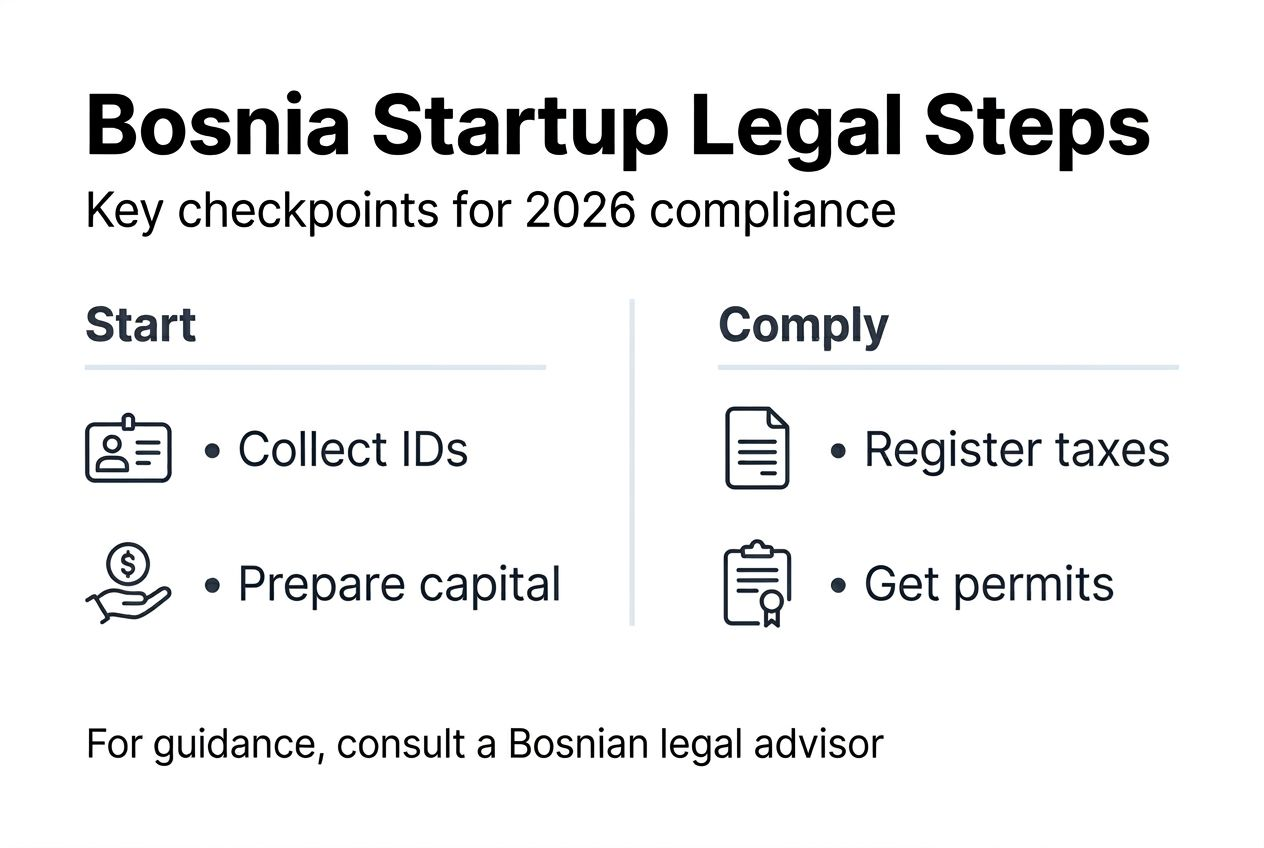
Identify whether your business activity falls under regulated categories by checking with relevant ministries and regulatory agencies. Each sector has distinct application procedures, qualification requirements, and inspection standards. Don't assume you can start operations while applications are pending.
Application processing typically takes 30 to 60 days depending on sector complexity and inspection requirements. Some permits require physical premises inspections, professional certifications, or minimum capital thresholds beyond standard incorporation requirements. Budget extra time for these authorizations in your launch timeline.
Follow this licensing process:
- Identify all required licenses for your specific business activities.
- Gather qualification documents including professional credentials and insurance.
- Submit applications with required fees to appropriate regulatory bodies.
- Schedule and pass any mandatory inspections or examinations.
- Obtain formal license approval before commencing regulated activities.
Failure to obtain necessary permits can halt your entire operation. Regulators can impose daily fines until you achieve compliance or permanently revoke your right to operate in that sector. Check our regulatory overview for doing business for sector-specific guidance.
Common mistakes and risk mitigation
Late or missing tax and social security registrations top the list of startup compliance failures. Founders often focus on product development and customer acquisition while ignoring mandatory filing deadlines. Penalties accumulate automatically, creating unexpected financial burdens that strain early-stage cash flow.
Insufficient or missing founders' agreements create disasters when co-founders disagree. Without clear documentation of ownership percentages, decision rights, and exit terms, you face expensive litigation that distracts from business growth. Courts cannot enforce verbal understandings or assumed arrangements.
Neglecting GDPR compliance until regulators investigate leaves you vulnerable to maximum penalties. Many startups incorrectly believe privacy rules only apply to large corporations. The law makes no size exceptions for data protection obligations.
Common mistakes to avoid:
- Missing registration deadlines for tax, social security, and statistical office
- Operating without sector-specific licenses or permits
- Using generic contract templates that violate Bosnian labor law
- Failing to document data processing activities and legal basis
- Skipping founders' agreements to save initial legal costs
- Assuming verbal agreements with co-founders are enforceable
"The startups that succeed long-term treat legal compliance as a competitive advantage, not a cost center. Proper structure from day one prevents expensive problems that derail growth later."
Thorough planning and proactive registrations significantly reduce litigation risk and regulatory penalties. Invest in proper legal setup during formation rather than fixing problems after they escalate. Visit our startup legal insights for ongoing compliance guidance.
Expected timelines, costs, and outcomes
Legal costs for complete startup compliance in Bosnia typically range from €500 to €1,200 depending on entity complexity, sector-specific licensing, and contract requirements. This includes notarization fees, court registration, mandatory publications, and initial legal advisory services. Budget additional amounts for specialized sectors requiring environmental permits or professional liability insurance.
Full compliance from initial preparation through final registrations usually takes six to eight weeks if you proceed methodically without delays. Online registration portals can shorten this timeline by several weeks. Factor in extra time if your business requires sector-specific licenses with inspection requirements.
| Compliance Milestone | Estimated Timeline | Typical Cost |
|---|---|---|
| Prerequisites and document preparation | 1-2 weeks | €100-€200 |
| Company incorporation and court registration | 2-3 weeks | €300-€500 |
| Tax and social security registrations | 1 week | €50-€100 |
| GDPR policies and contract drafting | 1-2 weeks | €200-€400 |
| Sector-specific licensing | 4-8 weeks | Variable |
Successful compliance delivers these outcomes:
- Formal company registration with court-issued certificate
- Tax identification number and VAT registration if applicable
- Social security and pension fund confirmation numbers
- Documented GDPR policies and data processing records
- Executed founders' agreements and employment contracts
- All required sector-specific licenses and permits
These outcomes provide legal authorization to operate, hire employees, invoice customers, and access business banking services. Proper setup also positions you for future investment rounds because investors demand clean legal foundations. Our strategic legal services can guide you through each stage efficiently.
Legal support designed for your startup journey
Navigating Bosnia's legal requirements without experienced guidance wastes time and increases risk exposure. Professional legal support tailored specifically for startups ensures you complete every compliance step correctly the first time, avoiding costly corrections and penalties that drain resources.
Our team specializes in incorporation procedures, regulatory compliance, and contract drafting for growth-focused companies in Bosnia and throughout the region. We understand the unique challenges startups face balancing rapid development with legal obligations. You get practical advice aligned with your business realities, not generic templates that create problems later.
We also provide cross-border legal guidance as you scale internationally. Whether you're expanding to European markets or managing remote teams across borders, we help you navigate complex multi-jurisdictional requirements efficiently. Partner with experienced corporate and technology lawyers who understand startup dynamics and regulatory complexity. Explore our strategic legal services, learn about our cross-border legal expertise, or review our comprehensive doing business legal guide to see how we support your growth.
FAQ
How long does company registration typically take in Bosnia and Herzegovina?
Company registration typically requires around 15 working days in Bosnia and Herzegovina for standard applications. Online portals can reduce this timeframe by approximately 40% compared to traditional paper submissions. Complex structures or incomplete documentation may extend the timeline.
Is a founders' agreement legally required to start a company in Bosnia?
Founders' agreements are not legally mandatory under Bosnian corporate law. However, they are highly recommended to prevent ownership conflicts, clarify management roles, and establish exit procedures. Courts enforce written agreements, making them essential protection for multi-founder startups.
What are the penalties for non-compliance with GDPR in Bosnian startups?
GDPR violations can result in fines up to €20 million or 4% of annual global turnover, whichever amount is higher. Supervisory authorities increasingly audit startups, particularly in technology sectors. Early compliance implementation is crucial to avoid these severe financial penalties.
When must a startup appoint a Data Protection Officer?
GDPR requires a DPO for companies processing personal data on a large scale or handling sensitive data categories regularly. Smaller processors may not need a formal DPO appointment but must still designate someone responsible for privacy compliance and implement documented data protection policies.