
Many business leaders encounter commercial law only when disputes arise or contracts fail, often too late to prevent costly mistakes. Commercial law governs business transactions, contracts, sales, trade, and the relationships between merchants and consumers. Understanding its scope and practical implications empowers you to build stronger foundations for growth, manage risks proactively, and navigate regulatory complexities with confidence. This guide clarifies what commercial law encompasses, how it differs from related legal areas, and why mastering its fundamentals is essential for business success in Bosnia and Herzegovina and across Europe.
Table of Contents
- Key Takeaways
- Understanding commercial law and its key domains
- How commercial law supports business operations and growth
- Differences and interplay between commercial law and corporate law
- Navigating commercial law in Bosnia and Herzegovina and Europe: practical considerations
- Explore expert legal support for your business
- What is commercial law?
Key Takeaways
| Point | Details |
|---|---|
| Scope of commercial law | Commercial law governs contracts, sales, trade and relations between merchants and consumers, shaping daily business operations. |
| Early specialist advice | Engaging strategic legal services early in transaction planning prevents disputes and strengthens negotiating positions. |
| Core domains outlined | The core domains include contract formation, sales, trade regulations, payment systems, security interests and dispute resolution. |
| Bosnia and Europe link | In Bosnia and Herzegovina local commercial law interacts with European frameworks, requiring regional insight to navigate regulatory complexity. |
Understanding commercial law and its key domains
Commercial law forms the legal backbone of business activity. It establishes the rules governing how companies buy, sell, trade, and interact with customers and other businesses. Unlike other legal areas that focus on company structure or employment relationships, commercial law governs business transactions, contracts, sales, trade, commerce, and relations between merchants and consumers. This distinction matters because commercial law directly affects your daily operations, from negotiating supplier agreements to ensuring payment terms protect your cash flow.
The scope of commercial law extends across multiple interconnected domains. Contract law ensures agreements between parties are legally binding and enforceable. Sales law governs the transfer of goods and services, including warranties, delivery obligations, and remedies for breach. Trade regulations address cross-border transactions, customs compliance, and international commercial standards. Payment systems and negotiable instruments like cheques and promissory notes fall under commercial law's umbrella, as do secured transactions where businesses pledge assets as collateral for financing.
Understanding these domains helps you recognise when commercial law applies to your business decisions. Whether you're drafting a distribution agreement, structuring payment terms for international clients, or resolving a dispute over defective goods, commercial law provides the framework for protecting your interests and enforcing your rights. Engaging strategic legal services for business early in transaction planning prevents disputes and strengthens your negotiating position.
The practical application of commercial law touches nearly every business function:
- Contract formation and enforcement mechanisms that make agreements legally binding
- Sales transactions including warranties, delivery terms, and risk allocation
- Trade finance instruments such as letters of credit and bills of exchange
- Security interests in movable property and inventory financing
- Payment systems and electronic commerce regulations
- Dispute resolution procedures including arbitration and mediation
- Consumer protection requirements affecting B2C transactions
For businesses operating in Bosnia and Herzegovina, understanding how local commercial law interacts with broader European frameworks becomes essential. The legal guide to doing business in Bosnia & Herzegovina provides region-specific insights that help you navigate this complexity. Commercial law's flexibility allows businesses to structure transactions creatively while maintaining legal certainty, but only when you understand the boundaries and requirements that apply to your specific situation. This knowledge transforms legal compliance from a reactive burden into a strategic advantage that supports sustainable growth.
How commercial law supports business operations and growth
Commercial law creates the predictability businesses need to operate confidently and scale effectively. When you enter a contract, you need assurance that courts will enforce its terms if the other party fails to perform. Commercial law ensures legal frameworks are in place for business transactions and dispute resolution, providing this essential certainty. This legal infrastructure allows you to plan investments, commit resources, and build partnerships knowing your rights and obligations have clear legal backing.
The enforceability of commercial agreements directly impacts your ability to secure financing and attract investors. Lenders assess legal risk before extending credit, and investors evaluate whether your contracts protect their interests. Strong commercial law frameworks reduce these perceived risks, lowering your cost of capital and improving access to growth funding. When your contracts clearly allocate risks, specify remedies for breach, and include enforceable dispute resolution clauses, you demonstrate legal sophistication that builds stakeholder confidence.

Risk management represents another critical function of commercial law. Every business transaction carries inherent risks: suppliers may fail to deliver, customers might default on payments, or products could prove defective. Commercial law provides tools to allocate and mitigate these risks through warranty provisions, limitation of liability clauses, insurance requirements, and security interests. Understanding how to structure these protections prevents costly disputes and preserves business relationships when problems arise. The contract structure and investment outcomes connection illustrates how legal design choices directly affect business results.
Compliance with commercial law requirements also protects your business from regulatory penalties and reputational damage. Consumer protection laws, trade regulations, and payment system rules impose specific obligations on businesses. Violations can result in fines, contract invalidity, or enforcement actions that disrupt operations. Staying ahead of these requirements through proactive legal advice for business success prevents compliance failures and positions your company as a trustworthy market participant.
Commercial law's role in dispute resolution deserves particular attention. Even well-structured contracts sometimes lead to disagreements. Commercial law provides mechanisms for resolving these disputes efficiently through negotiation, mediation, arbitration, or litigation. Choosing the right dispute resolution method in your contracts saves time and money when conflicts arise. Arbitration clauses, for example, offer privacy and speed compared to public court proceedings, making them attractive for cross-border commercial disputes.
The strategic benefits of mastering commercial law include:
- Enhanced negotiating power through understanding legal rights and remedies
- Reduced transaction costs by preventing disputes and streamlining enforcement
- Improved cash flow management through effective payment terms and security interests
- Stronger vendor and customer relationships built on clear legal foundations
- Competitive advantage from sophisticated contract structures that attract better partners
- Regulatory compliance that avoids penalties and protects business reputation
Pro Tip: Schedule quarterly reviews with legal counsel to assess how changes in commercial law affect your standard contracts, payment terms, and trading relationships. This proactive approach identifies compliance gaps and optimisation opportunities before they become problems, supporting sustainable growth while managing legal risk effectively.
Differences and interplay between commercial law and corporate law
Business leaders often confuse commercial law with corporate law, yet these legal domains serve distinct functions. Commercial law is distinct from corporate law although both overlap in governing business activities. Corporate law focuses on company formation, governance structures, shareholder rights, director duties, and internal corporate relationships. It answers questions about how to establish a company, who has authority to bind it, and how decisions get made within the organisation. Commercial law, by contrast, governs external business transactions and relationships with third parties.
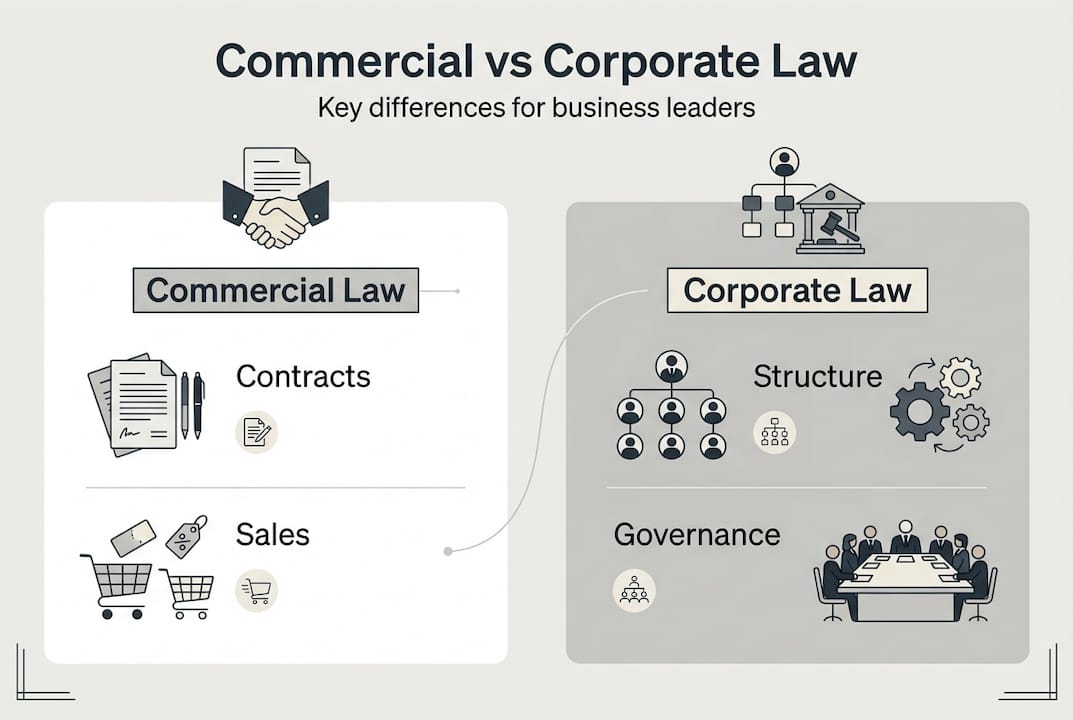
This distinction matters for practical decision-making. When you're deciding whether to form a limited liability company or a joint stock company, you're dealing with corporate law questions. When you're negotiating a supply agreement or structuring payment terms with a distributor, you're operating in the commercial law domain. Corporate law creates the legal entity that conducts business; commercial law regulates how that entity transacts with others.
The interplay between these areas becomes apparent in real-world situations. A company's authority to enter contracts depends on corporate law rules about board approval and officer authority. Yet the contract's enforceability, interpretation, and remedies for breach fall under commercial law. Similarly, corporate law determines whether a company can pledge assets as security, while commercial law governs how those security interests are created, perfected, and enforced. Understanding both domains helps you structure transactions that satisfy corporate governance requirements while protecting commercial interests.
Consider a merger transaction. Corporate law governs the approval process, shareholder voting, and legal mechanics of combining entities. Commercial law addresses the purchase agreement's terms, representations and warranties, indemnification provisions, and post-closing obligations. Both legal frameworks must align for the transaction to succeed. The corporate law essential guide explores these corporate governance dimensions in detail.
| Aspect | Commercial law | Corporate law |
|---|---|---|
| Primary focus | External business transactions and relationships | Internal company structure and governance |
| Key areas | Contracts, sales, trade, payments, security interests | Formation, directors' duties, shareholders, capital |
| Typical questions | Is this contract enforceable? What remedies apply for breach? | Who has authority to approve this? What are director obligations? |
| Regulatory framework | Uniform Commercial Code, trade laws, consumer protection | Company laws, securities regulations, corporate governance codes |
| Dispute types | Breach of contract, payment defaults, warranty claims | Shareholder disputes, director liability, governance failures |
| Strategic impact | Enables transactions, manages commercial risk | Establishes legal entity, defines decision-making authority |
The practical implications of this distinction include:
- Corporate law determines whether your company can legally enter a transaction
- Commercial law governs whether that transaction is enforceable and how disputes get resolved
- Corporate governance requirements may impose approval processes before commercial commitments
- Commercial contracts must respect corporate law limitations on authority and capacity
- Directors face corporate law duties when approving commercial transactions
- Commercial disputes may trigger corporate law questions about proper authorisation
Successful business leaders develop competency in both areas or engage advisers who understand how they intersect. A contract signed by someone lacking corporate authority may be unenforceable despite meeting all commercial law requirements. Conversely, a properly authorised agreement that violates commercial law principles exposes your company to liability regardless of corporate compliance. Integrating both perspectives into your decision-making process protects your business comprehensively and supports strategic objectives effectively.
Navigating commercial law in Bosnia and Herzegovina and Europe: practical considerations
Operating in Bosnia and Herzegovina and broader European markets requires understanding how commercial law helps businesses navigate legal complexities essential for growth initiatives in Bosnia and Herzegovina and Europe. The regional legal environment presents unique challenges stemming from Bosnia's complex constitutional structure, ongoing harmonisation with EU commercial law standards, and the interaction between local and international legal frameworks. Businesses must navigate multiple layers of regulation while maintaining compliance with both domestic requirements and European trading standards.
Bosnia and Herzegovina's legal system reflects its federal structure, with commercial law competencies divided between the state, entities, and cantons. This creates complexity in determining which laws apply to specific transactions and which courts have jurisdiction over disputes. The country has made significant progress harmonising commercial law with EU standards as part of its integration process, but gaps and inconsistencies remain. Understanding these nuances prevents costly mistakes and positions your business to operate effectively across the region.
European commercial law frameworks increasingly influence Bosnian practice, particularly in areas like consumer protection, electronic commerce, and payment services. Even if your business operates primarily within Bosnia, you likely encounter EU law through supply chains, customer relationships, or financing arrangements. Cross-border transactions require particular attention to conflict of laws rules that determine which country's commercial law governs the agreement. The legal guide for doing business in Bosnia provides essential context for navigating these regional considerations.
Practical steps for navigating commercial law in this environment include:
-
Conduct thorough due diligence before entering commercial relationships. Verify that potential partners have legal capacity, proper authorisation, and clean commercial records. This prevents disputes over contract validity and enforceability.
-
Choose governing law and jurisdiction carefully in cross-border contracts. Select legal frameworks and dispute resolution forums that provide predictability, enforceability, and alignment with your business interests. Consider arbitration for international disputes.
-
Structure security interests properly according to local law requirements. Bosnia's secured transactions regime requires specific formalities for creating and perfecting security interests. Failing to comply renders your security unenforceable against third parties.
-
Understand consumer protection obligations if you sell to individuals. Bosnia has adopted EU-influenced consumer protection standards that impose specific disclosure, warranty, and remedy requirements on B2C transactions. Non-compliance triggers regulatory penalties.
-
Implement compliant payment and invoicing practices. Commercial law regulates payment terms, interest on late payments, and invoicing requirements. Aligning your practices with these rules improves cash flow and prevents disputes.
-
Monitor regulatory changes affecting your industry. Commercial law evolves as Bosnia continues EU harmonisation and responds to market developments. Staying informed helps you adapt proactively rather than reactively.
-
Document transactions thoroughly with clear written agreements. While oral contracts may be enforceable, written documentation prevents disputes over terms and provides evidence if litigation becomes necessary.
The cross-border business lawyer perspective becomes essential when your operations span multiple jurisdictions. Different countries apply different commercial law principles to contracts, sales, and payment obligations. Understanding how these variations affect your transactions prevents unexpected liabilities and enforcement problems. Choice of law clauses, jurisdiction agreements, and international commercial terms (Incoterms) help manage this complexity.
Regional considerations also extend to enforcement mechanisms. Bosnia's court system can be slow and unpredictable, making alternative dispute resolution attractive for commercial disputes. Including arbitration clauses in contracts provides faster, more reliable dispute resolution than litigation. International arbitration awards enjoy broad enforceability under the New York Convention, which Bosnia has ratified.
Pro Tip: Engage specialised local legal counsel before finalising significant commercial transactions in Bosnia and Herzegovina. Local expertise identifies jurisdiction-specific requirements, drafting conventions, and enforcement considerations that generic templates miss. This upfront investment prevents far more expensive problems later and demonstrates commercial sophistication that strengthens your negotiating position with sophisticated counterparties.
Explore expert legal support for your business
Mastering commercial law's complexities requires more than understanding general principles. You need practical guidance tailored to your specific business context, industry, and growth objectives. Whether you're structuring your first international supply agreement, resolving a payment dispute, or ensuring compliance with evolving regulations, specialised legal support transforms uncertainty into strategic advantage.

Our approach combines deep commercial law expertise with practical business understanding. We help growth-oriented companies navigate legal complexities while maintaining focus on commercial objectives. From contract negotiation and drafting to dispute resolution and regulatory compliance, our services align legal frameworks with your business realities. The corporate law essential guide and strategic legal services for business demonstrate how integrated legal support drives better business outcomes.
For businesses entering or expanding in Bosnia and Herzegovina, our regional expertise provides essential advantages. We understand the nuances of local commercial law, entity structures, and regulatory requirements that generic advice misses. The legal guide for doing business in Bosnia offers a starting point, but personalised counsel ensures your specific situation receives the attention it deserves. Explore how proactive legal partnership supports your growth initiatives with confidence and precision.
What is commercial law?
What exactly does commercial law cover?
Commercial law governs business-to-business and business-to-consumer transactions including contracts, sales, trade, payments, and dispute resolution. It provides the legal framework that makes business relationships enforceable and predictable.
How does commercial law differ from corporate law?
Commercial law regulates external business transactions and relationships with third parties, while corporate law governs internal company structure, governance, and shareholder relationships. Both areas intersect when companies enter transactions, requiring integrated legal analysis.
Why should business leaders understand commercial law?
Understanding commercial law helps you structure better contracts, manage transaction risks, ensure compliance, and resolve disputes efficiently. This knowledge directly supports growth by reducing legal uncertainty and strengthening business relationships.
How do I find reliable commercial law support in Bosnia and Herzegovina?
Seek legal advisers with demonstrated expertise in Bosnian commercial law and cross-border transactions. Look for firms that understand regional complexities and provide practical, business-focused guidance rather than purely academic analysis. The legal guide to doing business in Bosnia & Herzegovina offers valuable context.
What are the most common commercial law mistakes businesses make?
Common mistakes include using generic contract templates without localisation, failing to specify governing law and jurisdiction, inadequately documenting transactions, ignoring security interest formalities, and reacting to legal issues rather than preventing them through proactive planning.