
Many Bosnian business leaders mistakenly think corporate law only concerns registering a company. Corporate law actually underpins sustainable growth, governance, risk mitigation, and expansion. This guide clarifies corporate law's scope and its strategic value for business leaders looking to grow and expand internationally, providing practical insights for navigating complex regulations and supporting cross-border operations.
Table of Contents
- What is corporate law: definition and scope
- Corporate law framework in Bosnia and Herzegovina
- Corporate structures and formation
- Common misconceptions about corporate law
- International expansion and cross-border considerations
- Compliance and risk management
- Case studies on effective corporate law application
- Explore expert corporate legal services for your business
- Frequently asked questions about corporate law in Bosnia and Herzegovina
Key takeaways
| Point | Details |
|---|---|
| Corporate law scope | Governs company formation, governance, compliance, and risk management beyond registration. |
| Bosnia governance system | Features a two-tier governance system balancing control and oversight for stakeholder protection. |
| Structure selection impact | Choosing the right corporate structure affects liability, capital requirements, and operational flexibility. |
| International expansion role | Corporate law frameworks critically influence legal risk and success in cross-border growth. |
| Misconception risks | Misunderstanding corporate law increases legal exposure and hinders sustainable business growth. |
What is corporate law: definition and scope
Corporate law primarily governs the creation, organization, management, and dissolution of companies, setting rules for how businesses structure internally and relate legally with third parties. This legal framework establishes the rights and obligations of everyone involved in a company, from shareholders to directors to employees.
Corporate law covers multiple critical domains:
- Company formation and registration requirements
- Governance structures defining authority and decision-making processes
- Shareholder rights including voting, dividends, and information access
- Director and officer fiduciary duties to act in the company's best interests
- Regulatory compliance with reporting, disclosure, and transparency obligations
- Contractual relationships with suppliers, customers, and partners
- Mergers, acquisitions, and corporate restructuring frameworks
These legal domains regulate how your business interacts internally among stakeholders and externally with markets, regulators, and other entities. Directors carry fiduciary duties requiring loyalty, care, and good faith in managing company affairs. You face ongoing compliance obligations including annual reports, financial disclosures, and board meeting documentation.
Understanding corporate law helps you structure governance effectively, protect shareholder interests, and minimize legal risks as you grow. It provides the legal foundation for sustainable operations and strategic expansion. Without proper corporate law knowledge, you risk governance failures, regulatory penalties, and disputes that derail growth plans.
Corporate law framework in Bosnia and Herzegovina
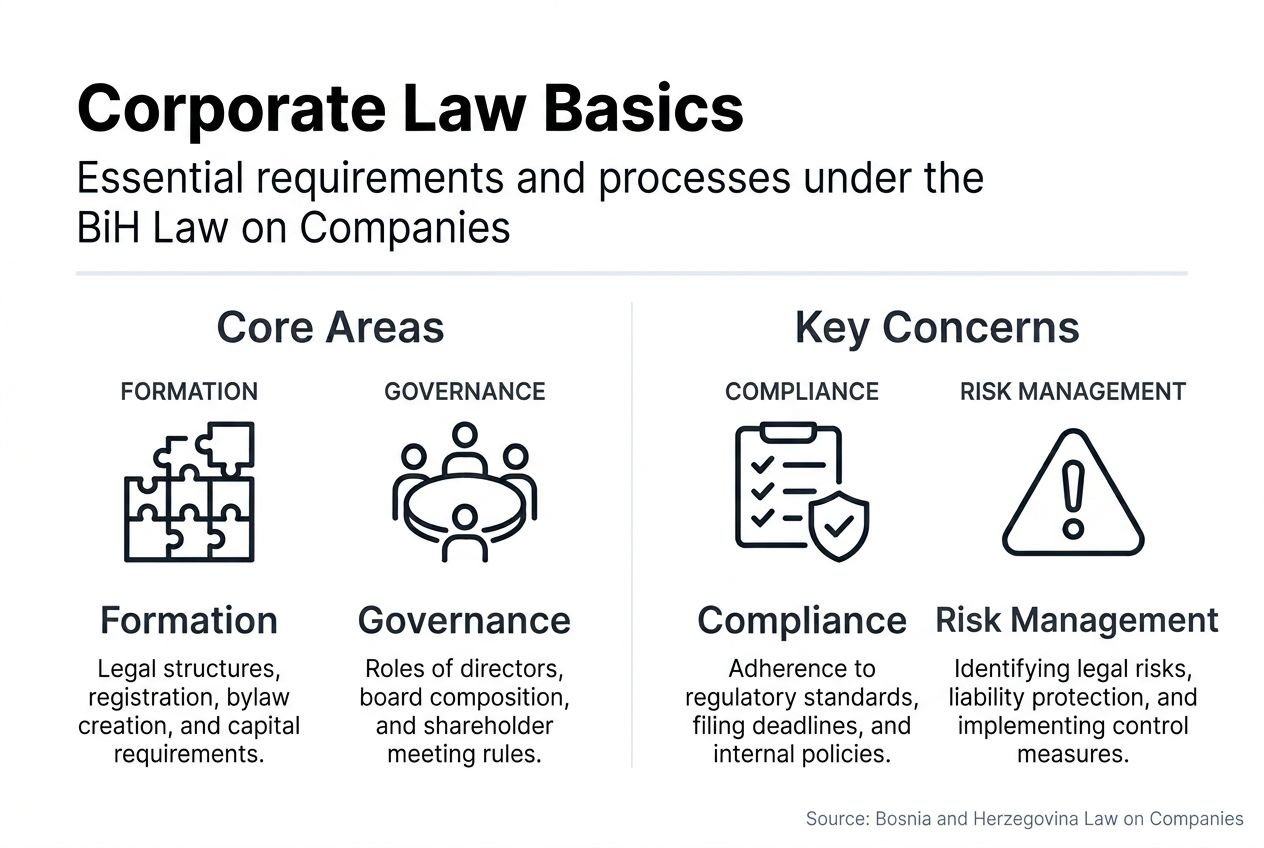
The Law on Companies in Bosnia and Herzegovina establishes the primary legal framework governing corporate entities in the country. This legislation defines company types, registration procedures, governance requirements, and compliance obligations specific to the Bosnian legal environment.
Corporate governance in Bosnia typically follows a two-tier system including a management board and a supervisory board, which balances operational control and oversight to protect shareholder interests. The management board handles day-to-day operations and strategic implementation. The supervisory board monitors management performance, approves major decisions, and ensures compliance with legal and ethical standards.
Key features of Bosnia's corporate law framework include:
- Mandatory registration with the relevant court registry before commencing operations
- Annual financial reporting and disclosure requirements for transparency
- Defined capital contribution rules varying by corporate structure
- Board composition requirements balancing independence and expertise
- Shareholder meeting procedures for major decisions and approvals
- Specific dissolution and liquidation processes protecting creditor rights
This dual-board system creates accountability layers protecting stakeholders from management overreach or negligence. Supervisory boards typically include independent members providing objective oversight. Regular reporting obligations ensure transparency for shareholders and regulatory authorities.
Pro Tip: Subscribe to legal updates from your legal advisor specializing in Bosnia to stay current with regulatory changes affecting corporate governance and compliance requirements.
Corporate structures and formation
Bosnian law offers several corporate structures, each with distinct legal characteristics affecting liability, capital, governance, and operational flexibility. The two most common forms are Limited Liability Companies (LLCs) and Joint Stock Companies (JSCs).

LLCs suit small to medium enterprises needing operational flexibility with lower regulatory burdens. They require modest initial capital, feature simplified governance structures, and limit shareholder liability to capital contributions. JSCs work better for larger firms seeking access to equity markets or requiring formal governance frameworks. They demand higher minimum capital, implement structured board systems, and facilitate public share offerings.
| Feature | LLC | JSC |
|---|---|---|
| Minimum capital | Lower threshold | Significantly higher requirement |
| Liability | Limited to contributions | Limited to share value |
| Governance | Flexible, simpler structure | Mandatory two-tier boards |
| Share transferability | Restricted, requires approval | Freely tradable |
| Regulatory burden | Moderate compliance | Extensive reporting obligations |
| Suitability | SMEs, family businesses | Large companies, public offerings |
Choosing the right structure requires analyzing your growth trajectory, capital needs, and governance preferences. LLCs provide agility for rapidly evolving businesses with concentrated ownership. JSCs enable capital raising through share issuance while implementing robust governance protecting diverse shareholders.
Additional structural considerations include:
- Branch offices for foreign companies entering Bosnia without creating separate legal entities
- Partnerships for professional services requiring personal liability sharing
- Holding company structures for managing multiple subsidiaries or investments
Pro Tip: Align your corporate structure selection with long-term international expansion plans, considering how different forms facilitate cross-border transactions and foreign investment.
Common misconceptions about corporate law
Several widespread misconceptions about corporate law create unnecessary risks for Bosnian business leaders. Correcting these misunderstandings helps you apply corporate law strategically.
-
Misconception: Corporate law only matters during company registration. Reality: Corporate law continuously governs your operations through ongoing compliance obligations, governance requirements, and stakeholder relations. Registration is just the starting point. You must maintain proper records, hold required meetings, file reports, and update registrations as your business evolves. Ignoring these ongoing duties creates legal vulnerabilities and potential penalties.
-
Misconception: Directors' responsibilities are purely operational. Reality: Directors carry fiduciary duties requiring them to act in the company's best interests with care, loyalty, and good faith. These legal obligations extend beyond daily management to strategic oversight, risk management, and compliance assurance. Directors can face personal liability for breaches including conflicts of interest, negligent decisions, or regulatory violations.
-
Misconception: Corporate law has minimal impact on international expansion. Reality: Corporate law frameworks critically shape your ability to enter foreign markets, structure cross-border transactions, and manage international legal risks. Different jurisdictions impose varying governance requirements, reporting obligations, and liability standards. Understanding these differences prevents costly legal disputes and facilitates smoother market entry.
-
Misconception: Compliance is only relevant for large corporations. Reality: All companies regardless of size must meet applicable compliance obligations. Smaller businesses often face proportionate requirements but cannot ignore reporting duties, tax obligations, or governance standards. Non-compliance creates reputational damage and legal exposure regardless of company size.
Recognizing these misconceptions helps you approach corporate law proactively rather than reactively. Proper legal understanding supports sustainable growth and reduces avoidable risks.
International expansion and cross-border considerations
Corporate law profoundly influences your ability to expand internationally and navigate foreign jurisdictions successfully. Each country imposes unique legal requirements for foreign companies operating within its borders.
Understanding local corporate laws when entering new markets prevents regulatory violations and facilitates smoother operations. Legal systems vary significantly across jurisdictions regarding corporate governance, tax treatment, employment law, and intellectual property protection. These differences create compliance challenges and transactional risks you must address strategically.
Preparing legally for international expansion requires systematic steps:
- Research target jurisdiction's corporate law requirements including registration procedures, capital thresholds, and governance obligations before committing resources.
- Determine optimal market entry structure such as subsidiary formation, branch establishment, joint venture, or partnership based on legal and tax implications.
- Engage local legal experts familiar with jurisdiction-specific corporate law to guide structuring decisions and ensure compliance.
- Establish cross-border contractual frameworks addressing dispute resolution, applicable law, currency issues, and regulatory compliance mechanisms.
- Implement governance processes accommodating multiple legal jurisdictions while maintaining consistent standards and reporting across operations.
Corporate law frameworks facilitate international partnerships and trade by providing legal certainty for transactions. Clear contractual terms, proper entity structuring, and compliance protocols reduce disputes and enable efficient cross-border commerce.
Cross-border transactions introduce complexities including foreign investment restrictions, currency controls, and conflicting legal requirements. You need legal strategies addressing these challenges. For companies doing business in Bosnia while expanding internationally, understanding how Bosnian corporate law interfaces with foreign legal systems becomes critical.
Foreign market entry often involves choosing between establishing subsidiaries or branch offices. Subsidiaries create separate legal entities with independent liability, while branches extend the parent company with shared legal responsibility. Each structure carries distinct tax, regulatory, and operational implications requiring careful legal analysis.
Compliance and risk management
Corporate law in Bosnia and Herzegovina mandates specific reporting and disclosure obligations protecting stakeholder interests and market transparency. These requirements include annual financial statements, shareholder meeting minutes, board resolutions, and registry updates reflecting ownership or structural changes.
Non-compliance carries serious consequences beyond financial penalties. You risk reputational damage undermining stakeholder trust, regulatory sanctions limiting operational capacity, and increased legal exposure in disputes. Compliance failures can trigger investigations, audits, and potential director liability.
Integrating compliance and risk management into operations requires proactive strategies:
- Establish internal compliance calendars tracking reporting deadlines, filing requirements, and regulatory updates to prevent missed obligations.
- Implement document management systems maintaining required corporate records including meeting minutes, resolutions, contracts, and correspondence.
- Conduct regular compliance audits reviewing adherence to corporate governance standards, reporting accuracy, and regulatory requirements.
- Assign clear compliance responsibilities to specific individuals or committees with authority and resources for effective oversight.
- Develop risk assessment frameworks identifying legal, operational, and reputational risks requiring mitigation strategies.
- Create whistleblower mechanisms enabling employees to report compliance concerns without retaliation.
Proactive compliance mitigates operational risks by identifying potential issues before they escalate into legal problems. Regular training keeps directors and officers informed about their legal responsibilities and evolving regulations.
Pro Tip: Schedule annual board-level training on GDPR and corporate governance obligations to ensure leadership understands legal responsibilities and data protection requirements affecting modern businesses.
Risk management extends beyond regulatory compliance to encompass contractual risks, governance failures, and strategic legal exposures. Effective corporate law application integrates legal considerations into business decision-making rather than treating compliance as a separate function.
Case studies on effective corporate law application
Companies in the Western Balkans implementing robust corporate governance frameworks achieve measurably better outcomes. Statistics link strong corporate governance practices with a 30% higher growth rate during expansion phases compared to companies with weak governance structures.
Successful applications of two-tier governance systems in Bosnia demonstrate how proper board separation enhances decision quality. Companies employing independent supervisory boards report fewer governance disputes and better strategic oversight. The supervisory board's independent perspective prevents management conflicts of interest and ensures decisions align with shareholder interests.
Compliance failures provide cautionary lessons about corporate law's importance. One Bosnian manufacturing company faced significant penalties after failing to update ownership registrations following an internal restructuring. The oversight created legal ambiguity about authority to bind the company, resulting in contract disputes and delayed transactions. Another company encountered difficulties expanding internationally because its governance documentation didn't meet foreign investor due diligence standards.
Actionable lessons from these cases include:
- Maintain meticulous corporate records enabling quick responses to legal inquiries and due diligence requests.
- Update registrations promptly when ownership, governance, or structural changes occur to maintain legal clarity.
- Implement governance standards exceeding minimum legal requirements to demonstrate credibility to investors and partners.
- Conduct pre-expansion legal audits identifying compliance gaps before entering new markets or seeking investment.
- Engage specialized legal counsel for complex transactions rather than relying solely on general business advisors.
These examples illustrate how corporate law application directly impacts business outcomes. Companies treating corporate law as a strategic asset rather than administrative burden position themselves for sustainable growth. For deeper analysis of legal strategies supporting business success, explore additional legal insights addressing specific industries and jurisdictions.
Explore expert corporate legal services for your business
Navigating corporate law complexities in Bosnia and Herzegovina requires specialized expertise aligned with your business objectives. Strategic legal services tailored to growth-oriented companies provide the guidance you need for sustainable expansion.
Expert legal advisors help you structure governance frameworks meeting regulatory requirements while supporting operational efficiency. They guide corporate formation decisions, ensuring you select structures optimizing liability protection, tax treatment, and flexibility. For cross-border transactions, specialized counsel addresses jurisdictional complexities and facilitates smoother international operations.
Whether you're establishing operations, expanding internationally, or optimizing governance, proven legal expertise minimizes risks and maximizes growth potential. Legal advisors experienced in doing business in Bosnia understand local regulatory nuances while maintaining global perspectives essential for international expansion.
Frequently asked questions about corporate law in Bosnia and Herzegovina
What corporate structure is best for SMEs in Bosnia and Herzegovina?
Limited Liability Companies typically suit SMEs because they require lower minimum capital, offer operational flexibility, and impose lighter regulatory burdens than Joint Stock Companies. LLCs provide adequate liability protection while allowing concentrated ownership and simplified governance, making them ideal for family businesses and growing enterprises.
How does the two-tier board system protect shareholder interests?
The two-tier system separates operational management from oversight by assigning daily decisions to the management board while the supervisory board monitors performance and approves major transactions. This separation prevents conflicts of interest, ensures independent review of management actions, and creates accountability protecting shareholders from potential mismanagement.
What are key compliance obligations under Bosnian corporate law?
Companies must file annual financial statements, maintain updated registry information, hold required shareholder and board meetings, preserve corporate records for specified periods, and submit tax returns meeting deadlines. Specific obligations vary by corporate structure, but all entities face reporting and transparency requirements ensuring stakeholder protection.
How can companies mitigate cross-border legal risks effectively?
Engage local legal experts in target jurisdictions before entering markets, conduct thorough due diligence on foreign legal requirements, structure transactions with clear dispute resolution mechanisms, and implement compliance processes accommodating multiple legal systems. Proper planning and expert guidance reduce regulatory violations and contractual disputes.
What common legal pitfalls should business leaders avoid when expanding internationally?
Avoid assuming your home jurisdiction's corporate law applies abroad, neglecting to verify foreign investment restrictions, underestimating compliance costs in new markets, and failing to structure entities optimally for tax and liability purposes. Many businesses also overlook employment law differences and intellectual property protection variations across jurisdictions, creating unnecessary exposure.
Recommended
- Strategic Legal Services for Business | Franjo Vucic
- Franjo Vučić – Corporate & Technology Lawyer | Vucic Legal
- Doing Business in Bosnia & Herzegovina | Legal Guide for International Companies
- Insights | Franjo Vucic Legal Advisory
- Korp.ph | Corporate Governance in the Philippines: What Business Owners Must Know