
TL;DR:
- Family businesses in Bosnia and Herzegovina are governed by general laws rather than a dedicated statute.
- Key issues include succession planning, inheritance disputes, founder dependency, and multi-entity compliance challenges.
- Proactive legal advice, formal governance structures, and professional management are essential for long-term survival and growth.
Family businesses form the backbone of Bosnia and Herzegovina's private sector, yet many owners operate under a significant misconception: that a dedicated legal framework exists to govern them. There is no specific statute in Bosnia and Herzegovina covering family businesses as a distinct category. Instead, owners must navigate a patchwork of company law, inheritance rules, and tax regulations, often across multiple legal entities and cantonal jurisdictions. This article clarifies what the law actually requires, identifies the most critical risks, and provides concrete strategies for compliance and long-term growth.
Table of Contents
- Understanding family business law in Bosnia and Herzegovina
- Key challenges facing family businesses
- Succession planning and professionalisation strategies
- Legal compliance and growth strategies for family businesses
- Why 'family business law' in Bosnia and Herzegovina requires creative compliance
- Next steps: Expert legal advice for family businesses in Bosnia and Herzegovina
- Frequently asked questions
Key Takeaways
| Point | Details |
|---|---|
| No dedicated statute | Family businesses in Bosnia and Herzegovina rely on general company, inheritance and civil laws. |
| Survival depends on planning | Most family firms fail within one generation due to a lack of formal succession planning and professionalisation. |
| Forced heirship rules | Succession must comply with forced heirship requirements, granting mandatory shares to children and spouses. |
| Creative compliance needed | Business owners must creatively navigate complex entity rules and leverage expert advice for growth and stability. |
| Practical strategies for success | Valuation, external management, diversification and formal contracts are key to family business survival in BiH. |
Understanding family business law in Bosnia and Herzegovina
Family business law, as practised across modern jurisdictions, is a specialised area focusing on ownership, management, succession, governance, and dispute prevention for family-controlled firms. It addresses who owns shares, who manages operations, how leadership transfers between generations, and how family disputes are handled before they threaten the business itself. In jurisdictions with dedicated statutes, these questions have clear legislative answers. In Bosnia and Herzegovina, the situation is considerably more complex.
Family businesses in BiH are governed by general company laws, inheritance rules, and related regulations rather than any single, unified framework. This means that legal advice for family firms must draw from multiple sources simultaneously. A succession question, for example, implicates both the Law on Companies and the Law on Inheritance, as well as potentially the civil code and relevant tax legislation. Owners who treat these areas as separate often discover gaps precisely when they are most exposed.
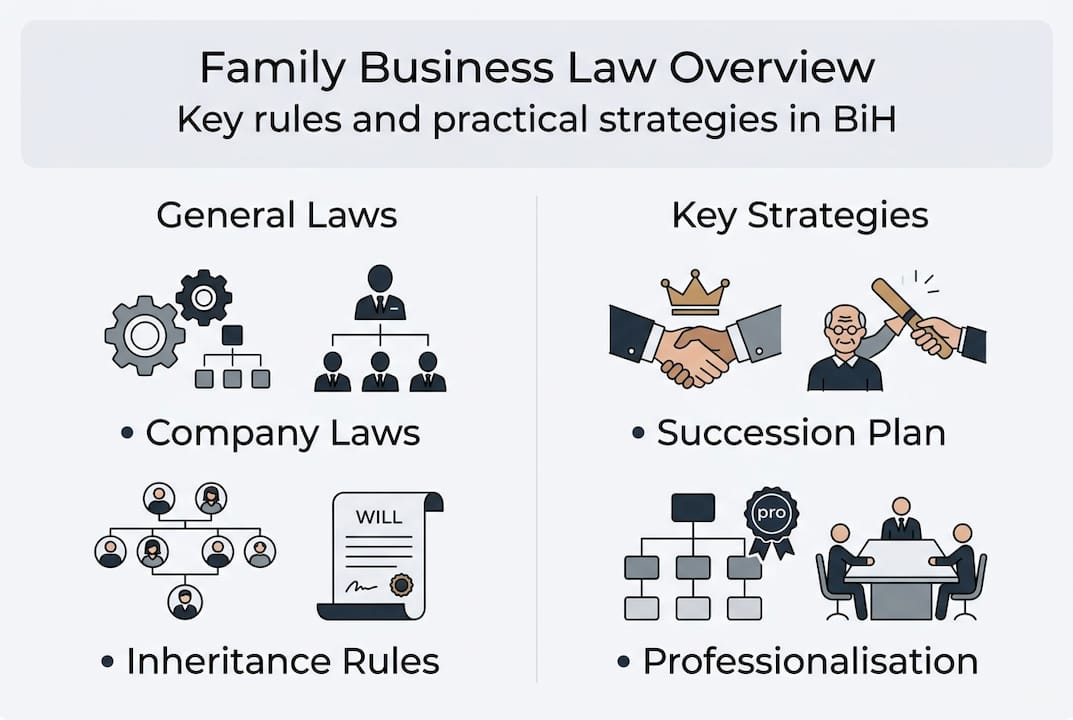
For business owners seeking an overview, the legal guide for Bosnia & Herzegovina outlines the foundational regulatory environment in detail. For those interested in how corporate governance structures interact with family ownership, a corporate law overview provides essential context.
Key statutes and rules relevant to family businesses in BiH include:
- Law on Companies (Federation BiH / Republika Srpska): Governs share ownership, director duties, and company structure.
- Law on Inheritance: Determines how assets pass on death, including forced heirship provisions.
- Law on Obligations: Covers contracts between family members, including gift agreements and business transfers.
- Tax legislation: Sets out capital gains, gift tax, and business transfer tax implications.
- Cantonal and entity-level regulations: Create additional layers of compliance obligation depending on where the business is registered.
The absence of a single family business statute does not reduce legal complexity. It increases it. Business owners who treat succession, governance, and ownership as informal matters expose themselves to disputes, tax liabilities, and potential loss of the business itself.
This is the starting point for any serious compliance or growth strategy. Understanding which laws apply and how they interact is not optional. It is foundational.
Key challenges facing family businesses
Now that the framework is clear, it is important to examine the practical challenges that BiH family business owners encounter most frequently. These are not hypothetical risks. They reflect recurring patterns observed across the private sector.
Family firms account for over 97% of private companies in BiH, yet only approximately 30% survive to the second generation. The primary reason is not market competition or economic instability. It is the absence of formal succession plans, documented governance structures, and clear ownership agreements. When a founder retires or passes away, the absence of documentation creates an immediate legal and operational vacuum.
Several specific challenges compound this structural problem:
- Founder dependency: Many BiH family firms are built entirely around a single individual's relationships, knowledge, and authority. When that person steps back, the business lacks the institutional memory to function independently.
- Sibling rivalry and inheritance disputes: Without a clear ownership agreement or will, multiple heirs may claim equal rights to management and profit distribution, creating paralysis or litigation.
- Forced inheritance conflicts: BiH inheritance law grants mandatory shares to children and spouses, which can result in unwilling or unqualified individuals becoming shareholders by operation of law.
- Absence of prenuptial agreements: A divorce involving a family business owner can directly affect business ownership if shares are treated as marital property.
- Third-party sale risks: In the absence of a right-of-first-refusal clause in the company's founding act, shares can be transferred to outside parties without the family's consent.
Edge cases such as founder dependency, sibling rivalry, forced inheritance, lack of prenuptial agreements, and third-party sales represent the most common triggers for business instability in family-controlled firms across comparable jurisdictions. BiH is not an exception.
| Generation | Global survival rate | Estimated BiH rate |
|---|---|---|
| Second generation | ~30% | ~30% |
| Third generation | ~12% | Below 12% |
| Fourth generation and beyond | ~3% | Estimated lower |
The multi-entity system in BiH adds a regulatory layer absent in most EU jurisdictions. A business registered in the Federation BiH operates under different cantonal rules than one registered in Republika Srpska. Owners with operations across both entities face doubled compliance obligations, separate tax considerations, and potentially different inheritance procedures.

Pro Tip: Begin succession planning at least five to ten years before any anticipated ownership transfer. Involve both legal and financial professionals from the outset. The cost of planning is a fraction of the cost of resolving a succession dispute after the fact.
Accessing proactive legal advice at an early stage is consistently the most cost-effective approach to managing these risks.
Succession planning and professionalisation strategies
Given these challenges, the question becomes practical: how can family businesses in BiH secure their future? Succession planning is not a single document. It is a coordinated legal and operational process.
BiH inheritance law establishes forced heirship rules under which children and spouses receive mandatory shares, typically equal to half of what they would receive under intestate succession. This means that a business owner cannot simply will the entire business to one preferred heir. Any plan that ignores forced heirship is legally vulnerable from the start.
Effective succession planning involves several interconnected steps:
- Business valuation: Obtain a formal, documented valuation of the business before any transfer discussion. This establishes a credible baseline for negotiations among family members, tax authorities, and potential external buyers.
- Identify and assess heirs: Evaluate whether family members have the competence, interest, and temperament to lead the business. This assessment should be honest and documented.
- Draft a family constitution: This is a governance document setting out agreed rules for ownership, management roles, dispute resolution, and succession. It is not legally binding in the same way as a contract, but it provides a reference point that courts and mediators can consider.
- Formalise agreements: Back the family constitution with legally binding instruments including updated founding acts, shareholder agreements, gift contracts, or testamentary dispositions as appropriate.
- Consider professionalisation: If heirs are not suitable for management roles, appoint professional managers while retaining family ownership. This separates ownership from management, which is often the most stable long-term structure.
Succession planning in BiH involves business valuation, professionalising management, establishing family constitutions, and considering an outright sale if heirs lack the interest or competence to continue the business.
| Transfer method | Advantages | Risks |
|---|---|---|
| Gift to family member | Maintains family control; possible tax advantages | Forced heirship claims; potential for disputes |
| Sale to family member | Clear valuation; legal certainty | Financing requirements; family tension over price |
| Sale to third party | Full market value; clean exit | Loss of family legacy; staff and client disruption |
| Testamentary transfer | Owner retains control during lifetime | Forced heirship limitations; probate delays |
Professionalising management does not mean surrendering family values or legacy. It means equipping the business with the leadership capacity it needs to survive beyond its founding generation.
Reviewing the regulatory compliance checklist and understanding corporate law for leaders are practical starting points for business owners who are beginning this process.
Pro Tip: When drafting a family constitution, engage a legal adviser to ensure that the governance provisions are consistent with existing company documentation and do not inadvertently conflict with founding act provisions or shareholder rights under applicable law.
Legal compliance and growth strategies for family businesses
Once a solid foundation is established through succession planning and proper governance, the focus can shift to compliance and growth. These two objectives are not in tension. A well-structured family business is typically better positioned for growth precisely because its legal house is in order.
Several strategies are particularly relevant for family businesses in BiH:
- Restructuring for asset protection: Separating operating assets from property assets through distinct legal entities reduces exposure to business liabilities. For example, holding real estate in a separate company protects it from creditors of the operating business.
- Diversification: Family businesses concentrated in a single sector or geography face concentrated risk. Legal structuring can facilitate controlled diversification without diluting family ownership or triggering adverse tax events.
- Internationalisation: BiH businesses expanding into EU markets must navigate additional regulatory requirements. Proper legal structuring from the outset avoids costly restructuring later.
- External management: Introducing professional managers, even in advisory or interim roles, often improves governance quality and signals creditworthiness to lenders and investors.
Using a family constitution for values and rules, assessing heir competence honestly, implementing gradual handover to professional management, and conducting thorough business valuation are all recognised best practices. BiH's multi-entity system adds complexity to each of these steps, but it does not make them impossible.
Business valuation, diversification, internationalisation, external management, and leveraging available tax exemptions are consistently identified as the key drivers of compliance and growth for BiH family businesses.
Key compliance steps and common pitfalls worth tracking:
| Compliance step | Common pitfall |
|---|---|
| Update founding act to reflect ownership | Delayed updates create ownership ambiguity |
| Register ownership changes formally | Informal transfers are unenforceable |
| Document all family loans and transfers | Undocumented transactions attract tax scrutiny |
| File succession-related documents on time | Late filings result in penalties and disputes |
| Check cantonal-specific requirements | Assuming uniform rules leads to non-compliance |
Pro Tip: Always verify whether the business's founding act contains provisions that conflict with a planned succession or restructuring. Founders frequently overlook outdated provisions that restrict share transfers or require unanimous shareholder approval for major decisions.
Guidance on doing business in Bosnia and practical legal guidance for growth are available for those ready to act on these strategies.
Why 'family business law' in Bosnia and Herzegovina requires creative compliance
The most important insight missing from most discussions of family business law in BiH is this: the absence of a dedicated statute is not simply an inconvenience. It is a structural condition that demands a different approach entirely.
Post-war BiH firms are maturing, and the demand for specialised legal advice is rising precisely because general laws were never designed to address the nuanced dynamics of family-controlled businesses. Owners who look for a single legal solution typically find themselves exposed. The law, as currently structured, rewards those who take a creative, integrated compliance approach.
BiH business owners should prioritise succession planning with lawyers and accountants, formalise arrangements through contracts and wills, and professionalise management structures to meet compliance expectations. This is not generic advice. In the BiH context, it reflects a genuine operational necessity.
The firms that survive across generations in this market are those whose owners treat legal compliance as a proactive investment rather than a reactive obligation. Engaging proactive legal advice well before a succession event or dispute arises is consistently the most reliable distinguishing factor between businesses that endure and those that do not.
Next steps: Expert legal advice for family businesses in Bosnia and Herzegovina
Family businesses in Bosnia and Herzegovina face a uniquely complex regulatory environment, and the stakes of getting it wrong are high. Ownership disputes, succession failures, and compliance gaps are all preventable with the right legal support in place.
Vucic.legal provides strategic legal guidance tailored precisely to these challenges. Whether the priority is succession planning, governance structuring, regulatory compliance, or cross-border growth, the firm's team offers practical, discrete, and expert advice aligned with business realities in BiH and beyond. Explore the full range of legal services for businesses or review detailed corporate law guidance to understand which services best address your specific situation. Early engagement consistently produces better outcomes than reactive legal management.
Frequently asked questions
Is there a dedicated family business law in Bosnia and Herzegovina?
No dedicated statute covering family businesses exists in BiH; instead, firms are governed by general company, inheritance, and tax laws applied together.
What are forced heirship rules in Bosnia and Herzegovina?
Forced heirship rules grant children and spouses mandatory shares, typically half of the intestate share, which cannot be overridden by will or contractual arrangement.
How can family businesses improve survival rates across generations?
Early succession planning, formal business valuation, professionalised management, and documented legal structures are the most reliable factors in improving generational survival rates.
Do cantons and entities within Bosnia and Herzegovina have different rules?
Yes. BiH's multi-entity system creates cantonal and entity-level variations in inheritance procedures and business regulations, so owners must verify requirements in each relevant jurisdiction.
Should outside managers be considered for family businesses?
Professional managers bring expertise and governance stability and are strongly advisable where heirs lack the interest, experience, or competence needed to lead the business effectively.