
TL;DR:
- Family law in Bosnia and Herzegovina can threaten business ownership during divorce, succession, or disputes.
- Effective legal strategies like prenuptial agreements, corporate restructuring, and succession planning protect business interests.
- Proactive legal planning and ongoing governance are essential for business continuity and minimizing family law risks.
Family law is frequently misunderstood as a purely personal domain, concerned only with marriages, divorces, and child arrangements. For entrepreneurs in Bosnia and Herzegovina, this misconception carries real financial risk. When a business is built during a marriage, its ownership, valuation, and continuity become directly exposed to family law proceedings. Divorce, succession disputes, and inadequate governance can disrupt operations, transfer ownership to unintended parties, or trigger costly litigation. This guide clarifies the intersections between family law and business ownership, identifies where entrepreneurs are most vulnerable, and presents the legal strategies available to safeguard both personal and business interests.
Table of Contents
- Understanding family law for entrepreneurs in Bosnia and Herzegovina
- Key family law risks facing business owners
- Legal protections and strategies: Shielding your business
- Family business succession and governance
- Why most entrepreneurs underestimate family law risks
- Professional legal help for business and family law challenges
- Frequently asked questions
Key Takeaways
| Point | Details |
|---|---|
| Family law impacts business | Family law in Bosnia and Herzegovina can directly affect your business assets and ownership if not carefully managed. |
| Be proactive with legal structures | Early planning using prenups, trusts, and sound governance can safeguard your interests when family disputes arise. |
| Professional advice is critical | Consulting a legal professional early can help anticipate and avoid major business risks from family law issues. |
| Succession planning prevents conflicts | Clear, timely succession and governance plans reduce the risk of disputes undermining your family business. |
Understanding family law for entrepreneurs in Bosnia and Herzegovina
Family law in Bosnia and Herzegovina governs the legal relationships between spouses, domestic partners, and family members. For entrepreneurs, its relevance extends well beyond the personal sphere. The moment a business is established or grows during a marriage, it can become subject to marital property rules, which may expose ownership stakes, business assets, or accumulated profits to division upon divorce.
Most entrepreneurs build their companies with full attention on commercial growth and none on personal legal exposure. This is understandable. Running a business demands focus. However, neglecting the legal interface between personal and business life creates vulnerabilities that can materialise quickly in the event of a family dispute.
The primary intersections that affect entrepreneurs include:
- Marriage and joint asset accumulation: Business interests established or expanded during a marriage may be classified as joint marital property under Bosnian family law.
- Divorce proceedings: Courts may assess business valuation and award a share to the non-entrepreneur spouse, disrupting ownership structure and, in some cases, operational control.
- Succession and inheritance: Without a clearly documented succession plan, disputes among heirs can freeze company decisions, delay transfers of ownership, and create prolonged litigation.
- Asset division ambiguity: When the boundary between personal finances and business finances is blurred, the risk of courts treating business assets as marital property increases significantly.
"The line between personal wealth and business value is often invisible to courts unless entrepreneurs actively work to establish it through legal structures."
A common misconception among entrepreneurs is that registering a company as a separate legal entity automatically insulates it from family law claims. This is not accurate. Courts in Bosnia and Herzegovina can still examine the economic contribution of a spouse, assess the growth in business value during the marriage, and award compensation accordingly. Understanding real estate law for startups is equally relevant, as business-owned property can also be drawn into family law disputes.
Another frequent oversight is failing to review employment law for startups when a spouse is also employed within the business. In such arrangements, a divorce could trigger overlapping family and employment claims simultaneously, creating compounded legal exposure.
Entrepreneurs who use a startup legal checklist when launching their businesses often overlook family law considerations entirely. That gap is one of the most common sources of legal vulnerability. According to family business survival data, protection strategies including prenuptial agreements, corporate restructuring, and early succession planning are among the most effective tools available to business owners in BiH.
Now that we have established the relevance of family law for entrepreneurs, let us clarify the key threats to business assets and continuity.
Key family law risks facing business owners
Entrepreneurs in Bosnia and Herzegovina face several distinct family law risks that, if unaddressed, can jeopardise business continuity. Understanding each risk category allows for more targeted and effective protection.

1. Divorce settlements targeting business shares
When a couple divorces, courts divide marital property. A business that grew substantially during the marriage is frequently considered a joint asset, even if only one spouse operated it. The court may order a buyout of the non-entrepreneur spouse's share, which in practice means the business owner must either raise significant capital or transfer part of their ownership. For smaller businesses without liquid reserves, this can be operationally catastrophic. Consulting resources on post-divorce business challenges illustrates how severe the operational disruption can be even after a settlement is reached.
2. Succession disputes and continuity risk
Family-run companies face heightened exposure when a founder passes away or becomes incapacitated without a clear succession plan in place. Disputes among heirs, particularly when multiple family members hold or claim an interest in the business, can paralyse decision-making, block access to accounts, and force judicial intervention. The risk is especially pronounced in Bosnia and Herzegovina, where many small and medium enterprises are founder-led and operate with informal governance arrangements.
3. Family disputes triggering instability
Even without a divorce, estrangement between family members who are co-owners or employees can generate disputes that affect daily operations. A co-owner spouse who withdraws cooperation, blocks access to shared accounts, or initiates legal proceedings creates operational disruption that extends well beyond the personal relationship.
4. Common failure points
The most frequent vulnerabilities identified in Bosnian family business cases include:
- No prenuptial or postnuptial agreement to define the separation between personal and business assets.
- Unclear ownership documentation, particularly in cases where a spouse contributed capital informally.
- Poor corporate governance, meaning no shareholders' agreement, no documented roles, and no defined succession process.
- Mixing personal and business finances, which weakens arguments that the business is a separate economic entity.
- Delayed legal advice, which limits available options once proceedings have commenced.
Pro Tip: The earlier a governance framework and personal asset boundary are established, the more defensible the business structure becomes in any legal proceeding.
Effective legal dispute management for companies depends heavily on how well-structured the business is before a dispute arises. Companies that have invested in clear documentation and formal governance are far better positioned to withstand family law challenges. Similarly, broader legal risks for scaling companies frequently include underestimated family law exposure, particularly as businesses grow in value and become more attractive targets in divorce proceedings.
Understanding these risks leads us to ask: what practical protections do entrepreneurs have at their disposal?
Legal protections and strategies: Shielding your business
Several legal mechanisms are available to entrepreneurs in Bosnia and Herzegovina seeking to separate personal family matters from business interests. Each carries distinct advantages and limitations within the local legal context.
| Protection mechanism | Applicability in BiH | Key strength | Key limitation |
|---|---|---|---|
| Prenuptial agreement | Possible, less common | Clearly defines asset separation | Cultural resistance; requires mutual agreement before marriage |
| Postnuptial agreement | Possible | Addresses existing asset exposure | Can be contested if perceived as unfair |
| Corporate restructuring | Highly applicable | Separates personal and business assets structurally | Requires careful execution to withstand scrutiny |
| Shareholders' agreement | Highly applicable | Controls ownership transfer and governance | Must be maintained and updated regularly |
| Trust structures | Limited in BiH context | Strong asset protection | Not widely recognised in local law; complex to establish |
| Succession planning | Essential | Ensures business continuity | Requires professional and family consensus |
According to family business protection strategies, tools including prenuptial agreements, corporate restructuring, asset protection planning, trusts, and early succession and governance planning are among the most effective mechanisms for shielding a business from divorce claims in Bosnia and Herzegovina.
Key protective measures in practice:
- Clear ownership documentation: Every ownership stake should be formally registered, with roles and contributions clearly recorded. Ambiguity is a liability.
- Shareholders' agreement: This document can include provisions that restrict the transfer of shares to non-owners in the event of divorce, creating a contractual buffer against forced ownership changes.
- Corporate restructuring: Placing a business within a holding company structure, or ensuring the operating company is legally distinct from personal assets, creates a meaningful boundary that courts must acknowledge.
- Early legal advice: Engaging qualified legal counsel before a family dispute arises is far more effective than responding to a claim that has already been filed.
Pro Tip: A shareholders' agreement that includes a right of first refusal clause can prevent court-ordered ownership transfers to a divorcing spouse by allowing existing shareholders to purchase the disputed shares first.
The value of corporate structure for protection cannot be overstated. Entrepreneurs who have invested in formalising their business structure enjoy far greater legal resilience. It is equally important to consider business confidentiality when handling sensitive ownership and financial information during family law proceedings. The full range of strategic legal services available to Bosnian entrepreneurs reflects how integrated these issues are across corporate and family law disciplines.
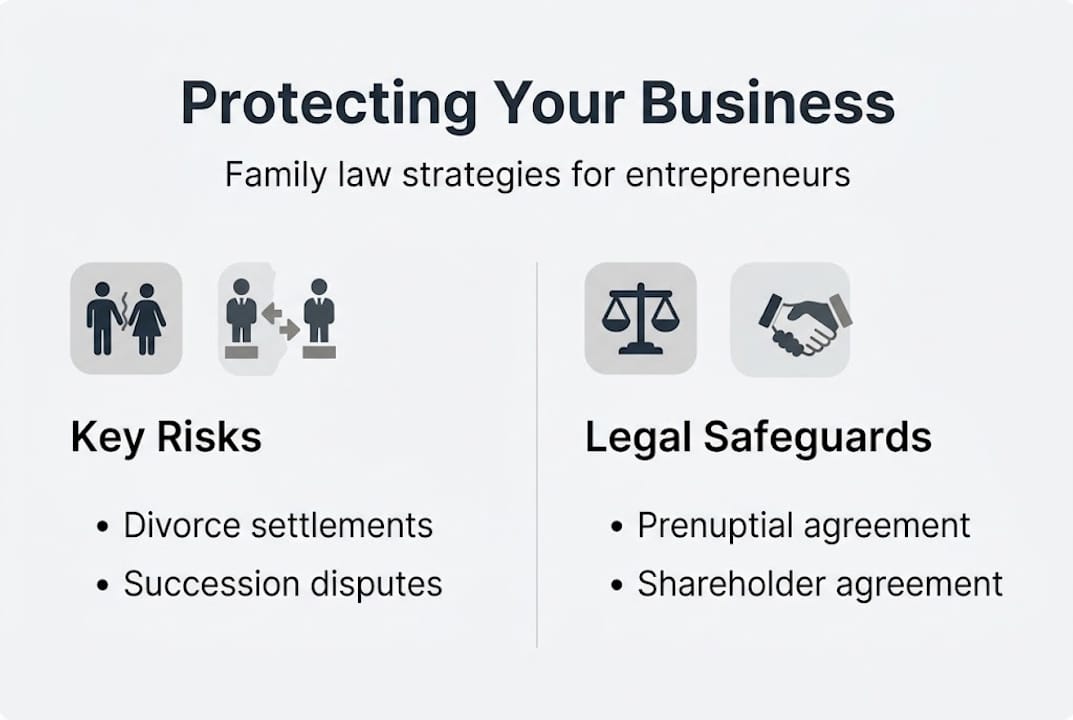
With these strategies in mind, it is vital for entrepreneurs to take action early, especially regarding succession planning.
Family business succession and governance
Succession planning is one of the most critical and most frequently neglected aspects of managing a family business. It sits at the precise intersection of family law and corporate governance, and failures at this intersection have ended businesses that were otherwise commercially successful.
Strong governance structures reduce the probability of disputes arising in the first place. When roles, responsibilities, ownership rights, and succession pathways are formally documented, there is far less room for competing interpretations among family members or heirs.
| Succession planning stage | Key action | Common mistake to avoid |
|---|---|---|
| Early planning | Define ownership roles and succession criteria | Assuming family consensus without documentation |
| Legal structuring | Draft shareholders' agreement and succession clauses | Using informal or verbal agreements |
| Governance implementation | Establish a board or advisory body | Concentrating all decisions with the founder |
| Transition execution | Formalise ownership transfer through legal instruments | Delaying transfer until a crisis forces it |
| Post-transition review | Update governance documents and legal registrations | Failing to amend documents to reflect new ownership |
A step-by-step approach to succession planning for family businesses in Bosnia and Herzegovina includes:
- Assess the current ownership structure. Identify all parties with a legal or informal claim to ownership and document their status.
- Establish a clear governance framework. This should include formal roles, a defined decision-making process, and accountability mechanisms that function independently of family relationships.
- Draft a succession plan. Specify who will assume leadership, how ownership will transfer, and what conditions must be met. This plan should be reviewed by qualified legal counsel.
- Integrate the succession plan with legal instruments. Update the shareholders' agreement, the company articles, and any relevant personal legal documents such as wills.
- Communicate the plan to all relevant parties. Ambiguity about succession generates disputes. Clarity, even when conversations are difficult, prevents litigation.
- Review the plan regularly. Business circumstances and family situations change. The succession plan should reflect current realities, not assumptions made years earlier.
According to family business survival practices in BiH, early governance structures and formalised succession planning are among the most reliable protections available to family-owned companies facing family law risks. Professional legal advice is central to executing these steps effectively.
Entrepreneurs seeking to understand corporate law for leaders will find that succession and governance sit firmly within the corporate law domain, even when the underlying trigger is a family dispute. The broader corporate law expertise available through specialist advisers provides essential support for navigating these overlapping legal areas.
By implementing these processes, entrepreneurs gain clarity and strength. Let us now review a broader perspective on why so many business owners still fall short in this area.
Why most entrepreneurs underestimate family law risks
The most common and costly error is not the absence of knowledge. It is the assumption that legal structures, once created, continue to offer protection without maintenance. A shareholders' agreement drafted in 2015 may not account for business growth, changed ownership, or new family circumstances in 2026. Structures that are not regularly reviewed lose their protective value.
There is also a cultural dimension in Bosnia and Herzegovina that cannot be ignored. Prenuptial agreements carry social stigma, and many entrepreneurs avoid them to preserve family harmony. However, this reluctance creates measurable legal exposure. Family business resilience data consistently shows that businesses with proactive protective structures fare significantly better in family law disputes.
The critical lesson is that proactive legal planning is not a luxury reserved for large corporations. It is a baseline requirement for any entrepreneur who has built meaningful value in a business and wishes to protect it. Reviewing Franjo Vucic's legal insights provides further guidance on how strategic legal planning intersects with business protection in the Bosnian context. Entrepreneurs who treat legal structuring as an ongoing business priority, rather than a one-time administrative task, are the ones who maintain control when personal circumstances change.
Professional legal help for business and family law challenges
Protecting a business from family law exposure requires expert, context-specific legal guidance. Generic advice rarely accounts for the unique complexities of Bosnian family and corporate law operating simultaneously.

Vucic.legal provides tailored legal support for entrepreneurs navigating these challenges in Bosnia and Herzegovina. From reviewing ownership structures and drafting shareholders' agreements to advising on succession planning and asset protection, the firm offers practical solutions grounded in local legal reality. Whether you are establishing protections before a dispute arises or responding to an active family law claim, timely professional advice makes a material difference. Explore the full range of business legal services or consult with a specialist corporate law adviser to understand your current exposure and available options.
Frequently asked questions
Can a business be divided in a divorce in Bosnia and Herzegovina?
Yes, a business can be considered marital property and may be subject to division in divorce settlements if it was acquired or grew during the marriage. Courts may assess business value and award a proportional share to the non-entrepreneur spouse, as noted in BiH family business protection guidance.
Are prenuptial agreements common and effective for entrepreneurs in BiH?
Prenuptial agreements are less common in BiH due to cultural attitudes, but when properly executed, they represent one of the clearest ways to protect business assets from division during divorce proceedings.
What is the first step an entrepreneur should take to protect their business from family law disputes?
The first step is to seek qualified legal advice to evaluate current personal and business exposure, then implement appropriate protective legal structures before a dispute arises, in line with established protection strategies.
Can family law disputes delay or endanger business succession in family firms?
Yes, unresolved family law disputes can significantly disrupt succession planning by freezing ownership transfers and generating prolonged litigation, a risk well-documented in family business survival research in BiH.