
TL;DR:
- Bosnia's fragmented legal system across three jurisdictions creates complex compliance requirements for foreign companies.
- Successful market entry depends on thorough preparation, local relationships, and understanding multi-level approval processes.
- Ongoing compliance involves navigating diverse tax, legal, and regulatory obligations across different entities.
Bosnia and Herzegovina presents genuine commercial opportunity for growth-oriented companies, particularly those targeting emerging European markets. Yet the country's fragmented regulatory structure across three distinct jurisdictions creates a compliance environment that can stall even well-resourced organisations. Missteps in registration, tax obligations, or sector-specific ownership rules carry real consequences: delayed operations, financial penalties, and reputational risk. This guide provides a structured, practical roadmap covering legal context, entry prerequisites, incorporation steps, and ongoing compliance strategies designed to support confident decision-making for international business leaders.
Table of Contents
- Understanding Bosnia's legal landscape: What you need to know
- Preparing for market entry: Prerequisites and checkpoints
- Registering and incorporating your business: Step-by-step process
- Ensuring compliance and long-term operation
- A practical perspective: Why context and relationships matter most in Bosnia
- Get expert help with Bosnian business law
- Frequently asked questions
Key Takeaways
| Point | Details |
|---|---|
| Understand regulatory fragmentation | Bosnia and Herzegovina has three legal systems and complex approval processes to navigate. |
| Prepare required documents early | Advance preparation on ownership, sanctions, and compliance speeds entry and avoids delays. |
| Allow ample registration time | Full company registration can take several weeks or even months depending on the region. |
| Stay vigilant post-launch | Ongoing compliance and informed local relationships are vital for long-term success. |
Understanding Bosnia's legal landscape: What you need to know
The single most important factor shaping any market entry into Bosnia and Herzegovina is the country's administrative fragmentation. Unlike most European jurisdictions where a single national framework governs business registration and compliance, BiH operates through three largely autonomous legal and regulatory authorities. Understanding this structure is not optional; it is the prerequisite for every subsequent step.
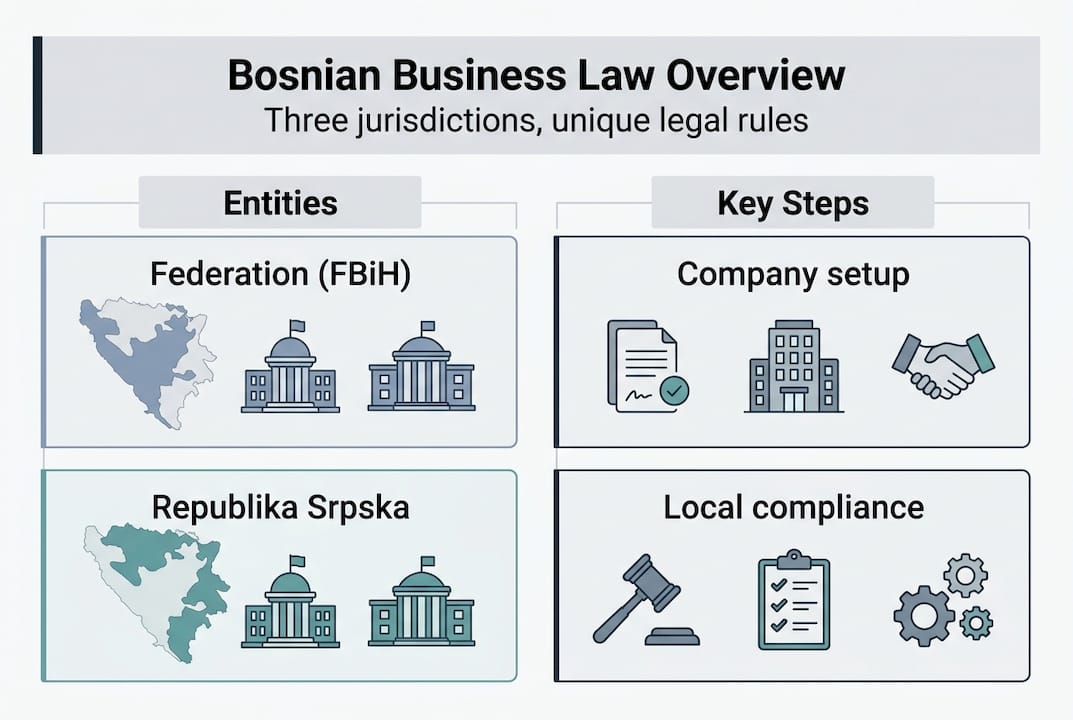
The three jurisdictions are the Federation of Bosnia and Herzegovina (FBiH), Republika Srpska (RS), and the Brčko District. Each maintains its own court system, company registration authority, tax administration, and body of commercial law. A business incorporated in FBiH cannot simply extend its operations into RS without satisfying separate registration and compliance requirements there. This creates a layered compliance burden that has no real equivalent in most Western European markets.
The investment climate in BiH reflects this complexity directly, with separate business registration, tax, and compliance rules in each entity complicating market entry for foreign investors. For companies accustomed to operating under unified national frameworks, the adjustment in approach and planning is substantial.
A useful legal guide for Bosnia will address not just national-level obligations but the specific requirements of the sub-entity in which operations are planned. The practical business steps in Bosnia differ materially depending on whether a company is registering in Sarajevo, Banja Luka, or Brčko.
Key differences across jurisdictions
| Jurisdiction | Registration authority | Tax body | Notable characteristic |
|---|---|---|---|
| Federation of BiH | FBiH courts/registration offices | FBiH Tax Administration | Cantonally divided; ten cantons with varying local rules |
| Republika Srpska | RS Agency for Intermediary, IT, and Financial Services (APIF) | RS Tax Administration | More centralised structure; single registration process |
| Brčko District | Brčko District Government | Brčko District Tax Administration | Separate self-governing district; distinct rules apply |
Beyond the structural fragmentation, international business leaders should be aware of several recurring operational challenges:
- Multi-level approvals: Even routine business decisions may require sign-off from cantonal, entity, and state-level authorities simultaneously.
- Political instability: Governance disputes between BiH's political blocs periodically slow legislative progress and regulatory updates.
- Bureaucratic delays: Administrative bottlenecks are common, particularly in permit processing and licence renewals.
- Inconsistent enforcement: Regulatory interpretation can vary between municipalities, even within the same entity.
Companies that attempt to navigate these conditions without local legal expertise frequently encounter preventable delays. The Bosnia startup compliance checklist provides a practical starting point for identifying which obligations apply at each administrative level.
Understanding where your business will primarily operate and which entity's laws govern your core activities is the single most decisive early choice a market entrant can make. It shapes everything from your corporate structure to your tax planning approach.
Preparing for market entry: Prerequisites and checkpoints
After clarifying the fragmented legal context, the next step is to ensure you meet all entry prerequisites. Preparation here is not merely administrative; it is strategic. Companies that invest in thorough pre-entry due diligence consistently experience smoother registration processes and fewer compliance surprises during operation.

The first decision concerns entry structure. Foreign companies typically choose between three options: a wholly owned subsidiary, a branch office, or a representative office. Each carries different liability profiles, tax implications, and operational permissions. A subsidiary is a separate legal entity, offering the strongest liability protection. A branch office operates as an extension of the parent company, meaning the parent retains direct liability. A representative office is the most limited structure, generally restricted to promotional or liaison activities without the ability to generate revenue.
Comparison of entry structures
| Structure | Legal personality | Parent liability | Revenue-generating | Best suited for |
|---|---|---|---|---|
| Subsidiary | Yes | Limited | Yes | Full commercial operations |
| Branch office | No | Direct | Yes | Defined project work |
| Representative office | No | Direct | No | Market research, liaison |
Once the structure is selected, several preparatory steps follow. A numbered approach helps ensure nothing is overlooked:
- Document preparation: Gather apostilled certificates of incorporation, shareholder registers, director identification, and notarised translations into the relevant local language (Bosnian, Croatian, or Serbian).
- Sanctions and AML screening: Verify that all beneficial owners, directors, and counterparties are clear of EU, US, and UN sanctions lists. This is a non-negotiable compliance obligation.
- Property and title review: If premises are being acquired or leased, conduct a thorough review of the land registry. Fragmented land registries are a documented challenge, and title defects are not uncommon.
- Sector-specific ownership checks: Foreign investors receive national treatment, with 100% ownership permitted in most sectors. However, defence and media are restricted to a maximum 49% foreign ownership. Technology, manufacturing, and services remain fully open.
- FIPA engagement: The Foreign Investment Promotion Agency of Bosnia and Herzegovina (FIPA) offers free support to incoming investors, including access to a database of investment projects and sector-specific incentives. Engaging FIPA early can materially reduce the time spent identifying relevant approvals.
- Incentive identification: Available incentives include customs exemptions on imported equipment and a 30% corporate income tax (CIT) reduction for companies reinvesting more than 50% of profits. These can significantly improve the financial case for market entry.
Understanding the essentials of corporate law at this stage helps leaders ask the right questions of local advisers. The regulatory checklist for Bosnia in 2026 is a useful reference for confirming that preparation covers all mandatory bases.
Pro Tip: Engage a local legal adviser before submitting any documentation. Requirements for notarisation, apostille, and translation can differ between cantons and entities. Submitting incorrect or incomplete documents resets the process clock entirely.
Registering and incorporating your business: Step-by-step process
Once prepared, you can move confidently into the actual business registration and incorporation phase. This is where thorough preparation pays off directly. Incomplete documentation is the leading cause of registration delays, and in Bosnia's fragmented system, delays compound quickly.
The general registration process follows a sequential structure, though the precise sequence and responsible authorities vary by jurisdiction:
- Draft and notarise founding documents: The articles of association and founding decision must be prepared in accordance with local company law and notarised before a certified notary in the relevant jurisdiction.
- Submit to the competent court or registration authority: In FBiH, this is typically the cantonal court with jurisdiction over the company's registered address. In RS, APIF handles registration centrally, which generally makes the process more predictable.
- Obtain a court registration decision: The registration authority reviews the application and issues a formal decision confirming the company's legal existence. This step is where delays most commonly occur.
- Register for tax identification: Following court registration, the company must register with the relevant entity tax administration to obtain a tax identification number (TIN). This is a separate process and cannot proceed without the court decision.
- Register with the statistics authority: A statistical classification number (JIB) is required for all legal entities and is obtained from the Federal Institute of Statistics or the RS Institute of Statistics, as applicable.
- Customs and indirect tax registration: Companies engaged in the import, export, or sale of goods liable to VAT must register with the Indirect Taxation Authority (ITA) of BiH, which is the single state-level body responsible for VAT and customs.
"Registration timelines in Bosnia and Herzegovina can range from 37 to 81 days, depending on jurisdiction and the completeness of documentation submitted. Delays are most common at the court registration stage."
The variance in that timeframe is significant from a planning perspective. A company entering RS through APIF and submitting a complete application may complete registration closer to the lower end of the range. A company navigating cantonal courts in FBiH, particularly in busier jurisdictions such as Sarajevo, should plan conservatively.
The startup checklist for Bosnia provides a granular breakdown of required documents by entity type. For companies acquiring or leasing premises as part of registration, it is equally important to navigate property risks carefully before committing to a registered address.
Pro Tip: Appoint a local legal representative with a verified address in the relevant jurisdiction before beginning registration. This person will receive official correspondence on your company's behalf and can flag issues before they escalate into formal rejections.
Ensuring compliance and long-term operation
With your business incorporated, the next priority is staying compliant and managing ongoing risks. Registration is a milestone, not a conclusion. Bosnia's regulatory environment evolves, and the challenges that exist at entry do not disappear once operations begin.
The ongoing compliance obligations for businesses in BiH include:
- Annual financial reporting: Companies must submit audited or unaudited financial statements to the relevant entity authority, depending on size and legal form.
- Corporate income tax returns: CIT returns are filed annually with the entity tax administration. Tax rates differ slightly between FBiH and RS, and deductions available in one entity may not apply in the other.
- VAT reporting: Businesses registered for VAT with the ITA must submit periodic VAT returns, typically monthly or quarterly depending on turnover thresholds.
- Labour law compliance: Employment contracts, social contributions, and payroll obligations are governed at entity level. FBiH and RS labour laws differ in areas such as termination rights, notice periods, and collective bargaining obligations.
- Regulatory licence renewals: Sector-specific licences and permits often carry renewal obligations on annual or multi-year cycles.
Beyond routine reporting, companies must maintain active awareness of the risk environment. The investment climate in BiH highlights key challenges including corruption, a weak judiciary, property rights disputes, fragmented land registries, and multi-level approvals as factors that continue to suppress foreign direct investment levels. These are not abstract concerns; they manifest in day-to-day operational decisions.
Best practice for long-term compliance in Bosnia includes:
- Scheduling an annual legal compliance audit with a local legal adviser covering tax, employment, regulatory licences, and corporate governance.
- Maintaining a direct relationship with FIPA to receive updates on regulatory changes and new investment support programmes.
- Monitoring property rights issues actively, particularly if the business holds or leases real estate.
- Establishing a clear dispute resolution framework before disputes arise. The Bosnian judiciary is slow and unpredictable; arbitration clauses in commercial contracts are strongly advisable.
Understanding why legal guidance matters for business growth is directly relevant here. Compliance failures in BiH carry both financial penalties and reputational consequences that are disproportionately difficult to resolve in a fragmented legal system. Equally, having a strategy in place to manage legal disputes before they escalate is one of the most valuable investments a foreign business can make.
Pro Tip: Do not rely solely on national-level regulatory updates. Changes in cantonal law in FBiH or municipal ordinances can affect operating requirements without receiving widespread attention. A local legal partner with entity-level visibility is essential for timely awareness.
A practical perspective: Why context and relationships matter most in Bosnia
The legal frameworks in Bosnia and Herzegovina are documented, codified, and largely accessible. Yet experience shows that formal compliance alone rarely determines how quickly or effectively a foreign business establishes itself. Multi-level approvals and political instability create an environment where the interpretation and pace of official processes are heavily influenced by factors that are not visible in any legal text.
In practice, approvals move faster when the relevant authorities are familiar with the applicant or their local representative. Introductions to municipal officials, relationships with cantonal chambers of commerce, and credibility built through local partnerships all shape operational speed in ways that pure legal compliance cannot replicate. International leaders who invest only in documentation and not in these relationships consistently find themselves waiting longer than necessary for approvals that are technically straightforward.
This is not an argument for circumventing process; it is an argument for understanding it fully. The most effective market entry strategies in BiH combine precise formal compliance with genuine local engagement. That means selecting local partners and advisers not just for their technical knowledge but for their institutional relationships and contextual understanding of how each jurisdiction actually functions.
Political dynamics between the entities and at state level also affect the regulatory environment in ways that are difficult to anticipate from outside. Legislative reforms can stall for months or years due to inter-entity disagreements. Sector-specific regulatory updates may be adopted at different speeds in FBiH and RS. Companies with local advisers who understand legal guidance for growth in this context are far better positioned to adapt quickly when conditions shift.
Treating Bosnia as a standard European market entry will lead to repeated surprises. Treating it as a distinctive operating environment that rewards local knowledge and relationship investment is the more accurate and more effective approach.
Get expert help with Bosnian business law
Navigating Bosnia and Herzegovina's regulatory environment requires more than a checklist. It demands specialist knowledge across multiple jurisdictions, practical experience with registration and compliance processes, and the local insight to anticipate where difficulties will arise.
Vucic.legal provides strategic legal advisory services covering the full lifecycle of business entry and operation in BiH. From selecting the right corporate structure and guiding you through registration in FBiH, RS, or Brčko District, to ensuring ongoing compliance with tax, labour, and sector-specific regulations, the firm offers end-to-end support. Explore the corporate law guide for foundational context, review the full range of legal services for business, or learn more about the firm's cross-border legal expertise for international market entry.
Frequently asked questions
How long does business registration take in Bosnia?
Registration typically takes between 37 and 81 days, depending on the jurisdiction selected and the completeness of the documentation submitted at the outset.
Can foreign investors fully own Bosnian companies?
Yes. Foreign investors may hold 100% ownership in most sectors, with the exception of defence and media, where foreign ownership is capped at 49%.
What incentives are available for foreign businesses?
Available incentives include customs exemptions on imported equipment and a 30% corporate income tax reduction for companies that reinvest more than 50% of their annual profits.
What are the most common challenges for foreign businesses in Bosnia?
Corruption, a weak judiciary, and fragmented property registries are the most consistently reported challenges for foreign businesses, alongside complex multi-level approval processes.