
TL;DR:
- Founders often underestimate the legal complexity involved in SaaS procurement, including compliance with multiple overlapping frameworks like GDPR and the EU AI Act. A thorough legal review of SaaS contracts, data privacy obligations, and vendor risk is essential before deployment to avoid costly compliance failures. Engaging legal counsel early helps mitigate risks related to ownership, data rights, high-risk AI features, and ongoing vendor assessments.
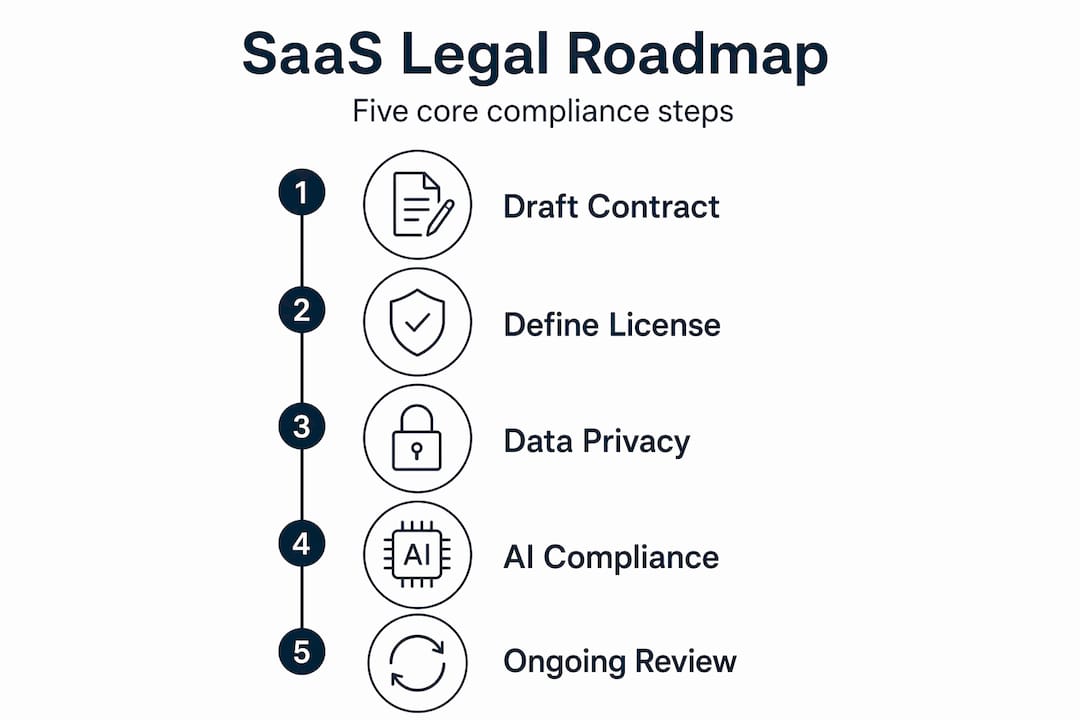
Founders adopting SaaS solutions frequently underestimate the legal complexity embedded in seemingly routine procurement decisions. The legal aspects of SaaS span multiple overlapping regulatory frameworks: GDPR, the EU AI Act, local data protection legislation in Bosnia and Herzegovina, and sector-specific rules such as HIPAA. Each framework carries its own enforcement mechanisms, and non-compliance can result in penalties that materially affect a company's financial position and market access. This guide addresses the contractual, data privacy, AI compliance, and vendor risk dimensions that decision-makers must understand before deploying any SaaS platform in an international context.
Table of Contents
- Key takeaways
- The legal aspects of SaaS agreements
- Data privacy in SaaS: GDPR, Bosnian law, and beyond
- AI components in SaaS: compliance obligations
- Vendor assessment and ongoing compliance
- Expert perspective: what founders consistently underestimate
- How Vucic supports SaaS compliance in Bosnia and Herzegovina
- FAQ
Key takeaways
| Point | Details |
|---|---|
| Contracts define risk allocation | SaaS agreements must explicitly address IP ownership, data use restrictions, and indemnification to protect the customer's position. |
| Data privacy obligations are layered | Founders must reconcile GDPR, Bosnian data protection law, and cross-border transfer mechanisms simultaneously, not sequentially. |
| AI components require early compliance design | Retrofitting AI compliance after deployment costs two to three times more than building it in from the outset. |
| Vendor due diligence is contractual, not optional | SOC 2 Type II certification, subprocessor disclosure, and breach notification terms must appear in the written agreement, not only in the vendor's marketing materials. |
| Legal involvement should precede deployment | Engaging legal counsel before signing a SaaS agreement prevents structural compliance failures that are expensive to unwind. |
The legal aspects of SaaS agreements
A SaaS agreement is not simply a subscription contract. It is a legally binding instrument that governs access to software, data handling rights, liability allocation, and service continuity. Understanding its core architecture is the starting point for any founder.
Ownership, licence scope, and data rights
SaaS vendors grant a licence to use their software, not ownership of it. This distinction matters because the terms governing that licence will determine what the customer can and cannot do with the platform, including whether data processed through it can be exported, deleted on request, or used by the vendor for product development. Customer data must remain the exclusive property of the customer, and agreements should expressly prohibit vendors from using that data to train AI models. Absent such a clause, silence in the contract will generally favour the vendor.
Core contractual clauses
The table below identifies the clauses that carry the greatest legal and commercial risk in software as a service contracts, and the negotiating position that customers should aim for.
| Clause | Vendor's default position | Customer's target position |
|---|---|---|
| Service level agreement | Best-efforts uptime language | Defined uptime percentage (e.g., 99.9%) with financial remedies for breach |
| Data ownership | Ambiguous or silent | Express customer ownership and prohibition on AI training use |
| Termination rights | Vendor-favourable notice periods | Mutual termination for cause, data export window post-termination |
| Indemnification | Limited to direct damages | Coverage of third-party IP claims, data breach costs, and regulatory fines |
| Limitation of liability | Capped at one month's fees | Cap tied to annual contract value or uncapped for data breaches |
| Intellectual property | All derivative works vest in vendor | Customer retains rights to any configurations, outputs, or integrations it develops |
Indemnification clauses are among the most heavily negotiated provisions in SaaS transactions. They transfer financial liability for third-party claims, including IP infringement and data breaches, from the customer to the supplier. Founders should treat a vendor's refusal to accept meaningful indemnification as a substantive risk indicator, not merely a commercial inconvenience.
Pro Tip: Request a redlined version of the vendor's standard terms before the first commercial discussion. A vendor's willingness to negotiate is itself a signal of their operational maturity.
Data privacy in SaaS: GDPR, Bosnian law, and beyond
Data privacy in SaaS is not a single compliance checkbox. For companies operating in or with Bosnia and Herzegovina, it requires reconciling GDPR obligations, the Bosnian Law on Personal Data Protection, and in some sectors, additional frameworks such as HIPAA.

Establishing the controller-processor relationship
The first analytical step is determining whether the SaaS vendor is a data processor or an independent data controller. In most cases, the vendor processes personal data on behalf of the customer, making the customer the data controller. This relationship must be formalised in a Data Processing Agreement (DPA), which is a mandatory requirement under GDPR Article 28. The DPA must specify the subject matter, duration, nature and purpose of the processing, the type of personal data involved, and the categories of data subjects.
The following obligations typically fall on the customer as data controller:
- Conducting a legitimate interest assessment or identifying another lawful basis for processing before deployment.
- Providing data subjects with a privacy notice that accurately reflects how the SaaS platform processes their data.
- Implementing mechanisms to honour data subject rights including access, rectification, erasure, and portability.
- Notifying the relevant supervisory authority within 72 hours of becoming aware of a personal data breach.
- Maintaining records of processing activities that cover the SaaS deployment.
- Conducting a Data Protection Impact Assessment where the processing is likely to result in high risk to individuals.
Privacy policies are not merely regulatory formalities. They function as auditable records of the organisation's data handling commitments, and regulators treat gaps between stated policy and actual practice as aggravating factors in enforcement.
Cross-border data transfers
Many SaaS vendors process data in the United States or other non-EEA jurisdictions. For companies subject to GDPR, this requires a valid transfer mechanism. Standard Contractual Clauses (SCCs) are currently the most reliable option. The EU-US Data Privacy Framework provides an alternative legal basis for transatlantic transfers, but its long-term stability is uncertain following the precedent set by the invalidation of its predecessors. Founders should document which transfer mechanism applies to each vendor and maintain contingency procedures in the event that mechanism is challenged or invalidated.
Pro Tip: Review the vendor's DPA and privacy policy in parallel with the main agreement. Inconsistencies between the two documents are a common source of compliance exposure that contract reviews alone miss.
| Data transfer mechanism | Current status | Practical risk level |
|---|---|---|
| Standard Contractual Clauses | Valid and widely used | Low, subject to supplementary measures |
| EU-US Data Privacy Framework | Valid as of mid-2026 | Medium, uncertain long-term durability |
| Binding Corporate Rules | Valid for intra-group transfers | Low but resource-intensive to implement |
| Adequacy decision (third countries) | Country-specific | Variable |
For more detail on GDPR enforcement exposure and board-level accountability in SaaS contexts, see Vucic's analysis of GDPR as a board responsibility.
AI components in SaaS: compliance obligations
Most SaaS platforms now incorporate AI features, whether predictive analytics, automated decision-making, or natural language interfaces. Each of these components may trigger obligations under the EU AI Act, which applies extraterritorially to systems that affect EU users regardless of where the vendor is incorporated.
The EU AI Act's high-risk classification, effective August 2026, imposes specific obligations on vendors and deployers of AI systems used in areas such as recruitment, credit assessment, critical infrastructure, and legal services. These obligations include:
- Implementing a documented risk management system covering the entire AI system lifecycle.
- Maintaining human oversight mechanisms that allow intervention or override of automated decisions.
- Conducting conformity assessments before placing high-risk systems on the market.
- Keeping technical documentation and audit logs that demonstrate ongoing compliance.
- Establishing bias testing protocols and incident response procedures for AI-related failures.
The financial consequences of non-compliance are material. GDPR-related fines for AI failures have reached €345 million, and HIPAA violations in AI-adjacent healthcare SaaS contexts carry penalties of up to $1.5 million per incident. These figures make AI compliance architecture a boardroom priority, not a technical afterthought.
Founders should understand that compliance cannot be retrofitted cheaply. Building compliance from day one through design patterns such as append-only decision logs, model version pinning, and explainability modules is two to three times less costly than addressing deficiencies after deployment. For additional context on scaling AI-enabled SaaS within a compliant legal architecture, Vucic has published practical guidance on legal risks when scaling technology companies.
Pro Tip: Ask every SaaS vendor with AI features to provide their EU AI Act compliance roadmap in writing. Vendors who cannot produce one present a regulatory risk that will transfer to you as the deployer.
Vendor assessment and ongoing compliance
SaaS procurement does not end at contract signature. The shared responsibility model that governs most SaaS deployments means that the customer retains legal accountability for how personal data is processed, even when the vendor controls the infrastructure. This makes ongoing vendor assessment a legal obligation, not merely good practice.
The table below summarises the key criteria for evaluating a vendor's compliance posture at the procurement stage and during the contract lifecycle.
| Assessment area | What to request | Why it matters |
|---|---|---|
| Security certification | SOC 2 Type II report (6-month minimum period) | Type II reports evidence control effectiveness over time, not just at a point in time |
| ISO 27001 certification | Current certificate and scope of certification | Demonstrates a documented information security management system |
| Subprocessor disclosure | Full list with jurisdictions and processing purposes | Required for DPA accuracy and cross-border transfer compliance |
| Breach notification | Contractual obligation to notify within 24 to 72 hours | Enables the customer to meet its own regulatory notification deadlines |
| Data retention and deletion | Written policy and contractual commitment | Supports data minimisation obligations and user rights management |
| Audit rights | Contractual right to audit or receive third-party audit reports | Provides ongoing assurance beyond the initial assessment |
Vendor risk assessment must address subprocessors, jurisdictional exposure, data retention practices, and certifications such as ISO 27001 and FedRAMP. Many founders focus only on the primary vendor and neglect the subprocessor chain, which is precisely where data breaches and compliance failures tend to originate.
Founders operating in regulated sectors should also require Business Associate Agreements (BAAs) where HIPAA applies, and should build periodic reassessment triggers into vendor contracts, such as annual reviews or reviews following any material change in the vendor's ownership, infrastructure, or subprocessor list.
Pro Tip: A vendor's SOC 2 Type I report tells you their controls existed on a given date. A SOC 2 Type II report tells you those controls actually operated effectively over time. Always request Type II.
Expert perspective: what founders consistently underestimate
I have worked with a number of growth-stage companies entering the Bosnian and broader European market, and the pattern I observe most frequently is not ignorance of the law. It is the assumption that SaaS contracts are standardised enough to sign without meaningful review.
That assumption is incorrect and costly. In my experience, the most consequential legal failures in SaaS deployments arise not from obscure regulatory provisions but from clauses that were present in the standard agreement and simply not read carefully. Data ownership provisions that silently authorise AI training. Liability caps set at one month's subscription fees for breaches that cause regulatory investigations costing multiples of that figure. Termination clauses that grant no post-termination data export window.
What I have found to be genuinely effective is treating legal review as a commercial risk filter rather than a compliance formality. When a vendor refuses to negotiate the data ownership clause or declines to produce a DPA, that tells you something about how they will behave when a problem arises. I have seen several clients avoid material regulatory exposure simply by walking away from vendors who could not answer basic questions about their subprocessor arrangements.
Bosnia and Herzegovina's data protection authority is developing its enforcement capacity. Founders who assume low local enforcement risk are extrapolating from past inactivity. The regulatory trend across the Western Balkans is clearly moving towards alignment with EU standards, and companies that have deferred compliance structuring will face disproportionate remediation costs when that alignment accelerates.
The practical recommendation I give consistently is this: engage legal counsel before signing, not after the first audit finding.
— Franjo
How Vucic supports SaaS compliance in Bosnia and Herzegovina
Managing the SaaS legal considerations that affect international deployments requires more than a checklist. Founders operating in or entering Bosnia and Herzegovina face a compliance environment that combines GDPR extraterritorial reach, evolving local data protection law, and the newly effective EU AI Act, all within a market where specialist technology legal counsel has historically been limited.
Vucic provides legal advisory services specifically structured for technology-driven businesses addressing these challenges. The firm's practice covers SaaS contract review and negotiation, Data Processing Agreement drafting, vendor compliance assessments, and regulatory strategy across Bosnian and EU jurisdictions. For founders seeking a foundational understanding of the corporate legal frameworks that underpin SaaS governance, Vucic's guide to corporate law for leaders provides relevant structural context. For cross-border SaaS contracting specifically, the firm's international contract law guide addresses the negotiation and drafting considerations that apply across jurisdictions. To discuss your specific SaaS legal requirements, contact Vucic directly through vucic.legal/services.
FAQ
What are the key legal aspects of SaaS agreements?
SaaS agreements must address licence scope, data ownership, service level commitments, indemnification, liability limits, and termination rights. Each clause allocates risk between the vendor and the customer, and the default terms will almost always favour the vendor.
Does GDPR apply to SaaS vendors based outside the EU?
Yes. GDPR applies wherever personal data of EU residents is processed, regardless of where the vendor is incorporated. SaaS vendors serving EU users must comply with GDPR's requirements for data processing, cross-border transfers, and data subject rights.
What is a Data Processing Agreement and when is it required?
A Data Processing Agreement is a contract required under GDPR Article 28 whenever a data controller engages a processor to handle personal data on its behalf. In most SaaS deployments, the vendor is the processor and the customer is the controller, making a DPA mandatory.
How does the EU AI Act affect SaaS platforms?
The EU AI Act classifies certain AI features in SaaS as high-risk and imposes obligations including risk management systems, human oversight mechanisms, conformity assessments, and technical documentation. These requirements apply from August 2026 and carry extraterritorial scope.
What compliance certifications should founders require from SaaS vendors?
Founders should require SOC 2 Type II reports, ISO 27001 certification, and where applicable, FedRAMP authorisation. SOC 2 Type II is particularly important as it covers a minimum six-month observation period, providing meaningful assurance of operational security controls rather than a point-in-time snapshot.