
TL;DR:
- Bosnia's fragmented legal framework increases compliance complexity and investment deterrence.
- Proactive legal strategies in data protection, IP, and ESG are crucial for growth and resilience.
- Embedding compliance in business practices enhances investment appeal, operational stability, and asset security.
Bosnia and Herzegovina presents a paradox for growth-focused business leaders. The country offers genuine commercial opportunity, yet fragmented legal frameworks across entities and cantons create duplicative regulations that increase compliance complexity and deter investment. Most leadership teams treat legal compliance as a cost centre, a box to tick before moving on to the next strategic priority. That instinct is costly. In BiH's regulatory environment, compliance is not a formality. It is one of the most reliable tools available for reducing operational risk, attracting capital, and building a resilient organisation capable of sustaining long-term growth.
Table of Contents
- Understanding legal complexity in Bosnia and Herzegovina
- New compliance requirements in 2026: Data protection, intellectual property, and ESG
- The strategic role of compliance in business growth and risk mitigation
- Practical frameworks and tech-enabled compliance solutions
- Conventional mistakes and the real opportunity for BiH leaders
- Support for your compliance journey
- Frequently asked questions
Key Takeaways
| Point | Details |
|---|---|
| Navigating fragmented laws | Understanding Bosnia’s complex regulatory environment is crucial for avoiding costly compliance errors. |
| Adapting to new requirements | Keeping up with 2026 data protection and intellectual property rules ensures legal and operational security. |
| Strategic compliance advantage | Proactive compliance builds investor trust, enhances reputation, and directly supports business growth. |
| Technology for risk reduction | Using tech-driven frameworks reduces corruption risks and supports efficient compliance management. |
Understanding legal complexity in Bosnia and Herzegovina
Before a growth-focused company can manage compliance effectively, it must first understand what makes BiH's legal environment structurally different from other markets in the region.
BiH operates under a constitutional framework that divides governance between two entities, the Federation of Bosnia and Herzegovina and Republika Srpska, along with the Brčko District. The Federation is itself divided into ten cantons, each with legislative authority in certain areas. The result is a layered regulatory architecture where a single business operation may be subject to state-level law, entity-level law, and cantonal law simultaneously.
The 2025 Investment Climate Statement confirms that this structure creates duplicative regulations that raise compliance costs and deter foreign investment. For a company operating across multiple cantons, this is not a theoretical concern. It is a daily operational reality.
| Regulatory level | Examples of jurisdiction |
|---|---|
| State (BiH) | Foreign investment, customs, trade |
| Federation BiH | Labour law, tax, business registration |
| Republika Srpska | Company law, environmental regulation |
| Cantonal | Inspections, licensing, local taxes |
| Brčko District | Separate unified legal framework |
This overlapping structure produces specific compliance traps that ambitious companies encounter regularly:
- Inconsistent licensing requirements: A trading licence valid in one canton may not satisfy requirements in another, even for identical business activities.
- Divergent labour regulations: Employment contracts, termination procedures, and minimum wage rules differ between entities, creating exposure for companies with employees in multiple jurisdictions.
- Parallel tax obligations: Companies face different reporting cycles and procedural requirements depending on the entity in which they are registered.
- Inconsistent enforcement: Regulatory enforcement intensity varies significantly across jurisdictions, making it difficult to calibrate compliance investment appropriately.
"The fragmented nature of BiH's regulatory architecture is not simply a bureaucratic inconvenience. It is a structural feature that requires deliberate legal planning at every stage of business development."
For companies seeking guidance on doing business in Bosnia, the starting point is always a clear-eyed assessment of which regulatory frameworks apply to their specific structure and activities. Skipping this step creates vulnerabilities that compound as the business scales. A thorough regulatory checklist for 2026 is one practical tool for mapping those obligations systematically. Companies that invest in legal guidance for growth early in their scaling journey consistently demonstrate stronger operational resilience when regulatory scrutiny increases.
New compliance requirements in 2026: Data protection, intellectual property, and ESG
Understanding the structural complexity of BiH's legal environment is the foundation. The next step is addressing the specific compliance priorities that carry the most significant risk and opportunity for growth companies in 2026.
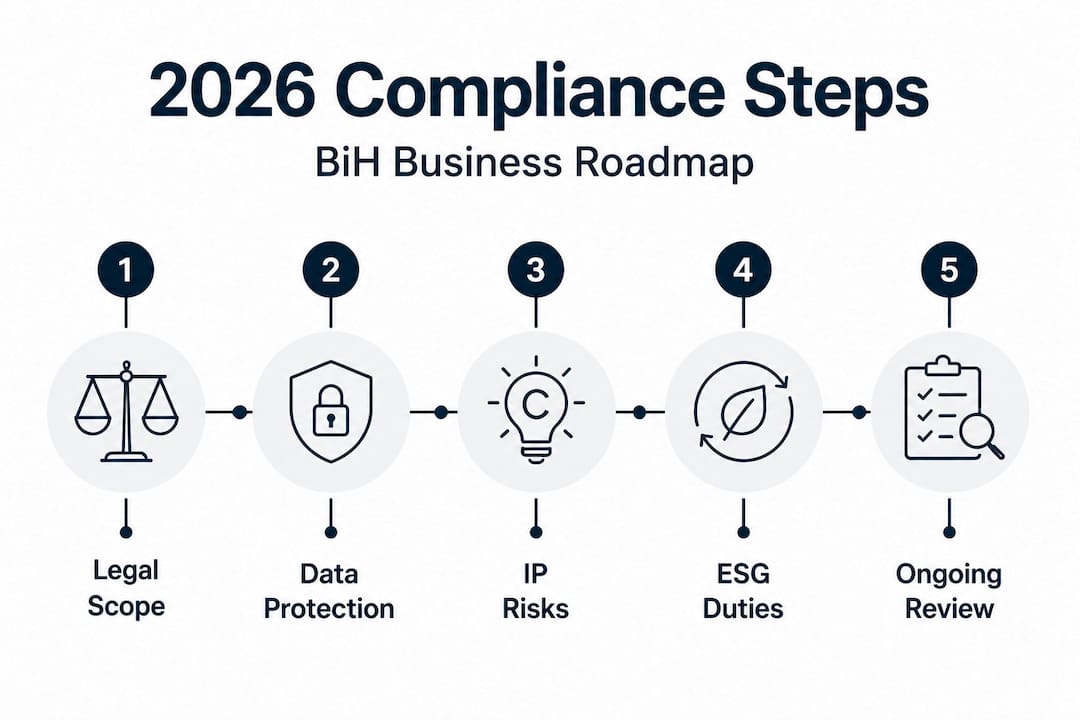
Three areas stand out: data protection, intellectual property, and environmental, social, and governance obligations.
Data protection under GDPR-aligned legislation
According to detailed analysis of recent legislative changes, BiH businesses must navigate parallel regulatory regimes, and recent GDPR-aligned data protection laws introduced in 2026 require internal training, risk assessments, and governance adjustments across the organisation. These are not optional improvements. They are legal obligations with enforcement consequences.
The practical steps for compliance with GDPR-aligned data protection requirements in BiH are:
- Conduct a data mapping exercise: Identify every category of personal data your company processes, the legal basis for that processing, and the parties with whom data is shared.
- Appoint a data protection officer or designated responsibility: Assign clear internal accountability for data governance, with documented authority and reporting lines.
- Complete a data protection impact assessment: For high-risk processing activities, a formal assessment is required before the activity commences.
- Update contracts with processors and partners: Data processing agreements must reflect current legal standards, including provisions for cross-border data transfers.
- Deliver documented staff training: Regulators expect evidence that employees handling personal data understand their obligations.
Intellectual property risks
The BiH software piracy rate stands at 66% as of 2022, contributing to approximately $15 million in annual losses. Despite laws that are technically TRIPS-compliant, enforcement gaps remain significant. For technology companies, software developers, and any business with proprietary digital assets, this is a material commercial risk.
| IP risk category | Specific concern | Recommended action |
|---|---|---|
| Software piracy | Unauthorised copying and distribution | Register IP, implement usage monitoring |
| Trade secrets | Inadequate confidentiality protections | Robust NDAs, access controls |
| Brand infringement | Trademark copying in adjacent markets | Register trademarks in all active jurisdictions |
| Contract IP | Ownership disputes with contractors | Explicit IP assignment clauses in all agreements |
ESG obligations
ESG requirements are no longer reserved for listed companies or multinationals. Growth companies operating in or entering European supply chains increasingly face ESG due diligence requirements from their commercial partners, lenders, and investors. In BiH, the regulatory framework is developing, but the commercial pressure is already present.
Pro Tip: Start your ESG compliance journey with a gap analysis aligned to the EU's Corporate Sustainability Reporting Directive. Even if formal obligations do not yet apply in BiH, voluntary alignment signals credibility to international investors and partners.
For a structured approach to these obligations, the startup compliance checklist for 2026 provides a practical starting point. Companies scaling their workforce also need to address employment law compliance as part of their broader regulatory programme.
The strategic role of compliance in business growth and risk mitigation
Compliance is not simply about avoiding penalties. For growth companies in BiH, a robust legal compliance programme creates measurable strategic value across three distinct dimensions: investment attractiveness, operational resilience, and asset protection.

Attracting investment
Investors conduct legal due diligence before committing capital. In BiH's complex regulatory environment, a company that can demonstrate clean corporate governance, documented compliance programmes, and clear IP ownership has a material advantage over competitors who cannot. Compliance gaps identified during due diligence delay transactions, reduce valuations, and in some cases prevent deals from completing.
The ability to present a coherent compliance record is not just defensive. It is a positive signal about the quality of management and the maturity of the organisation. For companies pursuing international business opportunities or attracting foreign capital, this signal carries real commercial weight.
Mitigating corruption and operational disruption
World Bank Enterprise Surveys consistently identify corruption and an unreliable court system as top obstacles for businesses operating in BiH. Companies that rely on informal arrangements or allow compliance gaps to persist are systematically more vulnerable to these risks. Robust compliance programmes, supported by technology-enabled monitoring, reduce the opportunities for corrupt actors to insert themselves into business processes.
This includes:
- Documented procurement processes: Clear, auditable procurement procedures reduce exposure to bribery claims and supplier-side corruption.
- Internal controls and audit trails: Technology systems that log approvals, transactions, and access decisions create records that defend against false allegations and internal misconduct.
- Whistleblower mechanisms: Internal reporting channels allow problems to be identified and addressed before they escalate into regulatory or reputational crises.
- Third-party due diligence: Formal assessment of agents, distributors, and commercial partners reduces the risk of liability for third-party conduct.
Protecting intellectual property and confidential assets
Given the significant IP enforcement gaps in BiH, companies cannot rely on reactive legal action to protect their assets. Prevention is the only reliable strategy. This means registering trademarks and copyright, embedding IP assignment clauses in all employment and contractor agreements, and implementing technical protections for software and proprietary data.
Pro Tip: Review your standard employment contracts specifically for IP ownership clauses. In many BiH companies, these clauses are absent or ambiguous, creating disputes when key employees depart or when the company seeks to commercialise its technology.
Proactive legal advice is the consistent differentiator between companies that scale successfully and those that face recurring legal disruptions. Access to professional compliance support services allows leadership teams to focus on growth while maintaining the legal foundations that protect it.
Practical frameworks and tech-enabled compliance solutions
Identifying compliance obligations is necessary but not sufficient. Growth companies need practical frameworks for managing those obligations continuously, without allowing compliance to become a drag on operational speed.
The following structured approach provides a reliable foundation for ongoing compliance management in BiH:
- Establish a compliance register: Document every regulatory obligation applicable to your business, including the relevant jurisdiction, the responsible internal owner, and the renewal or review date. This register becomes the master reference for compliance activity.
- Conduct quarterly legal reviews: Schedule regular reviews with legal counsel to identify changes in the regulatory environment, assess new obligations, and update the compliance register accordingly. BiH's legislative environment is not static, and reactive responses to regulatory change are consistently more expensive than proactive ones.
- Implement a contract management system: All contracts should be stored in a centralised, searchable repository with automated alerts for renewal and expiry dates. Expired contracts or unreviewed agreements are a common source of legal risk.
- Integrate compliance into onboarding processes: New employees and contractors should receive compliance training as part of their onboarding, with documented acknowledgement of key policies.
- Use technology for monitoring and reporting: Compliance management software can automate obligation tracking, generate audit-ready reports, and flag exceptions before they become violations.
Technology plays a particularly important role in addressing the corruption risk identified in World Bank Enterprise Survey data. When procurement approvals, expense authorisations, and contract decisions are processed through digital systems with documented audit trails, the opportunities for informal pressure are materially reduced.
Additional practical measures include:
- Annual IP audits: Review all intellectual property assets, confirm registrations are current, and assess whether new protections are required.
- Data protection reviews: Revisit data maps and processing records at least annually, particularly following any significant change in business operations or technology infrastructure.
- Supplier compliance assessments: Include compliance requirements in supplier contracts and conduct periodic assessments to verify adherence.
- Incident response planning: Develop documented procedures for responding to data breaches, regulatory inquiries, and legal disputes before those events occur.
"The most effective compliance programmes are not those designed to satisfy regulators. They are those designed to support business decision-making, reduce uncertainty, and protect the assets that create value."
Understanding the role of a legal advisor in this context is important. Legal counsel should function as a strategic partner, not merely as a responder to problems that have already materialised. Companies that build ongoing advisory relationships are better positioned to anticipate regulatory changes and adapt without disruption. When disputes do arise, having a clear framework for managing legal disputes significantly reduces their cost and duration. Regular engagement with current legal insights ensures leadership teams remain informed about developments relevant to their sector. Reviewing compliance review standards applied in adjacent regulatory contexts can also strengthen internal review processes.
Conventional mistakes and the real opportunity for BiH leaders
The most common mistake growth-focused leaders in BiH make is treating compliance as a reactive exercise. Legal requirements are addressed when a problem surfaces, an audit arrives, or a transaction requires clean documentation. By that point, the cost of remediation is always higher than the cost of prevention would have been.
There is a deeper issue. Reactive compliance misses the strategic opportunity entirely. When compliance is embedded into the business from an early stage, it becomes a source of competitive advantage rather than a tax on operational resources. Investors, partners, and sophisticated clients make decisions based on visible governance quality. Companies that can demonstrate this quality consistently command better terms and attract stronger partners.
The hidden costs of ignoring legal frameworks are rarely visible until they are unavoidable. Deferred compliance investment accumulates as a liability on the balance sheet of operational risk. When it surfaces, it typically does so at the worst possible moment: during a fundraising round, a commercial dispute, or a regulatory inspection.
The transformative effect of proactive legal adaptation is not theoretical. It is the consistent differentiator observed in companies that sustain growth through regulatory change, rather than being disrupted by it. The opportunity for BiH leaders is to reframe compliance investment as strategic infrastructure rather than administrative overhead.
Support for your compliance journey
Navigating BiH's regulatory environment requires more than general legal knowledge. It requires precise, experience-based guidance tailored to the specific structure, sector, and growth ambitions of your company.
Vucic.legal provides specialised legal advisory services for growth-focused companies operating in Bosnia and Herzegovina and the broader regional market. From structuring compliant corporate frameworks to addressing data protection, IP, and ESG obligations, the firm's advisors work as integrated partners in your growth strategy. Explore the corporate law guide for foundational context, review the full range of strategic legal services available, or download the compliance checklist for 2026 to begin mapping your obligations today.
Frequently asked questions
What are the main compliance challenges for business leaders in BiH?
Leaders face fragmented regulations across entities and cantons, overlapping legal requirements, and rapidly evolving obligations in data protection and ESG, making compliance both structurally complex and resource-intensive.
How do GDPR-aligned data protection laws affect companies in Bosnia and Herzegovina?
Under 2026 data protection requirements, companies must complete internal training programmes, conduct risk assessments, and update governance structures to reflect the stricter standards now in force.
Why is intellectual property compliance crucial for growth companies in BiH?
With a 66% software piracy rate and weak enforcement mechanisms, growth companies face real financial exposure from IP theft, making proactive registration and contractual protection essential rather than optional.
How can technology support legal compliance and reduce corruption risks?
Tech-enabled monitoring creates auditable records of business decisions and approvals, reducing opportunities for corrupt interference and providing documented evidence of compliance for regulators and investors.