
TL;DR:
- Legal guidance in technology companies integrates legal expertise into governance, product development, and risk management to ensure compliance and strategic growth. It covers intellectual property, data protection, AI governance, and cross-border regulations, which are essential for sustainable international expansion. Early legal involvement and embedding compliance by design mitigate risks, support innovation, and transform legal functions into strategic growth enablers.
Legal guidance in technology-driven companies is defined as the structured integration of legal expertise into corporate governance, product development, compliance architecture, and risk management. The role of legal guidance in technology-driven companies has expanded well beyond contract review. Today, it encompasses AI governance, data protection under frameworks such as the GDPR and the EU AI Act, intellectual property protection, and cross-border regulatory compliance. For entrepreneurs and decision-makers, legal counsel is no longer a cost centre to be engaged reactively. It is a strategic function that shapes product design, investor confidence, and market entry. Outside legal costs for startups often range from £150 to £300 per hour for corporate counsel, which underscores the need to deploy that investment at the right moments.
What is the role of legal guidance in technology-driven companies?
Legal guidance in technology-driven companies serves as the connective tissue between business operations and regulatory compliance. General Counsel and external counsel translate complex legal obligations into operational decisions that product, engineering, and commercial teams can act upon. The standard industry term for this function is "in-house legal advisory," though many early-stage firms rely entirely on external counsel until they reach Series B funding.
The scope of legal advice for tech firms covers at least four distinct domains. First, intellectual property protection secures the core assets of any technology business, from software patents to trade secrets. Second, data protection compliance under GDPR and equivalent frameworks governs how personal data is collected, processed, and stored. Third, AI governance addresses the ethical deployment of machine learning systems and the obligations imposed by the EU AI Act. Fourth, commercial contracting structures the relationships with customers, vendors, and investors in ways that limit liability and preserve strategic flexibility.
For companies operating across multiple jurisdictions, including Bosnia and Herzegovina and the broader European market, the complexity multiplies. A single product may trigger obligations under Bosnian data protection law, EU GDPR, and sector-specific regulations simultaneously. Legal counsel that understands both local regulatory requirements and international frameworks is not a luxury. It is a prerequisite for sustainable growth.
How does legal guidance support compliance and risk management in tech?
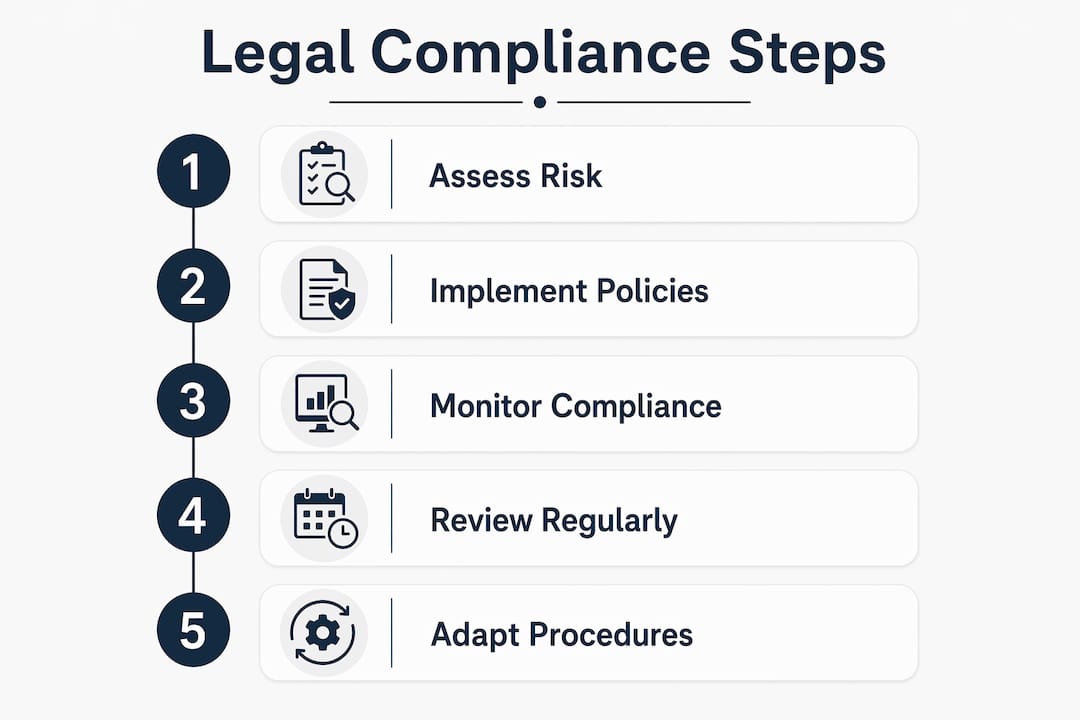
Compliance in technology companies is no longer a policy exercise. Compliance is increasingly an architectural problem, requiring identity verification, data flow mapping, and monitoring to be embedded directly into product infrastructure. This principle, known as compliance by design, means that legal teams must engage with engineering from the earliest stages of product development, not after a regulatory audit has identified deficiencies.
The fragmentation of privacy law creates significant regulatory tail risk. Fragmented privacy laws in the US alone include 22 separate state statutes, and companies operating internationally face an equally complex patchwork of national and supranational rules. This fragmentation is not merely a compliance burden. It is a competitive variable, because firms with the legal resources to navigate complexity can enter markets that less-prepared competitors cannot.
AI-specific compliance failures are well-documented and costly. In audits of AI systems, 47% lacked explicit consent, 39% were unable to erase training data on request, and 31% lacked human intervention mechanisms. Each of these failures represents a direct violation of GDPR obligations and, under the EU AI Act, potential classification as a high-risk system requiring conformity assessment.
Legal teams contribute to compliance in the following ways:
- Mapping data flows and identifying processing activities that require a legal basis under GDPR
- Reviewing AI vendor contracts to allocate liability for model outputs and data handling
- Drafting and maintaining privacy notices, terms of service, and data processing agreements
- Advising on sector-specific regulations such as the EU AI Act's risk classification tiers
- Coordinating responses to data subject access requests and regulatory investigations
Pro Tip: Engage legal counsel before signing any AI vendor contract. The allocation of liability for model outputs, data retention, and sub-processing is rarely favourable in standard vendor terms and requires negotiation.
How is the General Counsel role evolving in technology firms?
The General Counsel role in technology-driven firms has shifted from downstream legal gatekeeper to real-time operational collaborator. In-house lawyers now operate closely with product and engineering teams, embedding legal risk management into sprint cycles, product launches, and AI deployment decisions. This transformation is driven by the pace of AI adoption and the increasing regulatory scrutiny that accompanies it.
Technical fluency is now a professional expectation for General Counsel in technology companies. Understanding how large language models process data, how automated decision-making systems function, and where algorithmic bias can arise is no longer optional. Without this knowledge, legal counsel cannot assess whether a product feature triggers high-risk classification under the EU AI Act or creates liability under consumer protection law.
The responsibilities that now fall within the General Counsel's remit in a technology firm include:
- Overseeing AI governance programmes that span legal, ethics, product, and engineering functions
- Advising the board on regulatory risk exposure from new product features or market expansions
- Managing relationships with data protection authorities and responding to regulatory enquiries
- Structuring IP ownership and licensing arrangements to protect competitive advantage
- Evaluating General Counsel's role in business growth as a strategic partner rather than a compliance function
AI governance programmes provide competitive advantage by demonstrating compliance maturity to regulators and enterprise customers. The OECD tracked over 930 policy initiatives for trustworthy AI in 2023, signalling that governance is a permanent feature of the technology operating environment, not a transitional phase.
When should legal guidance be integrated into product development?
Legal guidance integrated into product workflows prevents the need to re-architect data pipelines and avoids costly compliance failures mid-sales cycle. Unified handling of terms of service, privacy policies, and AI risk assessments reduces last-minute changes that delay product launches and damage customer relationships. The practical implication is that legal and engineering teams must share a common working rhythm, not operate in separate silos.

Early-stage technology companies frequently miss the critical inflection points at which legal engagement is most valuable. Legal risk events occur before public launch, enterprise deals, and AI vendor contracts, and standard templates for IP assignments and employment agreements must be in place before these events occur. A founder who delays IP assignment until a Series A due diligence process will face significant complications, as investors routinely require clean IP ownership as a condition of investment.
The consequences of delayed legal involvement are concrete and measurable. IP disputes can render a product unlicensable. Missing data processing agreements can trigger GDPR enforcement. Poorly structured founder agreements can create deadlock in governance decisions. For companies entering the Bosnian or broader Western Balkans market, local corporate law requirements add another layer of complexity that external counsel familiar with the jurisdiction must address from the outset.
Pro Tip: Treat legal review as a standard gate in your product development lifecycle, alongside security review and QA testing. The cost of a legal review at the design stage is a fraction of the cost of a compliance remediation after launch.
A useful comparison illustrates the difference between reactive and proactive legal engagement:
| Approach | Timing | Typical outcome |
|---|---|---|
| Reactive legal engagement | Post-launch or post-incident | Remediation costs, regulatory fines, reputational damage |
| Proactive legal engagement | Pre-launch, pre-contract, pre-fundraise | Clean IP ownership, compliant architecture, investor-ready documentation |
How do tech companies balance speed and legal accuracy?
The tension between rapid innovation cycles and legal risk management is one of the defining operational challenges for technology-driven firms. Legal must work alongside engineering and commercial teams to embed compliance without slowing momentum. The solution is not to slow down product development. It is to redesign legal workflows so that legal review runs in parallel with, rather than sequentially after, product development.
Several practical strategies allow technology companies to maintain regulatory compliance without impeding their development velocity:
- Establish legal playbooks for recurring decisions. Standard positions on data processing, IP ownership, and vendor contracts reduce the time required for individual legal reviews and empower product managers to make routine decisions within pre-approved parameters.
- Deploy AI-assisted legal tools within the legal team. Contract analysis platforms and regulatory monitoring tools allow small legal teams to maintain oversight across a larger volume of transactions and regulatory changes than would otherwise be possible.
- Create a cross-functional AI governance committee. Including legal, product, engineering, and compliance representatives in a standing governance body ensures that legal risk is assessed at the point of product decision, not after the fact.
- Define escalation thresholds clearly. Not every product decision requires General Counsel review. Defining which decisions require legal sign-off and which can proceed under standing guidance reduces bottlenecks without increasing risk exposure.
- Monitor regulatory developments continuously. The EU AI Act, GDPR enforcement decisions, and sector-specific guidance evolve on a rolling basis. Legal teams that track these developments proactively can advise on compliance implications before they become urgent.
For companies operating in Bosnia and Herzegovina, the additional consideration is alignment between local regulatory requirements and EU-standard compliance frameworks. Bosnia is not yet an EU member state, but its regulatory trajectory and the requirements of EU-based customers and investors mean that EU-standard compliance is effectively the operating baseline for any growth-oriented technology firm in the region.
Key takeaways
Legal guidance in technology-driven companies is a strategic function that must be embedded in product development, governance, and risk management from the earliest stages of company growth.
| Point | Details |
|---|---|
| Compliance by design | Embed legal requirements into product architecture before launch, not after regulatory review. |
| General Counsel evolution | Modern GC roles require technical fluency in AI systems and real-time collaboration with engineering teams. |
| Early legal engagement | IP assignments, data processing agreements, and employment contracts must be in place before fundraising or enterprise sales. |
| AI governance as advantage | Structured AI governance programmes signal compliance maturity to regulators and enterprise customers. |
| Fragmented regulation | Operating across jurisdictions requires legal counsel with both local and international regulatory expertise. |
Legal guidance as a growth function, not a compliance checkbox
From practice, the most consistent pattern among technology companies that encounter serious legal problems is not ignorance of the law. It is the habit of treating legal counsel as a function to be engaged only when a problem has already materialised. By that point, the options available to the company are invariably more limited and more expensive than they would have been six months earlier.
The companies that extract genuine value from legal guidance treat their counsel as a working member of the leadership team. They bring legal into product discussions, not just contract negotiations. They ask legal to review AI vendor agreements before signing, not after a data breach. They structure IP ownership correctly at incorporation, not during due diligence.
For international technology firms entering Bosnia and Herzegovina or the broader Western Balkans, this discipline is particularly important. The regulatory environment is evolving, local legal requirements differ from EU norms in specific ways, and the consequences of non-compliance can include both local enforcement and the loss of EU market access. The legal risks of scaling a technology company in this region are manageable with the right counsel in place from the outset.
The emerging challenge that I expect to define the next three years is AI governance. The EU AI Act is now in force, and its obligations for high-risk AI systems are substantial. Technology companies that have not yet mapped their AI tools against the Act's risk classification tiers should treat that exercise as an immediate priority. The EU compliance guide for technology leaders is a practical starting point for that assessment.
— Franjo
Legal services for technology-driven companies

Vucic provides strategic legal advisory services to technology companies, startups, and growth-oriented businesses operating in Bosnia and Herzegovina and across European markets. The firm's approach treats legal counsel as a business partner engaged throughout the company lifecycle, from incorporation and IP structuring through to enterprise contracting, regulatory compliance, and cross-border transactions. For decision-makers seeking guidance on corporate law fundamentals or bespoke support during a fundraising round, product launch, or market entry, Vucic offers the combination of local regulatory knowledge and international legal standards that technology firms operating in this region require. Contact Vucic to discuss your company's specific legal requirements.
FAQ
What does legal guidance cover in a technology company?
Legal guidance in a technology company covers intellectual property protection, data protection compliance, AI governance, commercial contracting, and regulatory risk management. The scope expands as the company grows, typically moving from external counsel to an in-house General Counsel after Series B funding.
Why does compliance by design matter for tech firms?
Compliance by design means embedding legal requirements such as data flow mapping and identity verification into product architecture from the outset. Retrofitting compliance after a product is built is significantly more costly and creates regulatory exposure during the remediation period.
When should a tech startup first engage legal counsel?
Legal counsel should be engaged at incorporation to address IP assignment, founder agreements, and employment contracts. Legal risk events occur before public launch and before the first enterprise deal, making early engagement a prerequisite for investor-ready documentation.
What are the most common AI compliance failures under GDPR?
The most frequent failures include lack of informed consent, inability to erase training data, and absence of human intervention mechanisms. Audit data shows 47% of AI systems lacked explicit consent, representing direct GDPR violations with significant enforcement risk.
How does fragmented regulation affect technology companies?
Fragmented regulation creates compliance complexity and litigation risk, particularly for companies operating across multiple jurisdictions. Outside general counsel services can provide cost-effective coverage across jurisdictions before a company has the scale to justify a full in-house legal team.