
TL;DR:
- Embedding compliance strategically accelerates growth by reducing deal friction and enhancing market differentiation.
- Businesses in Bosnia face fragmented regulations, while EU laws impose strict penalties and extensive due diligence obligations.
- Proactive, integrated compliance approaches, like Minimal Viable Compliance and Compliance-as-Code, turn regulation into a competitive advantage.
Regulatory pressure across Europe has reached a level where compliance can no longer be treated as a back-office function. As regulatory complexity accelerates with the CSRD, AI Act, CSDDD, and DSA all imposing obligations simultaneously, forward-thinking organisations are appointing Chief Compliance Officers and integrating risk functions directly into their commercial strategies. The persistent misconception that compliance slows business down is being replaced by evidence that it enables faster deal closure, smoother market entry, and meaningful competitive differentiation. This article sets out the strategic case for compliance, examines the specific complexities facing businesses in Bosnia and Herzegovina and across the EU, and provides actionable frameworks for turning regulatory obligations into a genuine business asset.
Table of Contents
- Why compliance matters: Strategic impact on business growth
- Navigating regulatory complexity in Bosnia and Herzegovina and Europe
- Real costs and risks: Why non-compliance isn't an option
- Actionable compliance strategies: Making compliance a business enabler
- Our perspective: What most leaders miss about compliance as a growth driver
- Expert legal support: Transform compliance into business advantage
- Frequently asked questions
Key Takeaways
| Point | Details |
|---|---|
| Compliance unlocks growth | Treating compliance strategically accelerates sales and opens new markets. |
| Regulatory complexity is real | Businesses must navigate Bosnia’s fragmented law and EU’s expanding requirements. |
| Penalties outweigh costs | Non-compliance can cost millions and undermine business reputation. |
| Practical solutions exist | Minimal Viable Compliance and evidence-based frameworks make compliance achievable. |
| Expert support is essential | Legal advisors help transform compliance burdens into business advantages. |
Why compliance matters: Strategic impact on business growth
Compliance, in its simplest form, refers to the process of adhering to laws, regulations, standards, and internal policies relevant to a business's operations. However, this definition understates what compliance actually delivers when embedded at a strategic level. Rather than functioning as a constraint on growth, a well-structured compliance programme creates the conditions under which growth becomes faster, safer, and more scalable.
The evidence is practical. Compliance accelerates sales cycles by 40 to 60 percent in markets where enterprise buyers and institutional clients conduct detailed due diligence before contracting. A company that can immediately produce auditable evidence of its data protection posture, supply chain integrity, or financial controls removes friction from procurement processes. This is not a marginal improvement. In competitive B2B markets, it often determines which vendor wins a contract.
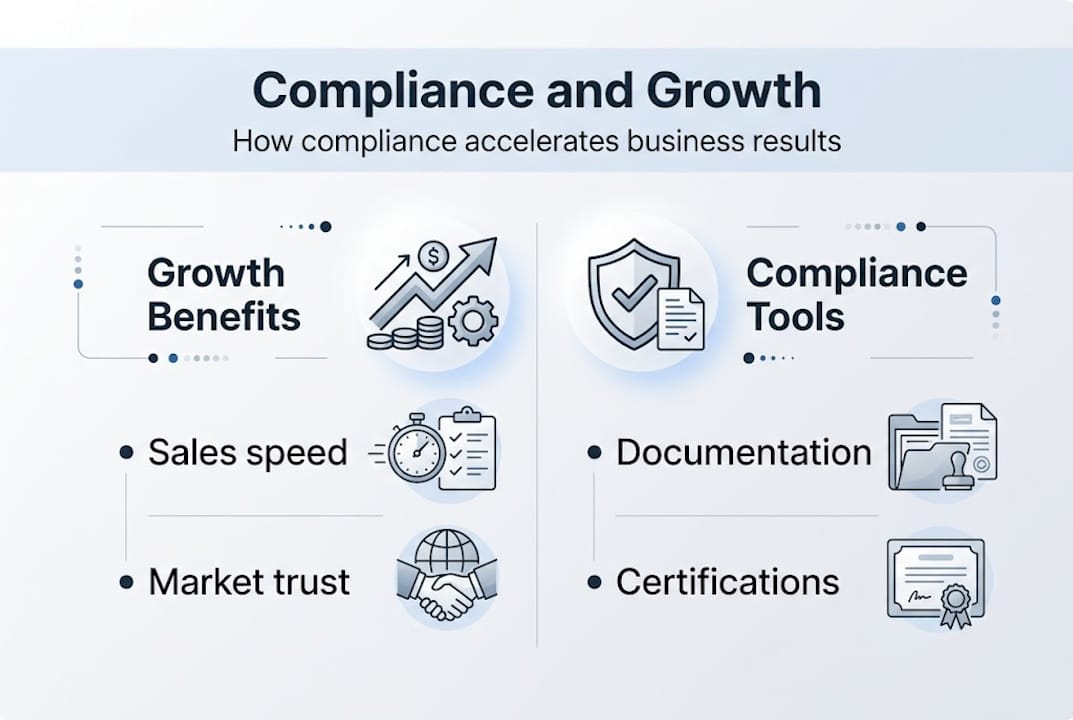
Beyond sales velocity, compliance functions as a form of market differentiation. Consider two technology companies bidding for the same contract with a European financial institution. One has invested in ISO 27001 certification, maintains a documented data processing register, and can demonstrate GDPR-compliant data flows. The other has similar technical capabilities but no formal compliance posture. The outcome of that procurement is rarely in doubt. Evidence-based compliance creates a signal of operational maturity that sophisticated buyers use to reduce their own third-party risk.
There is an ongoing debate about whether compliance represents a net cost or a net value. For smaller firms, regulatory overload is a genuine burden, consuming resources that might otherwise fund product development or market expansion. However, the empirical data consistently supports the view that compliance functions as a value driver for growth-oriented organisations. Companies that invest in structured compliance frameworks report measurable benefits including revenue premiums, reduced insurance costs, better access to capital, and fewer operational disruptions.
Key strategic benefits of compliance include:
- Faster market entry into regulated sectors such as finance, healthcare, and government procurement
- Reduced deal friction during M&A transactions, where compliance gaps can delay or derail valuations
- Stronger investor confidence, as institutional investors apply ESG and governance screening during funding rounds
- Operational resilience, as compliance frameworks force organisations to document processes and controls that reduce internal failures
It is also worth noting that over 60% of indicator overlap exists across major EU directives, meaning investment in one compliance framework frequently satisfies partial requirements of another. This creates genuine economies of scale for businesses that approach compliance systematically rather than on a directive-by-directive basis. For legal guidance connecting compliance to business growth, the strategic framing matters as much as the technical detail.
Navigating regulatory complexity in Bosnia and Herzegovina and Europe
If compliance unlocks business value, what complexities should you watch in Bosnia and EU markets? The answer differs significantly depending on jurisdiction, and misunderstanding those differences carries real cost.
Bosnia and Herzegovina presents a genuinely distinctive regulatory environment. The country operates under a multi-tiered legal framework spanning state, entity, and cantonal levels, producing regulations that frequently overlap and sometimes contradict one another. A business operating across both the Federation of Bosnia and Herzegovina and Republika Srpska may face materially different labour, tax, and commercial registration requirements in each entity. As the Bosnia Investment Climate Statement confirms, this fragmented system creates redundant obligations, exposes investors to corruption risks, and suffers from weak enforcement consistency. Foreign investors in particular are advised to secure local legal counsel and implement robust anti-corruption compliance protocols from the outset.

At the EU level, the compliance landscape is evolving rapidly. The Corporate Sustainability Reporting Directive (CSRD) and the Corporate Sustainability Due Diligence Directive (CSDDD) impose supply chain audit obligations on firms operating in or supplying to the European market. The Digital Operational Resilience Act (DORA) targets financial sector firms with prescriptive cyber resilience requirements. Taken together, DORA and CSDDD impose penalties of up to 5% of global annual turnover for non-compliance, a figure that concentrates attention sharply.
| Compliance dimension | Bosnia and Herzegovina | European Union |
|---|---|---|
| Legal framework | Multi-tiered: state, entity, cantonal | Harmonised directives with member state transposition |
| Enforcement consistency | Weak and variable across jurisdictions | Increasingly robust, especially in larger member states |
| Penalty exposure | Limited but unpredictable | Up to 5% of global turnover under CSDDD, DORA |
| Corruption risk | Elevated; strong anti-corruption controls required | Lower, but third-party risk obligations apply |
| Supply chain obligations | Limited formal requirements | Extensive due diligence under CSDDD and CSRD |
| Cyber resilience mandates | Nascent regulatory framework | Prescriptive under DORA for financial sector firms |
Understanding this divergence is essential for businesses that operate in or between both environments. A manufacturing company based in Bosnia and Herzegovina that supplies to German retailers, for instance, faces obligations under both Bosnia's cantonal licensing requirements and the EU's supply chain due diligence rules simultaneously. The practical solution is to build compliance structures that address both layers without duplicating effort unnecessarily.
Reviewing a legal guide for Bosnia compliance provides a structured starting point, particularly for foreign entrants who may underestimate the jurisdictional fragmentation. Using a detailed Bosnia compliance checklist helps ensure that entity-level and cantonal obligations are captured before commercial operations begin.
Real costs and risks: Why non-compliance isn't an option
Understanding the complexity, it is essential to weigh up the real risks and why deferring compliance can prove deeply costly.
The numbers are significant. Non-compliance costs average $14.82 million per incident across industries, factoring in penalties, legal fees, remediation costs, and lost business. Smaller financial institutions spend between 11 and 15.5% of their total payroll on compliance management, compared to 6 to 10% for larger institutions with greater economies of scale. European firms collectively spent an estimated €14.2 billion on sustainability compliance alone in 2024. These are not abstract projections. They reflect the operational reality for businesses that encounter regulatory scrutiny without adequate preparation.
For SMEs, the risk profile is different but no less serious. A small technology firm that processes personal data without a lawful basis under GDPR can face fines disproportionate to its revenue. A trading company that fails to conduct supply chain due diligence and is found to have sourced from non-compliant suppliers faces reputational and contractual exposure, not just regulatory penalties. The EU penalties under CSDDD of up to 5% of global turnover apply regardless of company size, removing the assumption that only large multinationals face meaningful enforcement risk.
A practical illustration: a mid-size logistics firm seeking to expand from Bosnia into the Austrian market is likely to encounter due diligence questions from its prospective Austrian partners regarding environmental standards, data handling, and labour conditions within its supply chain. Without documented compliance evidence, the partnership stalls. The cost of that delay, measured in lost revenue, management time, and renegotiated commercial terms, routinely exceeds the cost of building the compliance infrastructure in the first instance.
The following steps summarise the primary financial and operational consequences of non-compliance for growth-stage businesses:
- Regulatory fines and penalties, which can be substantial under EU frameworks and unpredictable under Bosnia's fragmented enforcement environment
- Lost contracts and procurement exclusions, as enterprise buyers and public sector clients require compliance certifications as pre-conditions
- Transaction delays in M&A, where compliance gaps discovered during due diligence reduce valuations or collapse deals entirely
- Increased insurance premiums, as underwriters price non-compliance risk into professional indemnity and cyber liability cover
- Management time and legal fees associated with remediation, which consistently exceed the cost of proactive compliance investment
Pro Tip: Begin building your compliance evidence pack before regulatory scrutiny arrives. Auditable documentation of policies, controls, and monitoring activities dramatically reduces both the likelihood of enforcement action and the severity of any penalty assessed.
For startups and early-stage businesses, reviewing a startup legal compliance checklist provides a structured basis for identifying obligations early. Businesses with employees operating in Bosnia and Herzegovina should also confirm their employment compliance in BiH from the point of hiring, not retrospectively.
Actionable compliance strategies: Making compliance a business enabler
Knowing these risks, the practical focus should shift to strategies that convert compliance into an operational and commercial advantage rather than a recurring cost.
The first framework worth adopting is Minimal Viable Compliance (MVC). MVC balances framework and operational approaches, beginning with clearly defined business end goals rather than an exhaustive list of regulatory requirements. The approach builds essential capabilities iteratively, starting with the controls most likely to be tested by regulators, clients, or investors. This prevents organisations from investing heavily in compliance areas that carry minimal risk while leaving higher-priority obligations underserved.
The second strategy is Compliance-as-Code, which involves integrating compliance requirements directly into technology workflows and automating evidence collection. Rather than relying on manual documentation exercises before each audit, organisations configure their systems to produce continuous, timestamped records of compliance activities. This approach is particularly relevant for technology companies operating within the EU's evolving data protection and cyber resilience frameworks.
Practical strategies combining MVC and Compliance-as-Code integrate people, process, and technology into a coherent compliance architecture. International standards such as ISO 27001 and SOC 2 provide pre-built frameworks that align with EU regulatory expectations, reducing the effort required to demonstrate compliance to multiple stakeholders simultaneously.
The following steps outline a structured approach to audit readiness for growth-stage businesses:
- Define the compliance scope by mapping all jurisdictions, regulations, and contractual obligations relevant to current and planned operations
- Conduct a gap analysis comparing current controls against regulatory requirements and client expectations
- Prioritise controls based on the risk and penalty exposure associated with each gap
- Document policies and procedures in auditable formats that can be shared with regulators, auditors, and commercial partners
- Automate evidence collection where technology allows, reducing reliance on manual compliance exercises
- Schedule regular reviews to capture regulatory changes before they create new gaps
Additional areas warranting attention include:
- Data processing records and legitimate interest assessments under GDPR
- Supply chain audit trails for firms subject to CSDDD obligations
- Cyber incident response plans meeting DORA requirements for financial sector businesses
- Environmental and sustainability reporting obligations under CSRD for qualifying firms
Pro Tip: Start with ISO 27001 or SOC 2 as a baseline compliance framework if your business operates in the EU technology sector. Both standards are widely recognised by enterprise buyers and regulators, and achieving certification creates transferable compliance evidence across multiple regulatory requirements.
For businesses with property holdings or real estate activities in Bosnia, understanding real estate compliance obligations is equally important. More broadly, proactive legal advice in Bosnia remains the most reliable mechanism for identifying compliance obligations before they become enforcement risks.
Our perspective: What most leaders miss about compliance as a growth driver
With tested strategies in hand, it is worth stepping back to address a pattern observed consistently across growth-stage businesses in Bosnia and the wider region: compliance is treated as a task to be completed rather than a position to be occupied.
The most commercially damaging mistake leaders make is initiating compliance work reactively, typically when a deal is already in progress, a regulator has already enquired, or a partner has already requested documentation. At that point, the cost of compliance is highest and the window for differentiation has already closed.
The organisations that extract genuine competitive advantage from compliance do so by treating it as a commercial strategy from day one. When international business in Bosnia is planned with compliance infrastructure in place, the early data is unambiguous: deal cycles move 40 to 60 percent faster, procurement conversations are shorter, and investor due diligence processes are less disruptive. Compliance built early becomes invisible during transactions. Compliance built late becomes the transaction's primary obstacle.
The practical implication is that compliance and commercial strategy should share the same planning horizon. Legal counsel, compliance officers, and business development functions should align from the outset. That alignment produces organisations that are genuinely difficult to displace in competitive markets.
Expert legal support: Transform compliance into business advantage
Compliance is not a static checklist. It is an evolving strategic function that requires legal expertise to calibrate correctly across jurisdictions, regulatory frameworks, and commercial contexts.
Vucic.legal provides legal services for business compliance specifically structured for growth-oriented companies operating in Bosnia and Herzegovina and across European markets. Our advisory approach prioritises pragmatic legal solutions that align with commercial realities rather than producing generic compliance documentation. For businesses managing cross-border compliance obligations across multiple jurisdictions, our team brings the jurisdictional knowledge and regulatory understanding necessary to build frameworks that hold under scrutiny. Whether your next step is market entry, a transaction, or a regulatory review, expert legal support transforms compliance from a cost into a competitive position.
Frequently asked questions
What are the main compliance challenges facing businesses in Bosnia and Herzegovina?
Businesses face a fragmented legal system spanning state, entity, and cantonal levels, producing duplicative obligations, corruption risks, and inconsistent enforcement. Securing qualified local legal counsel and implementing proactive anti-corruption measures are essential first steps.
How can compliance strategies boost business growth?
Integrating compliance early allows organisations to shorten sales cycles, differentiate in competitive procurement processes, and reduce transaction friction. Empirical data shows deal speeds increase by 40 to 60 percent when compliance evidence is readily available.
What are the financial penalties for non-compliance in Europe?
EU penalties under CSDDD and DORA can reach up to 5% of global annual turnover, supplemented by reputational damage, lost contracts, and significant management and legal costs associated with remediation.
What is Minimal Viable Compliance and how should it be implemented?
Minimal Viable Compliance combines policy frameworks with operational monitoring, starting from defined business end goals and building essential compliance capabilities iteratively rather than attempting full implementation in a single phase.