
A single unpaid debt of 1 million marks spiralled into a 110 million mark liability that nearly cost Bosnia and Herzegovina control of its airspace. This dramatic case reveals a dangerous misconception: that legal advice is only necessary when problems arise. In reality, waiting until disputes escalate creates catastrophic financial and operational risks. This article explores how proactive legal counsel mitigates regulatory complexities, reduces costs, and drives sustainable growth for businesses operating in Bosnia and Herzegovina's challenging institutional environment.
Table of Contents
- The Legal Landscape Challenges In Bosnia And Herzegovina
- How Proactive Legal Advice Mitigates Risks And Drives Growth
- Lessons From High-Profile Legal Disputes And Their Costs
- Practical Steps To Implement Proactive Legal Strategies In Your Business
- How Vucic Legal Supports Your Proactive Legal Needs
Key takeaways
| Point | Details |
|---|---|
| Proactive counsel adapts to regulatory changes | Early legal engagement helps businesses anticipate legislative shifts and maintain compliance in Bosnia's evolving legal framework. |
| Mitigates risks in complex environments | Expert advice reduces exposure to corruption, non-transparent procedures, and weak enforcement that characterise Bosnia's institutional landscape. |
| Enhances procurement success | Strategic legal planning increases tender success rates by 25% and reduces disputes in public procurement processes. |
| Prevents arbitration cost escalation | Thorough due diligence and early dispute management avoid spiralling debts and enforcement proceedings that can cripple operations. |
| Drives sustainable growth | Legal planning is an investment that improves market entry success by 10% and reduces regulatory fines by 15%. |
The legal landscape challenges in Bosnia and Herzegovina
Bosnia and Herzegovina presents a uniquely complex business environment that demands sophisticated legal navigation. The country's institutional architecture creates operational hurdles that catch unprepared companies off guard. Understanding these challenges is essential for any business leader considering market entry or expansion.
The regulatory framework suffers from endemic corruption, weak judicial systems, and non-transparent procedures that significantly increase business risks. Companies face unpredictable enforcement, inconsistent application of laws, and lengthy dispute resolution processes. These systemic issues create an environment where legal ambiguity becomes a daily operational reality.
Bosnian political structures further complicate matters. The complex institutional and territorial divisions adversely impact economic growth and deter foreign investment. Entity level tensions between the Federation of Bosnia and Herzegovina and Republika Srpska generate conflicting regulations and enforcement approaches. This fragmentation means businesses often navigate multiple, sometimes contradictory, legal regimes simultaneously.
Key challenges include:
- Inconsistent regulatory enforcement across different entities and cantons
- Corruption risks in public procurement and administrative processes
- Weak intellectual property protection and contract enforcement mechanisms
- Political instability affecting legislative predictability and policy continuity
- Limited transparency in government decision making and tender processes
- Bureaucratic delays that extend timelines for permits, licences, and approvals
Low economic growth intensifies competitive pressures. Companies operate in markets where margins are tight and regulatory missteps can prove fatal. The combination of institutional weakness and economic constraints creates an environment where proactive legal strategies become survival tools rather than optional enhancements. Navigating this landscape successfully requires comprehensive understanding of local legal frameworks and continuous monitoring of regulatory developments.
How proactive legal advice mitigates risks and drives growth
Engaging legal counsel before problems emerge transforms how businesses manage risk and capture opportunities in Bosnia and Herzegovina. The evidence demonstrates measurable benefits that directly impact profitability and operational stability.
Proactive legal strategies reduce regulatory fines by 15% and increase successful market entries by 10%. These aren't marginal improvements. They represent the difference between profitable operations and costly setbacks. Early legal involvement helps companies anticipate regulatory changes, structure compliant operations from inception, and avoid expensive corrections after launch.
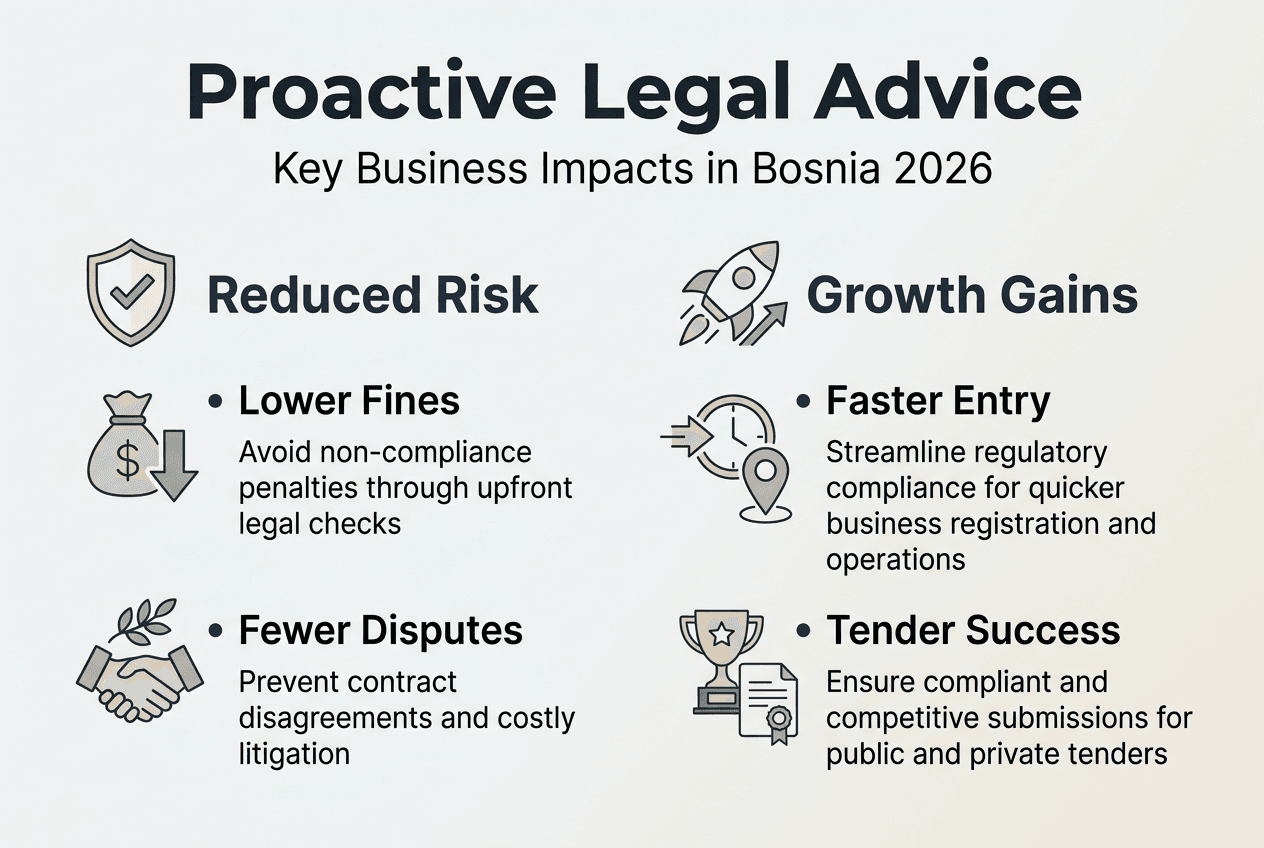
Due diligence becomes particularly powerful when conducted proactively. Companies implementing thorough pre-investment legal reviews face 20% fewer disputes than those conducting minimal assessments. This reduction stems from identifying contractual ambiguities, verifying counterparty legitimacy, and structuring agreements that withstand Bosnia's enforcement challenges. The upfront investment in legal analysis prevents downstream litigation costs that can exceed initial project budgets.
Practical benefits of proactive legal engagement:
- Early identification of regulatory compliance gaps before penalties accrue
- Structured contract frameworks that reduce ambiguity and dispute likelihood
- Strategic entity structuring that optimises tax efficiency and liability protection
- Ongoing monitoring systems that flag legislative changes affecting operations
- Relationship building with regulatory authorities that smooths approval processes
- Crisis preparedness protocols that enable rapid response to legal challenges
Public procurement illustrates these advantages clearly. Companies with proactive legal counsel achieve 25% higher tender success rates. This improvement results from understanding technical requirements, structuring compliant bids, and navigating the procedural complexities that disqualify unprepared competitors. In markets where government contracts represent significant revenue opportunities, this advantage compounds over time.
Regulatory compliance extends beyond avoiding fines. It builds reputational capital that opens doors with partners, customers, and financial institutions. Companies known for legal rigour attract better talent, secure more favourable financing terms, and gain preferential treatment in competitive situations. These intangible benefits often exceed direct cost savings.
Pro Tip: Establish quarterly legal review sessions with your counsel to assess regulatory changes, update compliance protocols, and identify emerging risks before they materialise. This rhythm creates accountability and ensures legal considerations inform strategic decisions rather than reacting to crises.
Integrating legal guidance into business planning transforms compliance from a cost centre into a competitive advantage. Companies that view legal counsel as strategic partners rather than transactional service providers consistently outperform peers in challenging markets. The key lies in engagement timing: involve lawyers when opportunities emerge, not after problems crystallise. This shift in mindset separates thriving businesses from those perpetually managing avoidable crises. Explore practical legal insights to deepen your understanding of strategic legal planning.
Lessons from high-profile legal disputes and their costs
Real cases provide sobering evidence of what happens when businesses neglect proactive legal strategies. The Viaduct arbitration dispute stands as a cautionary tale that every business leader operating in Bosnia should study carefully.

The Viaduct case demonstrates catastrophic cost escalation. An initial debt of 1 million marks grew to over 110 million through accrued interest, legal fees, and enforcement costs. This 11,000% increase occurred because authorities failed to address the obligation promptly and lacked proactive legal management. The delay transformed a manageable payment into a national crisis threatening critical infrastructure control.
Enforcement actions escalated beyond financial penalties. Non-compliance with arbitration rulings triggered enforcement proceedings that nearly resulted in asset freezes affecting Bosnia's airspace management. This operational disruption would have paralysed commercial aviation, demonstrating how legal disputes can cascade into broader economic damage. The reputational harm to Bosnia's investment climate compounded financial losses.
Key lessons from the Viaduct dispute:
- Incomplete due diligence creates hidden liabilities that emerge years later with compounded severity
- Delayed legal action exponentially increases costs through interest accumulation and enforcement fees
- Arbitration rulings carry enforcement mechanisms that can disrupt critical business operations
- Payment delays damage international reputation and deter future investment partnerships
- Proactive dispute resolution in early stages prevents escalation to enforcement proceedings
| Cost Component | Initial Amount | Final Amount | Increase Factor |
|---|---|---|---|
| Principal debt | 1 million marks | 1 million marks | 1x |
| Accrued interest | 0 marks | 95 million marks | N/A |
| Legal and enforcement fees | Minimal | 14 million marks | N/A |
| Total liability | 1 million marks | 110 million marks | 110x |
This pattern repeats across industries. Construction projects stall due to permit disputes that could have been resolved through proactive regulatory engagement. Joint ventures collapse when inadequate contract drafting leaves partnership terms ambiguous. Real estate transactions unravel when due diligence fails to identify encumbrances or ownership complications.
Pro Tip: Before entering any significant contract or investment in Bosnia, conduct comprehensive legal due diligence that examines not just current obligations but potential future liabilities including interest accrual mechanisms, enforcement procedures, and jurisdictional issues. Budget 2-3% of transaction value for thorough legal review.
The financial mathematics of neglecting proactive legal advice are brutal. A €50,000 investment in comprehensive due diligence and contract structuring prevents disputes that cost millions to resolve. Yet businesses consistently underinvest in upfront legal work, viewing it as an expense rather than insurance. This mindset shift separates companies that thrive from those that merely survive. Understanding corporate law fundamentals provides the foundation for making informed decisions about legal investment priorities.
Practical steps to implement proactive legal strategies in your business
Transforming legal advice from reactive to proactive requires systematic integration into business operations. These actionable steps provide a framework for building legal resilience in Bosnia's challenging environment.
Comprehensive due diligence forms the foundation. Before any investment, acquisition, or significant contract, conduct thorough legal assessments that examine regulatory compliance, counterparty legitimacy, contractual obligations, and potential liabilities. This process identifies red flags early when walking away or renegotiating terms remains feasible. Skipping this step to accelerate timelines invariably costs more in downstream complications.
Implementing proactive legal strategies:
- Establish ongoing legal counsel relationships rather than transactional engagements for continuity and institutional knowledge
- Conduct quarterly regulatory compliance audits that assess current operations against evolving legal requirements
- Create internal monitoring systems that track legislative changes affecting your industry and operational jurisdictions
- Develop standardised contract templates reviewed by counsel that reduce negotiation time and legal risk
- Build relationships with regulatory authorities through proper channels to facilitate smoother approval processes
- Implement employee training programmes on compliance requirements specific to Bosnia's regulatory environment
- Establish crisis response protocols that enable rapid legal consultation when unexpected issues arise
Regulatory monitoring deserves particular attention. Engaging legal professionals regularly improves compliance success by 25% in Bosnia and Herzegovina. This improvement stems from staying current with commercial law, labour regulations, tax requirements, and sector specific rules that change frequently. Monthly legal briefings keep leadership informed without requiring constant personal monitoring.
Public procurement demands specialised attention. Companies pursuing government contracts benefit from proactive legal involvement that ensures tender compliance, proper documentation, and procedural adherence. This preparation raises tender success rates significantly and reduces disqualification risks that waste bid preparation investments.
| Legal Strategy | Implementation Timeline | Compliance Improvement | Cost Reduction |
|---|---|---|---|
| Reactive legal response | After problems emerge | Baseline | Baseline |
| Quarterly legal reviews | 3 month cycles | 15% improvement | 10% reduction |
| Monthly monitoring | Ongoing | 25% improvement | 15% reduction |
| Integrated legal planning | Continuous | 35% improvement | 20% reduction |
Pro Tip: Create a legal compliance checklist specific to your industry and operations in Bosnia. Review this checklist monthly with your legal counsel, updating it as regulations change. This simple practice catches compliance gaps before they become violations and demonstrates good faith efforts if disputes arise.
Practical tools enhance implementation. Use regulatory compliance checklists tailored to Bosnia's 2026 requirements. Implement confidentiality protection protocols that safeguard proprietary information during negotiations and partnerships. For companies operating internationally, engage cross-border legal counsel that understands jurisdictional complexities.
Budgeting for legal services requires strategic thinking. Allocate 1-2% of annual revenue to proactive legal counsel, compliance systems, and ongoing monitoring. This investment prevents crises that consume 10-20% of revenue when they materialise. The return on investment becomes obvious when competitors face regulatory penalties, contract disputes, or operational disruptions that your company avoids through systematic legal planning.
How Vucic legal supports your proactive legal needs
Navigating Bosnia and Herzegovina's complex legal landscape requires specialised expertise that understands both regulatory frameworks and business realities. Vucic Legal provides tailored solutions that transform legal compliance from a burden into a competitive advantage for growth oriented companies.
Our practice focuses on the specific challenges businesses face in Bosnia's institutional environment. We offer comprehensive support across corporate law, cross-border transactions, regulatory compliance, and dispute resolution. This integrated approach ensures legal strategies align with business objectives rather than existing in isolation. From initial market entry planning through ongoing operations and expansion, we provide the proactive counsel that prevents costly mistakes and captures opportunities others miss.
Decision makers benefit from our deep understanding of Bosnia's entity level complexities, procurement processes, and regulatory enforcement patterns. We help structure compliant operations, navigate bureaucratic requirements, and build relationships with authorities that smooth approval processes. Our confidential, pragmatic approach prioritises business outcomes while maintaining rigorous legal standards. Explore our strategic legal services to understand how we support companies at every growth stage. Review our comprehensive guide to doing business in Bosnia for detailed insights. Access our 2026 regulatory compliance checklist to assess your current compliance status.
FAQ
What is proactive legal advice and why is it important?
Proactive legal advice involves engaging counsel before problems arise to anticipate risks, ensure compliance, and structure operations strategically. It's important because it prevents costly disputes, reduces regulatory penalties, and improves business outcomes by addressing legal issues when solutions remain affordable and flexible. Companies using proactive strategies consistently outperform reactive peers.
How can proactive legal advice reduce costs related to international arbitration?
Proactive advice ensures contracts include clear dispute resolution mechanisms and obligations are managed before they escalate. This prevents situations where arbitration debts spiral from 1 million to 110 million marks through interest and enforcement costs. Early intervention resolves disagreements through negotiation rather than expensive formal proceedings.
What practical steps can businesses take to stay compliant in Bosnia in 2026?
Businesses should use compliance checklists specific to Bosnia's regulatory environment, maintain ongoing relationships with legal counsel, and actively monitor legislative changes affecting their operations. Regular engagement with legal professionals improves compliance success by 25% through early identification of regulatory gaps and systematic updating of internal protocols.
How does proactive legal planning improve public procurement success rates?
Proactive legal involvement helps companies understand technical tender requirements, structure compliant bids, and navigate procedural complexities that disqualify unprepared competitors. This preparation increases tender success rates by 25% by ensuring documentation completeness, procedural adherence, and strategic positioning that aligns with evaluation criteria. Legal counsel identifies disqualification risks before submission.
What are the main legal risks businesses face in Bosnia and Herzegovina?
Main risks include endemic corruption, non-transparent administrative procedures, weak judicial enforcement, entity level regulatory conflicts, and unpredictable policy changes. These systemic challenges create environments where contractual ambiguities escalate into disputes, regulatory compliance becomes complex, and operational stability depends on sophisticated legal navigation. Proactive strategies mitigate these risks through thorough due diligence and ongoing monitoring.
Recommended
- Cross-Border Business Lawyer | Franjo Vucic
- Startup legal checklist 2026: ensure compliance in Bosnia
- Legal Guide to Doing Business in Bosnia & Herzegovina | Franjo Vucic
- Doing Business in Bosnia & Herzegovina | Legal Guide for International Companies
- Requirements to move to Switzerland for entrepreneurs 2026
- Trend merkbescherming 2026: gids voor startende ondernemers