
TL;DR:
- Bosnia's decentralized real estate system creates significant legal complexities and risks for startups.
- Due diligence must include cross-referencing multiple records, checking informal claims, and verifying approvals across entities.
- Proper legal counsel with regional expertise is essential to avoid costly property disputes and liabilities.
Securing property in Bosnia and Herzegovina can feel like a straightforward transaction until the complications surface. Even after completing official registration and payment, startups frequently discover that their rights are incomplete, disputed, or unenforceable. Bosnia and Herzegovina's decentralised real estate system operates across three distinct legal entities, each with its own rules, registries, and approval processes. For startups scaling operations or establishing a physical presence, this fragmentation creates risks that standard due diligence simply does not address. This guide explains what founders must understand before signing anything.
Table of Contents
- Why real estate law matters for startups in Bosnia and Herzegovina
- Understanding the legal landscape: Entities, due diligence, and records
- Startups and property: Company structures, ownership, and liability
- Common pitfalls and how to avoid them: Practical steps for startups
- The overlooked truths most startup founders miss in Bosnian property deals
- Connect with the right legal expertise for property success
- Frequently asked questions
Key Takeaways
| Point | Details |
|---|---|
| Decentralised law increases risk | Startups must navigate entity-specific regulations when dealing with property in Bosnia and Herzegovina. |
| Due diligence requires more than registry checks | Unofficial users, unsynchronised records, and urban plans can jeopardise property rights even after registration. |
| Structure ownership for liability protection | Using an LLC with proper capital helps shield startups from unexpected liabilities and transfer risks. |
| Expert guidance prevents costly mistakes | A local legal advisor helps startups identify risks and complete all necessary compliance steps. |
Why real estate law matters for startups in Bosnia and Herzegovina
Having set the context for why real estate law is far from straightforward, let's explore how the system creates unique risks for your startup.
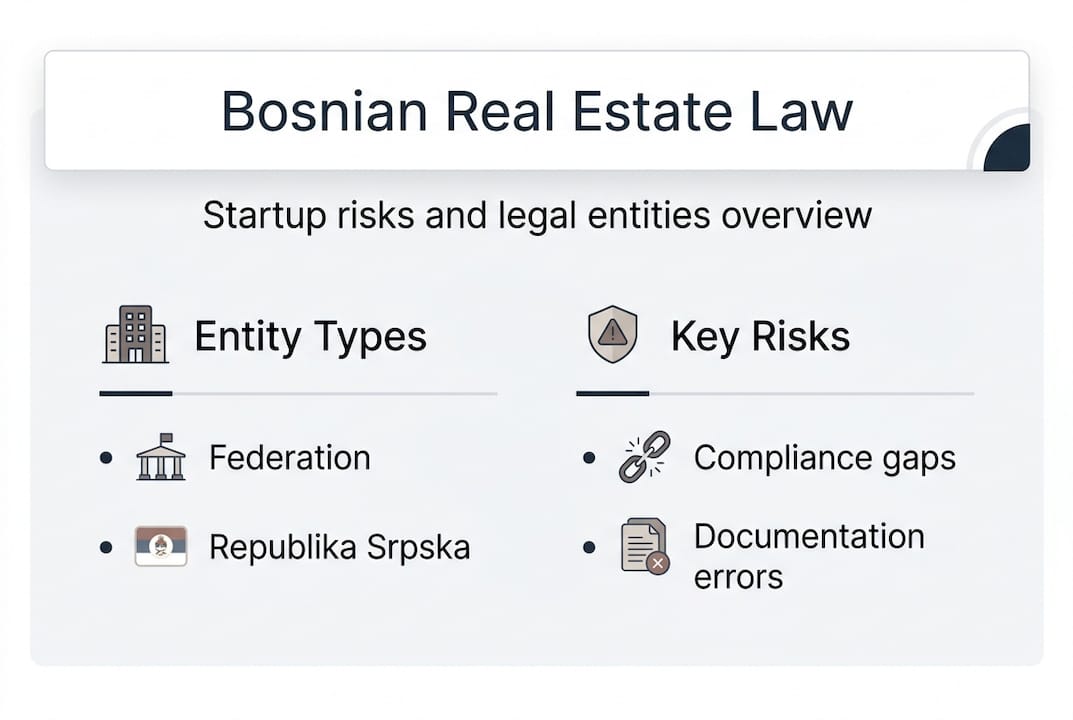
Most founders treat property acquisition as an operational task rather than a legal one. That assumption is costly in Bosnia and Herzegovina. The country's entity-specific compliance requirements mean that what is legally valid in Republika Srpska may not translate directly to the Federation of Bosnia and Herzegovina, and Brčko District operates under its own distinct framework. A startup expanding across entities faces a genuinely different legal environment at each step.
The consequences of ignoring this complexity are concrete. Property disputes can freeze assets for years. Delays in obtaining approvals can derail lease agreements and construction timelines. Failed investments, where a startup acquires property it cannot legally use for its intended purpose, are more common than most advisors admit. Refer to the legal guide to doing business in Bosnia and Herzegovina for a broader view of the regulatory environment startups must navigate.
The most common risks startups face in BiH real estate include:
- Unsynchronised land registries: Records held by courts and cadastral offices frequently contradict each other, creating genuine uncertainty over who holds valid title.
- Informal claims: Previous occupants or users may hold unregistered rights that are not visible in any official extract.
- Encumbrances not disclosed at sale: Mortgages, easements, and pre-emption rights can survive ownership transfer.
- Entity-specific regulatory gaps: Approval processes differ, and missing a cantonal or entity-level step can invalidate an otherwise complete transaction.
- State property complications: Properties that were formerly socially owned may require approval at the state level, adding significant time and uncertainty.
Pro Tip: Before committing to any property transaction, review your startup legal checklist to confirm that real estate due diligence is integrated into your broader compliance strategy from the outset.
Compliance is not optional when seeking investment or scaling. Institutional investors and international partners will scrutinise property holdings closely. Any unresolved title issue or regulatory gap becomes a direct obstacle to funding rounds and partnership agreements.
Understanding the legal landscape: Entities, due diligence, and records
Knowing why real estate law is so crucial, it's time to unpack the legal framework you'll need to operate in.
Bosnia and Herzegovina's three legal entities each govern real estate differently. Understanding these distinctions is the foundation of any sound property strategy.
| Entity | Key authority | Notable feature |
|---|---|---|
| Federation of BiH (FBiH) | Cantonal courts and cadastre | 10 cantons with varying local rules |
| Republika Srpska (RS) | Basic courts and RS cadastre | More unified registry system |
| Brčko District | District government | Separate legal regime from both entities |
Due diligence in BiH goes well beyond obtaining a land registry extract. The standard process must include:
- Cross-referencing court land books and cadastral records: These two systems often hold conflicting data, and unsynchronised land records are a primary source of post-purchase disputes.
- Identifying informal rights: Occupants or users without registered rights can still assert claims under certain circumstances, particularly where long-term use is established.
- Checking state property status: Formerly socially owned assets require BiH-level approval before transfer, a step that is frequently overlooked.
- Cantonal and municipal approvals: In FBiH, cantonal authorities add a layer of regulatory oversight that does not exist in the same form in RS.
- Reviewing encumbrances and pre-emption rights: These must be identified and resolved before any transaction is finalised.
Consult the regulatory compliance checklist for a structured overview of the approvals relevant to your entity of operation.
Pro Tip: Always request both the land book extract and the cadastral record simultaneously. Comparing them reveals discrepancies that neither document alone would disclose. This step alone has prevented significant losses for startups operating across multiple entities.
For startups considering operations in more than one entity, the practical implication is that doing business in Bosnia requires entity-specific legal counsel, not a single generalised approach. The risk of applying RS procedures to an FBiH transaction, or vice versa, is real and avoidable.
Startups and property: Company structures, ownership, and liability
With a grasp of the legal context, let's look at how startups can structure property ownership for maximum safety and agility.
The choice of legal entity through which a startup holds property directly affects its exposure to liability, tax obligations, and operational flexibility. In Bosnia and Herzegovina, the limited liability company (LLC, known locally as d.o.o.) is the most practical vehicle for property holding.

| Entity | Minimum LLC capital | Key consideration |
|---|---|---|
| Federation of BiH | 1,000 BAM | Higher threshold, cantonal registration |
| Republika Srpska | 1 BAM | Minimal barrier, unified RS registry |
| Brčko District | Separate rules | Consult District-specific requirements |
Holding property via a company structure insulates founders from personal liability and provides cleaner separation between business and personal assets. However, the LLC capital requirements differ significantly between entities, and the registration process must be completed correctly in the relevant jurisdiction.
One of the most underestimated risks in property acquisition is inherited liability. When a startup purchases property, it can inherit:
- Unpaid utility bills attached to the property rather than the previous owner.
- Outstanding tax obligations that follow the asset through transfer.
- Existing lease agreements with sitting tenants that cannot be terminated without due process.
- Environmental liabilities from previous industrial or commercial use.
"A clean title extract does not mean a clean acquisition. Liabilities travel with the asset, not the seller. Every purchase requires a full liability audit before completion."
Regarding leases, only agreements exceeding five years can be registered in the land books. Short-term leases are typically unregistered, which means they carry no public notice and their enforceability depends entirely on the written contract. Startups relying on short-term leases for operational premises should ensure the contract is precise and legally reviewed.
For guidance on structuring your company correctly, the corporate law guide provides a practical framework. Understanding legal guidance for growth is equally important when property forms a core part of your business assets.
Common pitfalls and how to avoid them: Practical steps for startups
Now that you understand what to look for in company structure and liability, here is how to ensure you are acquiring the rights you think you are.
A clean registry extract is the beginning of due diligence, not the end. Many startups treat a positive land book result as confirmation that a property is safe to acquire. In BiH, that assumption has led to significant operational and financial losses. A clean registry alone is insufficient; urban plans, infrastructure, environmental status, and state property classification must all be verified independently.
A practical due diligence process for startups should follow these steps:
- Obtain and cross-reference both land book and cadastral records for the specific parcel.
- Review the applicable urban plan to confirm the permitted use aligns with your intended business activity.
- Check infrastructure status: Confirm that utilities, road access, and services are legally connected and not subject to dispute.
- Conduct an environmental review: Former industrial sites may carry remediation obligations that transfer with ownership.
- Verify state property classification: If the property was formerly socially owned, confirm that BiH-level approval has been obtained or is not required.
- Identify all registered and unregistered users: Informal occupants can assert rights that delay or block your use of the property.
- Audit all liabilities: Obtain written confirmation from utility providers and tax authorities that no outstanding obligations exist.
"The most expensive property mistakes in Bosnia and Herzegovina are not the ones that appear in the registry. They are the ones that don't."
Pro Tip: Engage a region-specific legal advisor before any offer is made, not after. Proactive legal advice at the pre-negotiation stage costs a fraction of what dispute resolution or asset recovery will cost if problems surface post-completion.
Startups that invest in thorough, multi-layered due diligence consistently outperform those that rely on standard checks. The BiH market rewards preparation and penalises assumptions.
The overlooked truths most startup founders miss in Bosnian property deals
After covering practical steps and checklists, it is worth confronting some uncomfortable truths about real estate deals in Bosnia and Herzegovina.
Most legal risk assessments in BiH property transactions focus on what is visible: the registry, the contract, the price. What they consistently underweight is the operational disruption that follows when hidden liabilities or informal claims surface after completion. A disputed property does not just create a legal problem. It freezes capital, disrupts operations, and consumes management attention at precisely the moment a startup needs to be scaling.
The uncomfortable reality is that many advisors, including some local agents and generalist lawyers, are not sufficiently familiar with entity-specific nuances to catch the issues that matter most. Blind reliance on a registry extract remains the single most common error we observe. The registry reflects what has been formally recorded, not the full picture of rights and obligations attached to a property.
Real competitive advantage in BiH property acquisition comes from early, multi-layered due diligence conducted by advisors with direct regional experience. Review the legal insights available for BiH-specific guidance that goes beyond generic checklists. Founders who treat legal counsel as a late-stage formality consistently face avoidable losses.
Connect with the right legal expertise for property success
Navigating Bosnia and Herzegovina's fragmented real estate environment requires more than a checklist. It requires advisors who understand the entity-specific rules, the informal dynamics of local property markets, and the liability structures that can undermine an otherwise sound acquisition.
Vucic.legal provides legal services for startups across all stages of property transactions in BiH, from initial due diligence and LLC structuring through to negotiation, compliance, and dispute management. Whether you are establishing your first operational premises or acquiring assets as part of a growth strategy, expert guidance tailored to doing business in Bosnia makes a measurable difference to outcomes. Reach out to discuss your property objectives and ensure your next transaction is built on solid legal ground.
Frequently asked questions
What is the minimum capital to form an LLC for holding real estate in Bosnia and Herzegovina?
In Federation of BiH, a minimum of 1,000 BAM is required, while in Republika Srpska the minimum is 1 BAM. The registration process and applicable rules differ between the two entities.
Are all leases required to be registered in the land books?
Only leases over five years may be registered in the land books; most short-term leases are not entered into the land register and rely solely on contractual terms for enforceability.
Do new owners inherit any liabilities when purchasing property?
Yes, buyers can inherit unpaid liabilities including utility bills, tax obligations, and existing encumbrances attached to the property rather than the previous owner.
What are the most common pitfalls when startups buy property in Bosnia and Herzegovina?
Startups most frequently encounter unsynchronised land registries, informal user claims, and urban plan restrictions that render a property unsuitable for its intended business purpose.
Recommended
- Startup legal checklist 2026: ensure compliance in Bosnia
- Insights | Franjo Vucic Legal Advisory
- Legal Guide to Doing Business in Bosnia & Herzegovina | Franjo Vucic
- Doing Business in Bosnia & Herzegovina | Legal Guide for International Companies
- Почему покупать недвижимость заранее: полный гид - SunliteBG