
TL;DR:
- Confidentiality in legal advice is a fundamental ethical duty that protects client information from unauthorized disclosure, ensuring candid communication and effective legal counsel. It is distinct from, but related to, attorney-client privilege, which specifically protects certain communications in legal proceedings, and both require ongoing operational controls. The use of public AI tools poses significant risks to confidentiality and privilege by constituting third-party disclosure, making robust governance policies essential for legal and business practitioners.
Confidentiality in legal advice is defined as the professional and ethical duty of a lawyer to protect all information relating to a client's representation from disclosure without the client's consent or a lawful exception. This duty is broader than attorney-client privilege, which is a narrower evidentiary protection. The duty of confidentiality sits at the heart of the lawyer-client relationship, enabling candid communication and effective legal counsel. Without it, clients would withhold material facts, legal advice would be incomplete, and compliance with regulatory obligations would be compromised. For legal professionals and business owners operating across international markets, including Bosnia and Herzegovina, understanding the role of confidentiality in legal advice is not optional. It is a structural requirement of sound legal practice.
What ethical and legal frameworks govern confidentiality in legal advice?
Confidentiality obligations are codified in professional conduct rules across most jurisdictions. The American Bar Association's Model Rule 1.6, widely adopted in US state bars, requires lawyers to protect client information relating to the representation unless the client provides informed consent, disclosure is impliedly authorised, or a specific exception applies. The Illinois Rule 1.6 is illustrative: it covers all information relating to the representation, not merely communications, and lists narrow exceptions including preventing reasonably certain death or substantial bodily harm, preventing a client's crime or fraud, and complying with a court order.
Professional confidentiality is not absolute. Disclosure may be permitted or required to prevent serious harm, certain crimes, or to comply with legal orders. The 2026 guidance from the Law Society of British Columbia confirms that improper disclosure can harm client interests, result in loss of privilege, and trigger disciplinary proceedings. The consequences of breach extend beyond professional discipline to malpractice claims and reputational damage.
The scope of the duty is also temporal. A lawyer's obligation to maintain confidentiality continues after representation ends, covering digital communications and records created during the engagement. This is particularly relevant for businesses that change legal counsel or undergo corporate restructuring.
The key exceptions to confidentiality duties include:
- Prevention of serious crime or harm: Disclosure is permitted where a client intends to commit a crime likely to cause death, serious bodily harm, or substantial financial injury to a third party.
- Compliance with court orders: A lawyer may be compelled to disclose by a valid court order, though the lawyer should first assert privilege on the client's behalf.
- Self-defence in legal proceedings: A lawyer may disclose information to defend against a client's allegation of wrongdoing or to collect fees in a dispute.
- Regulatory compliance: Certain regulated sectors, including financial services and anti-money laundering regimes, impose mandatory reporting obligations that override confidentiality.
Pro Tip: Include a clear confidentiality clause in every engagement letter that specifies the scope of the duty, the exceptions that may apply, and the firm's policy on digital communications and AI tools. This sets expectations and reduces the risk of inadvertent waiver.
How does confidentiality differ from attorney-client privilege?
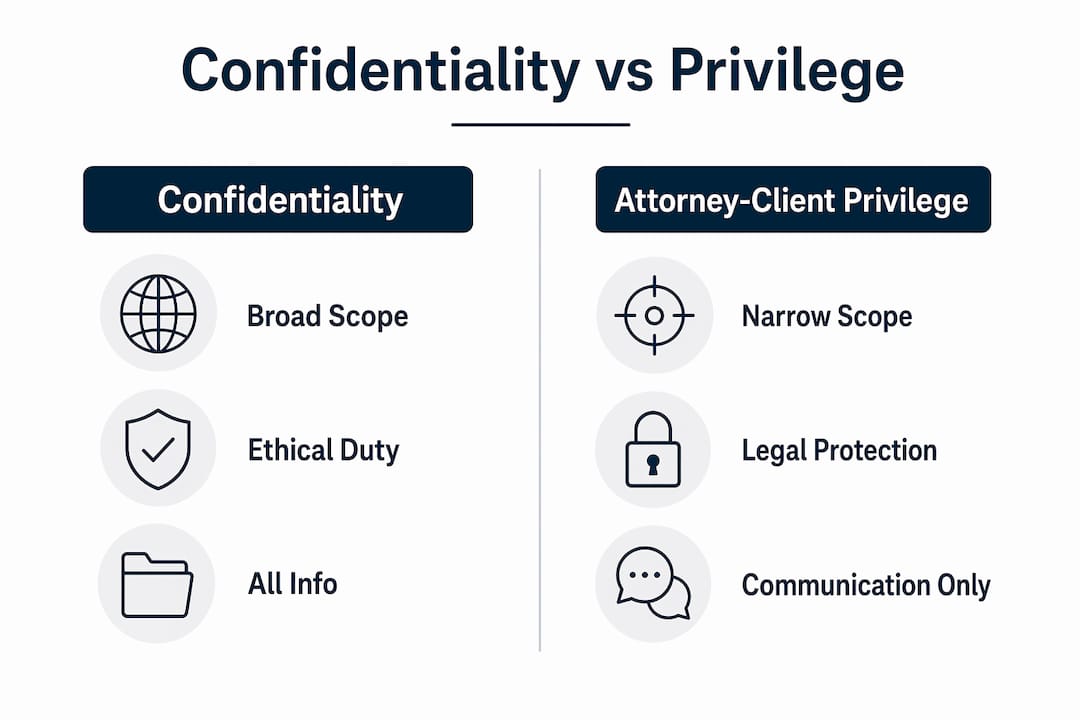
Confidentiality and attorney-client privilege are related but distinct protections. Confidentiality bars lawyers from sharing client information in any setting without permission. Privilege, by contrast, is an evidentiary rule that prevents compelled disclosure of certain communications in court or regulatory proceedings. The distinction matters because a communication can be confidential without being privileged, but a privileged communication is always confidential.
| Aspect | Confidentiality | Attorney-client privilege |
|---|---|---|
| Scope | All information relating to representation | Confidential communications made for legal advice |
| Setting | Applies in all contexts, not just court | Applies in judicial and regulatory proceedings |
| Holder | Lawyer's ethical duty | Client's right; lawyer asserts on client's behalf |
| Waiver | Breach of ethical duty; disciplinary consequences | Waiver destroys evidentiary protection permanently |
| Duration | Continues after representation ends | Survives death of client in most jurisdictions |
For privilege to attach, the communication must be made in confidence, between a lawyer and client, for the purpose of obtaining or giving legal advice. In corporate settings, courts assess whether reasonable steps were taken to maintain confidentiality. The presence of third parties, improper sharing within an organisation, or failure to mark documents as privileged can all defeat the protection. Unintentional waivers are common in corporate environments where legal and commercial teams share document repositories without adequate access controls.
The practical consequences of losing privilege are severe. Once waived, privilege cannot be restored. A document that loses privilege in one proceeding may be discoverable in subsequent litigation. Business owners and in-house counsel must treat privilege maintenance as an ongoing operational discipline, not a one-time designation.
Confidentiality breaches, while also serious, are addressed through professional conduct mechanisms rather than evidentiary consequences. The lawyer faces disciplinary action, potential malpractice liability, and loss of client trust. The client, however, retains the right to seek injunctive relief to prevent further disclosure.
What risks do AI tools pose to confidentiality and privilege?
The use of generative AI platforms in legal practice has created a category of risk that professional conduct frameworks are only beginning to address. The central problem is that inputting confidential client information into a public or consumer-grade AI platform constitutes a disclosure to a third party. That disclosure can destroy both confidentiality and privilege protections simultaneously.

The 2026 decision in US v. Heppner is the clearest judicial statement on this risk to date. In that case, 31 AI-generated documents produced using the Claude chatbot were held not to be protected by privilege or the work product doctrine. The court's reasoning was that submitting information to a third-party AI platform was inconsistent with maintaining the confidentiality required for privilege to attach. The decision has significant implications for any legal team or business that uses public AI tools to draft, analyse, or summarise legal communications.
The risks can be categorised as follows:
- Third-party disclosure: Consumer AI platforms process user inputs on external servers. Inputting privileged information into such a platform is legally equivalent to sharing it with a third party, which destroys privilege.
- Work product exposure: AI-generated drafts, summaries, and analyses may not qualify for work product protection if produced using a platform that retains or processes data externally.
- AI transcription and notetaking: Tools that automatically transcribe meetings or calls, such as consumer-grade transcription services, may capture privileged communications and store them on third-party servers.
- Employee misuse: Legal and commercial staff who use public AI tools for convenience, without understanding the privilege implications, represent a significant and underappreciated risk vector.
- Regulatory scrutiny: Data protection regulators in the EU, including under the GDPR framework, may treat AI platform disclosures as personal data breaches, adding a compliance dimension to the privilege risk.
The distinction between AI as a drafting aid and AI as a third-party recipient is critical. An AI tool deployed on a firm's own infrastructure, with no external data transmission, does not create the same disclosure risk. The technology law compliance obligations for businesses operating in the EU add a further layer of complexity, as data localisation and processing requirements intersect with privilege considerations.
Pro Tip: Adopt a written AI governance policy that explicitly prohibits inputting privileged or confidential client information into any public AI platform. Specify approved tools, require legal review before any new AI tool is adopted, and include AI usage training in annual compliance programmes.
What practical steps protect confidentiality in legal communications?
Maintaining confidentiality requires operational systems, not merely policy statements. The following measures address the most common failure points identified in professional conduct guidance and recent case law.
Restrict access to confidential communications by implementing document management systems with role-based access controls. Legal files should not be accessible to commercial or administrative staff without a defined need. In corporate settings, a shared drive accessible to the entire organisation is incompatible with privilege maintenance.
Train all staff who handle legal communications on the distinction between confidential and non-confidential information, the consequences of inadvertent disclosure, and the specific risks posed by public AI platforms. Training should be documented and repeated annually. The corporate confidentiality obligations that apply to businesses operating internationally make this training a compliance requirement, not merely good practice.
Review client communication channels regularly. Email remains the primary vector for inadvertent disclosure. Encrypted communication platforms, secure client portals, and clear protocols for sharing documents with third parties reduce the risk of unintended disclosure.
Include specific AI and technology provisions in engagement letters and confidentiality agreements. Clients should be informed of the firm's AI governance policy and the risks of using public AI tools to communicate about legal matters. This is particularly relevant for business clients whose in-house teams may independently use AI tools to process legal advice received from external counsel.
- Mark all privileged documents clearly and consistently, using headers such as "Privileged and Confidential: Attorney-Client Communication."
- Conduct periodic privilege audits, particularly before litigation or regulatory investigations, to identify documents that may have lost protection through inadvertent disclosure.
- Establish a clear protocol for responding to third-party requests for confidential information, including a requirement to assert privilege before any disclosure and to notify the client immediately.
Pro Tip: When advising business clients on legal guidance for growth, include a confidentiality audit as part of the initial engagement. Identifying existing privilege gaps before litigation arises is significantly less costly than addressing them after the fact.
Key takeaways
Confidentiality in legal advice is a structural protection that enables candid communication, supports privilege, and underpins compliance. Without operational systems to maintain it, both lawyers and business clients face disciplinary, evidentiary, and regulatory consequences.
| Point | Details |
|---|---|
| Confidentiality vs privilege | Confidentiality is an ethical duty covering all client information; privilege is a narrower evidentiary protection for specific communications. |
| AI tool risk | Inputting privileged information into public AI platforms constitutes third-party disclosure and can destroy both confidentiality and privilege. |
| Temporal scope | The duty of confidentiality continues after representation ends, covering all digital communications and records. |
| Operational systems | Access controls, staff training, and AI governance policies are required to maintain confidentiality in practice. |
| Waiver consequences | Privilege once waived cannot be restored; documents become discoverable in current and future proceedings. |
Confidentiality as a foundation, not a formality
Having advised businesses operating across multiple jurisdictions, I have observed a consistent pattern: confidentiality is treated as a compliance checkbox rather than an operational discipline. Engagement letters contain the standard clause, but the systems required to give that clause meaning are absent. Document repositories are shared too broadly, AI tools are adopted without legal review, and staff receive no training on the distinction between confidential and non-confidential communications.
The US v. Heppner decision in 2026 is a useful corrective. It demonstrates that courts will not protect privilege where the party claiming it has not taken reasonable steps to maintain confidentiality. The standard is not perfection, but it is more demanding than most corporate legal teams currently meet.
The international dimension adds further complexity. Businesses operating in Bosnia and Herzegovina, the EU, and other markets face overlapping confidentiality regimes. What constitutes a permissible disclosure under one jurisdiction's professional conduct rules may constitute a breach under another's data protection framework. Counsel advising cross-border clients must map these obligations explicitly, not assume equivalence.
The most effective approach is to treat confidentiality as a system requirement from the outset of any engagement. That means defined access controls, documented AI governance, trained staff, and regular audits. It also means educating clients on their own obligations, particularly regarding the use of AI tools to process legal advice. Clients who use public AI platforms to summarise or analyse advice received from external counsel may inadvertently waive the privilege that counsel worked to establish.
Confidentiality is not a passive protection. It requires active maintenance by both lawyer and client.
— Franjo
How Vucic supports businesses in protecting confidential legal communications
Vucic provides strategic legal advisory services to growth-oriented businesses operating in Bosnia and Herzegovina and across European markets, with confidentiality and discretion as core operating principles. For businesses managing cross-border transactions, regulatory compliance, or technology-related legal risk, the intersection of confidentiality obligations and operational practice requires specialist guidance.
The corporate law framework that governs business operations in Bosnia and Herzegovina includes specific confidentiality obligations that international companies must understand before entering the market. Vucic's advisory services cover the full range of confidentiality-related legal requirements, from engagement structuring and privilege management to AI governance policies and data protection compliance. For businesses seeking legal counsel that understands both the regulatory requirements and the operational realities of maintaining confidentiality in 2026, Vucic offers strategic legal services tailored to those demands.
FAQ
What is the role of confidentiality in legal advice?
Confidentiality in legal advice is the ethical and professional duty of a lawyer to protect all information relating to a client's representation from disclosure without consent or a lawful exception. It enables candid communication between client and lawyer, which is the foundation of effective legal representation.
How does attorney-client privilege differ from confidentiality?
Confidentiality is a broad ethical duty that applies in all contexts and covers all client information. Attorney-client privilege is a narrower evidentiary protection that prevents compelled disclosure of specific communications in court or regulatory proceedings.
Can using AI tools destroy attorney-client privilege?
Yes. In US v. Heppner (2026), a US court held that 31 AI-generated documents were not protected by privilege or the work product doctrine because they were produced using a public AI platform, constituting third-party disclosure.
Does the duty of confidentiality end when representation ends?
No. The duty of confidentiality continues after representation ends and covers all information obtained during the engagement, including digital communications and documents.
What are the consequences of breaching confidentiality in legal practice?
Breach of confidentiality can result in professional disciplinary proceedings, malpractice claims, loss of attorney-client privilege, and reputational damage. In regulated sectors, it may also trigger regulatory enforcement action under data protection or financial services law.