
TL;DR:
- Corporate structure in Bosnia determines liability, taxation, fundraising, and scalability strategies.
- Choosing the right legal form impacts daily operations, decision-making speed, and risk management.
- Expert legal guidance helps optimize structure for growth, legal compliance, and long-term success.
Most business leaders treat corporate structure as an administrative formality. They register an entity, tick the compliance boxes, and move on. Yet the legal form you choose determines your liability exposure, your tax obligations, your ability to raise capital, and your freedom to scale. Corporate structure affects liability protection, taxation, fundraising ability, and compliance requirements. For growth-oriented companies in Bosnia and Herzegovina, this decision carries enormous strategic weight. This guide unpacks the practical, operational, and financial dimensions of corporate structure so your leadership team can make informed choices with confidence.
Table of Contents
- Understanding corporate structure: The foundation for business growth
- Legal and financial impacts: Liability, tax, and fundraising explained
- Operational efficiency and decision-making: Why structure shapes results
- Comparing hierarchy and flexibility: Costs and competitive advantage
- A fresh perspective: Why copying 'standard' structures can hold your company back
- How expert legal support turns structure into an engine for growth
- Frequently asked questions
Key Takeaways
| Point | Details |
|---|---|
| Structure shapes growth | Your company’s structure directly affects legal risk, access to investment, and expansion flexibility. |
| Legal form drives compliance | Correct choice minimises liability and helps you meet regulatory requirements as you scale. |
| Operational clarity boosts performance | A well-defined structure speeds decisions, communication, and accountability within your team. |
| Hierarchy has pros and cons | Hierarchical models drive innovation but come with higher admin costs and lower flexibility. |
| Expert advice avoids costly mistakes | Strategic structuring support saves time and reduces risks for fast-growing Bosnian companies. |
Understanding corporate structure: The foundation for business growth
Corporate structure refers to the legal form through which a business is organised and owned. It defines the relationship between the company and its owners, how profits are distributed, who bears responsibility for losses, and how decisions are made. Getting this right from the outset is not just a legal exercise. It is a strategic lever.
In Bosnia and Herzegovina, the primary entity types available to businesses include:
- Sole proprietorship (samostalni poduzetnik): Simple and inexpensive to register, but the owner carries unlimited personal liability for all business obligations.
- Limited liability company (d.o.o.): The most widely used structure, offering limited liability to shareholders and significant operational flexibility. Minimum share capital requirements apply.
- Joint-stock company (d.d.): Suited for larger businesses seeking to raise capital from investors or public markets. Governance requirements are more demanding, but the structure supports complex ownership and fundraising arrangements.
- Branch offices and subsidiaries: Used by foreign entities entering the Bosnian market, each with different liability and tax treatment.
Understanding corporate law essentials is critical before committing to any one form, because restructuring later is costly and disruptive.
| Entity type | Liability | Capital requirement | Investor readiness |
|---|---|---|---|
| Sole proprietorship | Unlimited personal | None | Very low |
| LLC (d.o.o.) | Limited to contribution | Moderate | High |
| Joint-stock company (d.d.) | Limited to shares | High | Very high |
| Branch office | Parent bears liability | None | Moderate |
Pro Tip: Many early-stage founders in Bosnia choose the sole proprietorship for its simplicity, only to face significant restructuring costs when their first institutional investor requires a limited liability entity. If growth is part of your plan, start with an LLC.
Legal and financial impacts: Liability, tax, and fundraising explained
With a foundation established, the real-world stakes become clear. Your choice of structure is not abstract; it shapes your personal financial exposure, your tax burden, and your ability to attract the investment needed to scale.
Liability is the most immediate concern. A sole trader in Bosnia bears full personal liability, meaning creditors can pursue your personal assets if the business fails. An LLC limits each shareholder's exposure to their capital contribution, protecting personal savings, property, and other assets. A joint-stock company offers similar protections but with more formal governance requirements.
Taxation follows a different logic depending on your structure. Sole proprietors are taxed on business income as personal income. LLCs and joint-stock companies are subject to corporate income tax, currently at 10% in Bosnia and Herzegovina, followed by dividend taxation when profits are distributed. Choosing between these paths affects your effective tax rate and the options available for reinvestment.
Fundraising is where structure becomes a genuine competitive differentiator. Institutional investors, venture capital firms, and strategic partners expect a corporate entity that supports formal ownership structures, shareholder agreements, and equity instruments. Understanding legal risks in scaling is particularly relevant here, as poorly structured companies often discover these gaps only when a deal is on the table. The way you arrange investment contract structure also varies significantly depending on your entity type.
Here is a direct comparison:
| Structure | Liability exposure | Tax treatment | Fundraising suitability |
|---|---|---|---|
| Sole proprietorship | Unlimited | Personal income tax | Very limited |
| LLC (d.o.o.) | Limited | Corporate + dividend tax | Strong |
| Joint-stock company | Limited | Corporate + dividend tax | Excellent |
To reassess your structure as your business grows, work through these steps:
- Audit your current liability exposure and personal asset risk.
- Review your effective tax rate against alternative structures.
- Identify your next financing round and what investors will require.
- Engage a legal adviser to model the cost of transition versus the cost of staying put.
- Implement changes before, not during, a funding or M&A process.
Operational efficiency and decision-making: Why structure shapes results
Beyond legal boxes, structure changes day-to-day operations and determines how fast and well your business functions. The way a company is organised internally affects who can approve decisions, how information flows, and whether accountability is clear or diffuse.
Company structure impacts decision-making speed, efficiency, scalability, accountability, communication, risk management, and talent retention. For growth-oriented companies, each of these dimensions carries direct financial consequences.
"Only 46% of employees report knowing what is expected of them at work." This figure signals how much operational value is lost when organisational structure fails to define roles, responsibilities, and reporting lines clearly.
A well-designed structure addresses several critical operational needs at once:
- Decision speed: Clear authority structures reduce the time lost to escalation and ambiguity.
- Risk management: Defined accountability means risks are spotted and addressed by the right people at the right level.
- Communication: Structured reporting lines reduce information loss and internal conflict.
- Talent retention: High-performing professionals expect clarity about their role, career path, and authority. Without it, they leave.
When operational bottlenecks persist, leadership confusion is often the root cause. Understanding how to approach managing legal disputes in a structured way is also relevant here, as unclear governance creates conditions where internal disagreements escalate unnecessarily.

Comparing hierarchy and flexibility: Costs and competitive advantage
If operations depend on structure, the question becomes whether hierarchy or flexibility delivers better returns for your company. The answer depends on your growth stage, industry, and strategic priorities.
More hierarchical firms show higher return on assets, higher net profit margins, more patents, and greater acquisition activity. However, they also carry higher administrative costs and lower revenue per employee. Flat structures, by contrast, tend to move faster and adapt more readily, but can struggle with accountability at scale.
Legal form has a strong relationship with company efficiency, growth, and risk, and corporate forms with limited liability do not automatically produce the highest efficiency. This is a finding that many leaders find counterintuitive. Structure alone does not guarantee performance; how it is managed determines outcomes.
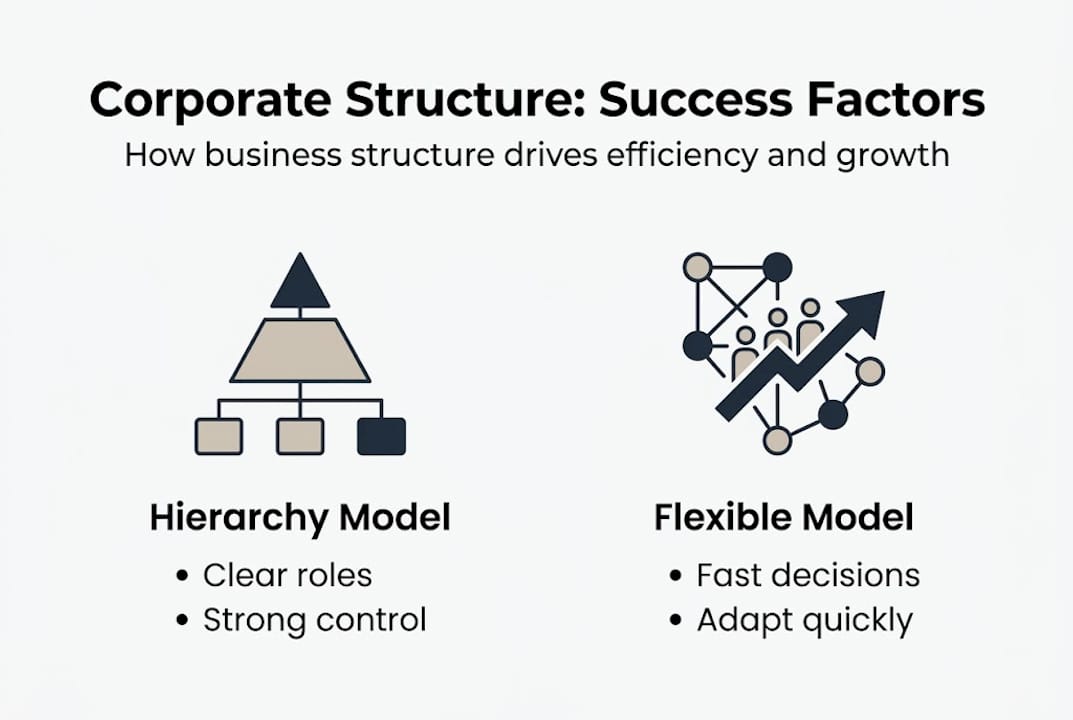
| Feature | Hierarchical structure | Flat structure |
|---|---|---|
| Decision speed | Slower | Faster |
| Innovation output | Higher (patents) | Variable |
| Administrative cost | Higher | Lower |
| Revenue per employee | Lower | Higher |
| Scalability | Strong | Moderate |
| Accountability | Clear | Can be diffuse |
Pro Tip: Many growth companies in Bosnia over-engineer hierarchy in the early stages, believing it signals professionalism to investors. In practice, it slows decisions and adds cost without proportionate gain. A lean, well-documented structure often outperforms a complex one at this stage.
Digital transformation and AI adoption are accelerating a shift towards flatter models. Companies that want to move quickly in technology-driven markets should factor in the structural drag that comes with excessive layers of management. Getting legal guidance for growth at this stage ensures that structural changes are compliant and strategically sound.
A fresh perspective: Why copying 'standard' structures can hold your company back
There is a tendency among business leaders in Bosnia and Herzegovina to adopt whatever structure their peers or advisers most commonly recommend, typically an LLC with a standard set of governance documents. This approach is understandable. It feels safe. But it carries a risk that rarely surfaces until the wrong moment.
Best practice templates are designed for average conditions. They do not account for your specific market position, ownership dynamics, investor profile, or growth ambitions. Over the years advising growth businesses in Bosnia, we observe the same pattern: companies that copy standard structures without interrogating whether they fit their actual strategy often face expensive restructuring precisely when they can least afford it, during a funding round, an acquisition, or a regulatory review.
The most common local pitfalls include over-engineering governance for control in early stages, underestimating how much flexibility matters as the business scales, and failing to revisit structure after significant operational changes. Explore our legal growth insights to see how structure decisions play out across different sectors and growth stages.
The right approach is to treat structure as a living decision. Evaluate it when you launch, revisit it when you scale, and reassess it when market conditions shift.
How expert legal support turns structure into an engine for growth
Understanding the strategic importance of corporate structure is only part of the challenge. Implementing the right structure and maintaining it through periods of growth requires precise legal expertise.
At Franjo Vučić Legal, we work with growth-oriented companies in Bosnia and Herzegovina to translate structural decisions into measurable competitive advantages. Whether you are selecting a structure at incorporation, restructuring ahead of investment, or navigating compliance as you scale, tailored legal counsel saves time, reduces risk, and positions your business for sustainable growth. Review our corporate law guide for a practical foundation, then explore our full range of strategic legal services to understand how expert structuring advice applies to your specific situation.
Frequently asked questions
What is the most common corporate structure in Bosnia and Herzegovina?
The limited liability company (LLC or d.o.o.) is the most widely used structure, offering liability protection and flexibility that suits most growth-stage businesses.
How does corporate structure influence tax obligations?
Your chosen structure determines whether business income is taxed at the personal or corporate level, directly affecting your overall tax burden and reinvestment options.
Can I change my company's corporate structure later?
Yes, restructuring is possible but involves legal, tax, and operational complexity; early structural mistakes become significantly more costly to resolve during investment or scaling phases.
Does having a more hierarchical structure improve performance?
Hierarchical firms show stronger innovation and financial returns in some areas, but higher administrative costs and reduced agility can offset these gains for growth-stage companies.
Why is clarity in organisational structure important for employee retention?
Clear structure defines roles and reporting lines, increasing accountability and ensuring that talent retention and communication are supported by a coherent operational framework.
Recommended
- What is corporate law: Essential guide for leaders
- Insights | Franjo Vucic Legal Advisory
- Why strategic legal advice drives growth for leaders
- Franjo Vučić – Corporate & Technology Lawyer | Vucic Legal
- Top technology trends: What business leaders need for 2026
- Sustainable growth strategies for entrepreneurs in 2026 – Starfireblast