
TL;DR:
- Family law issues like divorce and inheritance can disrupt business ownership and control.
- Proactive legal tools such as marital and shareholder agreements help manage family law risks.
- Regular review and integration of family law considerations into succession planning ensure business resilience.
Business leaders in Bosnia and Herzegovina frequently invest considerable effort in structuring shareholder agreements, drafting corporate bylaws, and mapping out leadership transitions, yet one critical variable is routinely overlooked: family law. The assumption that succession planning is purely a matter of corporate governance is not only common but genuinely costly. A single divorce, an unexpected inheritance claim, or a disputed will can unravel years of carefully constructed business arrangements. This article explains precisely how family law intersects with succession planning, identifies the most significant risks, and outlines the practical tools available to business owners who want to protect continuity and control.
Table of Contents
- Understanding the intersection of family law and business succession
- Common risks: How family law can disrupt your succession plan
- Key tools and strategies for risk management
- Best practices: Building a succession plan that survives family law surprises
- Perspective: Why most succession failures are preventable with a family-law lens
- How expert legal guidance can secure your business future
- Frequently asked questions
Key Takeaways
| Point | Details |
|---|---|
| Family law shapes succession | Ignoring family law can expose your business to unexpected ownership and control changes during succession. |
| Proactive planning reduces risk | Regularly reviewing legal structures and family dynamics ensures business continuity. |
| Legal tools provide security | Marital contracts, shareholder agreements, and trusts can safeguard your business legacy. |
| Expert advice is essential | A specialist legal team can anticipate and address risks that most business owners miss. |
Understanding the intersection of family law and business succession
Family law governs the legal relationships between individuals within a family unit, including marriage, divorce, inheritance, and parental rights. In a business context, these relationships directly affect who owns shares, who can exercise voting rights, and who ultimately controls strategic decisions. Understanding corporate law essentials is necessary, but it is insufficient on its own when family events can alter the ownership landscape overnight.
In Bosnia and Herzegovina, the legal framework for succession draws from both the Law on Inheritance and the Family Law of the relevant entity, whether the Federation of Bosnia and Herzegovina or Republika Srpska. These frameworks establish statutory inheritance rights that can override privately agreed succession arrangements if those arrangements are not legally sound. Spouses, children, and in some cases parents hold legally protected inheritance shares that courts will enforce regardless of informal understandings between business partners.
The following scenarios illustrate how family law becomes a business issue:
- A founding shareholder dies without a valid will, and statutory inheritance rules distribute shares among multiple heirs, none of whom have business experience or aligned interests.
- A co-founder divorces, and the court determines that shares accumulated during the marriage constitute marital property subject to division.
- A shareholder remarries, and the new spouse acquires inheritance rights that were never contemplated in the original shareholder agreement.
- A business owner's child from a previous relationship contests the estate, creating protracted litigation that freezes company decision-making.
The table below summarises how specific family law events map to business succession consequences:
| Family law event | Potential business impact | Risk level |
|---|---|---|
| Divorce | Forced share division or transfer | High |
| Death without a will | Statutory heirs become shareholders | Very high |
| Contested inheritance | Delayed or blocked leadership transition | High |
| Remarriage | New spousal inheritance rights | Medium |
| Birth of additional heirs | Diluted ownership structure | Medium |
Adopting proactive legal advice before these events occur is far more effective than attempting to manage them reactively. The intersection of family law and business succession is not a theoretical concern; it is a practical risk that materialises regularly in Bosnian business practice.
Common risks: How family law can disrupt your succession plan
Now that the basics of the intersection are clear, consider the concrete risks businesses face when family law factors are neglected. These risks are not abstract; they have measurable consequences for ownership structure, operational continuity, and company valuation.
Divorce and share division represent the most immediate threat. Under Bosnian family law, assets acquired during a marriage are generally treated as joint marital property. This includes business shares purchased or built up during the marriage. If a shareholder divorces, the court may award a portion of those shares to the former spouse, who then becomes an unwanted co-owner with full legal rights. This scenario can force leadership changes, disrupt board dynamics, and introduce a party with no strategic alignment to the business.
Inheritance disputes are equally disruptive. When a shareholder dies without a clear succession plan, statutory inheritance rules apply. Multiple heirs may receive fractional ownership of the same shares, creating a fragmented ownership structure that complicates governance. Legal risks in succession are particularly acute when the deceased held a controlling stake, as the resulting deadlock can paralyse strategic decisions for months or years.

Unexpected shareholders emerge when spouses or relatives inherit shares without any prior involvement in the business. These individuals may lack the expertise, motivation, or willingness to cooperate with existing management, creating friction at the ownership level that cascades into operational disruption.
The following list ranks the key succession risks triggered by family events, in order of typical severity:
- Death of a controlling shareholder without a will or buy-sell agreement.
- Divorce resulting in court-ordered share transfer to a former spouse.
- Contested estate leading to prolonged court proceedings and ownership uncertainty.
- Remarriage introducing new statutory heirs not contemplated in the original plan.
- Estranged family members asserting inheritance rights over business assets.
The comparison below illustrates the difference between businesses that address family law proactively and those that do not:
| Scenario | Business with family law planning | Business without family law planning |
|---|---|---|
| Shareholder divorce | Shares governed by marital contract; no forced transfer | Court-ordered share division; new unwanted co-owner |
| Shareholder death | Succession plan activates; smooth leadership transition | Statutory heirs inherit; governance disruption |
| Inheritance dispute | Shareholder agreement provides dispute resolution mechanism | Protracted litigation; frozen decision-making |
| New family members | Pre-agreed protocols manage new entrants | Unplanned dilution of ownership and control |
Effective management of legal disputes in business transitions depends heavily on having these structures in place before a crisis occurs.
Pro Tip: Conduct a family law exposure audit alongside your next corporate governance review. Identify every shareholder's marital status, family composition, and existing estate planning documents. This single exercise frequently reveals vulnerabilities that standard corporate due diligence misses entirely.
Key tools and strategies for risk management
Having outlined the main risks, the next logical step is to consider how to protect your business proactively. Several legal instruments are available to business owners in Bosnia and Herzegovina, and the most effective succession plans combine multiple tools rather than relying on any single mechanism.
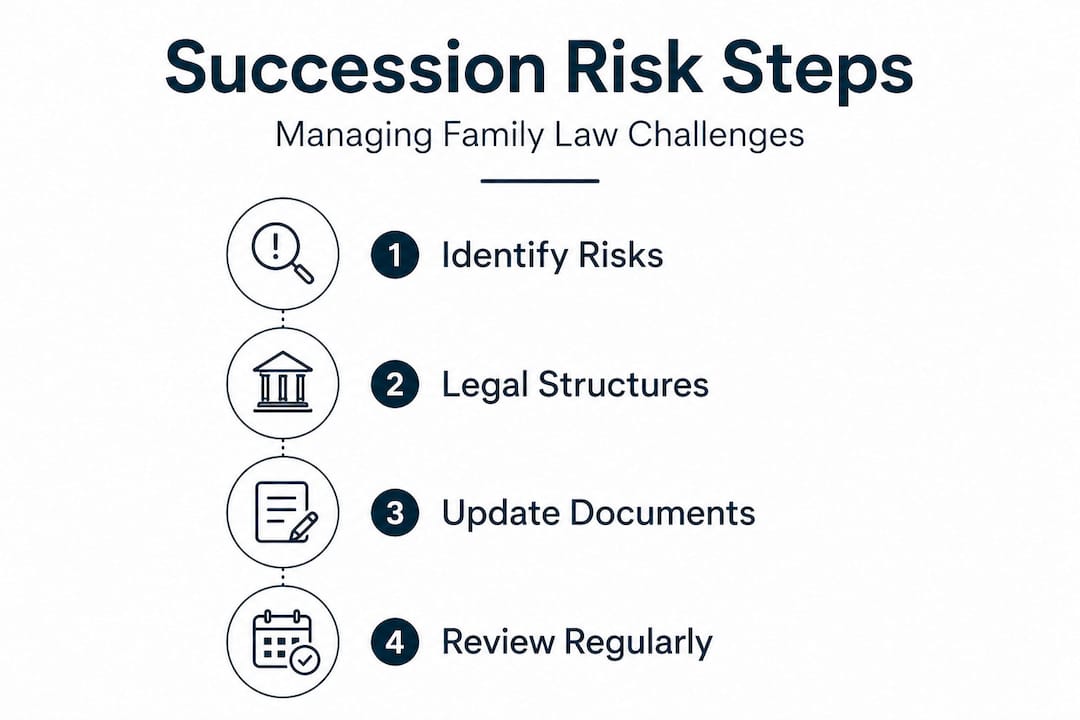
Marital contracts (prenuptial or postnuptial agreements) are among the most direct tools for separating personal family assets from business interests. A well-drafted marital contract specifies that business shares remain the separate property of the shareholder, regardless of when they were acquired. This removes the shares from the pool of marital property subject to division in the event of divorce. While marital contracts require both spouses to agree and must meet formal legal requirements to be enforceable, they provide a strong first line of protection.
Shareholder agreements are equally essential. These agreements can include provisions that restrict the transfer of shares to third parties, including family members who inherit or receive shares through divorce proceedings. Common mechanisms include:
- Pre-emption rights, which require any shareholder wishing to transfer shares to first offer them to existing shareholders.
- Drag-along and tag-along clauses, which manage the rights of minority and majority shareholders during ownership transitions.
- Buy-sell provisions triggered by death, divorce, or incapacity, which allow remaining shareholders to purchase the affected shares at a pre-agreed valuation.
- Restrictions on share transfers to persons who are not approved by the board or existing shareholders.
Holding companies and corporate structures provide an additional layer of protection. By holding business shares through a separate legal entity, individual shareholders can reduce their direct personal exposure to family law claims. The holding company owns the operating business, and the individual owns shares in the holding company. This structure adds complexity but can significantly limit the reach of family law proceedings into core business assets. Explore the full range of business law services available to structure these arrangements appropriately.
Succession planning documents, including wills, testamentary trusts, and powers of attorney, ensure that the shareholder's intentions are clearly documented and legally enforceable. A valid will that specifically addresses business shares, combined with a shareholder agreement that aligns with that will, creates a coherent framework that courts can follow without ambiguity. Protecting sensitive business arrangements also requires attention to business confidentiality, particularly when succession planning involves disclosing ownership structures or financial valuations to multiple parties.
Pro Tip: Schedule a formal legal review of all succession-related documents every two to three years, or immediately following any significant family event such as a marriage, divorce, birth, or death. Business structures and family circumstances evolve, and documents drafted five years ago may no longer reflect current realities.
Best practices: Building a succession plan that survives family law surprises
Once you know which tools are available, you need to embed these into ongoing practice. A succession plan is not a static document; it is a living framework that must be updated as both the business and the family evolve.
The following steps represent best practice for building a resilient succession plan:
- Map the ownership structure against family relationships. For each shareholder, document their marital status, existing estate planning documents, and any known family law exposures. This baseline assessment identifies where vulnerabilities exist before they become disputes.
- Align corporate documents with family law instruments. Ensure that shareholder agreements, company statutes, and marital contracts are consistent with one another. Contradictions between these documents create legal uncertainty that courts must resolve, often at significant cost to the business.
- Establish clear communication protocols. Define how and when family members will be informed of succession arrangements. Surprises create disputes. Transparent communication, governed by confidentiality agreements where necessary, reduces the likelihood of contested claims.
- Appoint a neutral executor or trustee. Where shares are to be held in trust or managed during a transition period, appointing a neutral professional rather than a family member reduces the risk of conflicts of interest.
- Test the plan against realistic scenarios. Run through hypothetical events, such as the sudden death of the majority shareholder or a contested divorce, and assess whether the current plan produces the intended outcome. Gaps identified in this exercise should be addressed immediately.
- Integrate succession planning into the broader corporate governance framework. Succession is not a one-time event; it is a governance responsibility. Corporate structure decisions should always account for succession implications from the outset.
"The businesses that navigate succession most successfully are those that treat family law not as an external complication but as an integral part of their governance strategy. Legal foresight at the planning stage costs a fraction of what reactive litigation costs when a family event disrupts an unprepared business."
Building resilience means accepting that family circumstances will change and designing a plan that accommodates those changes without requiring a complete restructure each time. The most durable succession plans are those built with flexibility, clarity, and legal precision from the beginning.
Perspective: Why most succession failures are preventable with a family-law lens
These best practices pave the way for future stability, but there is a deeper lesson that sets successful businesses apart from those that struggle through succession crises.
The most common reason succession plans fail is not inadequate corporate documentation. It is the persistent tendency to treat family law as someone else's problem, a personal matter separate from the boardroom. This separation is artificial and, in practice, extremely costly. Family law and corporate law operate in the same legal space. When a court divides marital assets, it does not pause to consider whether the business would prefer a different outcome. When statutory inheritance rules apply, they override informal agreements that were never properly documented.
Explore more succession insights and you will find a consistent pattern: the businesses that experience the most disruptive succession events are those where the founders assumed goodwill and family harmony would be sufficient. They are not. Goodwill does not survive a contested divorce or a disputed estate. Legal instruments do.
There is also a subtler point worth making. The visible risks in succession planning, such as tax liability, regulatory compliance, and leadership capability, receive significant attention precisely because they are visible. Family law risks are invisible until they materialise. A shareholder's marital difficulties, a strained relationship with an adult child, or an undisclosed second family are not matters that appear in a company's financial statements. Yet each of these situations can produce a legal claim that reshapes the ownership structure entirely.
Savvy business leaders recognise that invisible risks require deliberate investigation. They commission family law reviews alongside corporate due diligence. They ask their legal advisers to stress-test succession plans against family law scenarios, not just corporate ones. This integrated approach is not overcautious; it is the standard that serious succession planning demands.
How expert legal guidance can secure your business future
Considering everything above, what is the next practical step for business owners and executives in Bosnia and Herzegovina?
The intersection of family law and business succession is too consequential to address with generic templates or informal arrangements. It requires legal advisers who understand both the corporate governance framework and the family law landscape specific to Bosnia and Herzegovina, and who can draft instruments that hold up under judicial scrutiny.

Vucic.legal provides cross-disciplinary legal guidance that addresses succession planning as a unified challenge, not a series of disconnected documents. Whether you need to review your current shareholder agreement for family law vulnerabilities, draft a marital contract that protects business assets, or build a comprehensive succession framework from the ground up, specialist advice makes the difference. Review the available corporate law guidance to understand the full scope of considerations involved, and explore tailored legal services designed for businesses operating in Bosnia and Herzegovina. To discuss your specific situation and assess your current plan for vulnerabilities, consult Franjo Vučić directly and take the first step towards a succession plan built to last.
Frequently asked questions
Can a spouse claim business shares after a divorce in Bosnia and Herzegovina?
Yes, without a marital contract or clear company statute, spouses may claim shares acquired during the marriage due to family law provisions that treat such assets as joint marital property.
How often should a business succession plan be reviewed regarding family law?
Succession plans should be reviewed after major family events such as marriage, divorce, or the birth of children, and at minimum every two to three years to reflect changes in both family circumstances and the business structure.
Do inheritance disputes affect company control in Bosnia and Herzegovina?
Yes, inheritance disputes may delay or obstruct company leadership changes if family law is not addressed in the succession plan, as courts may freeze asset transfers pending resolution of competing claims.
What legal tools best protect businesses from family disputes?
Shareholder agreements with pre-emption rights and buy-sell provisions, marital contracts, and properly structured holding companies can each minimise business disruption arising from family conflicts, and they are most effective when used in combination.