
EU businesses have collectively faced over €5 billion in GDPR fines and related expenses since 2018, a figure that reframes legal guidance as a core business investment rather than an administrative formality. For companies operating in Bosnia and Herzegovina or expanding across European markets, the regulatory environment is layered, fast-moving, and unforgiving of gaps. This article sets out the specific risks of operating without proper legal support, quantifies the cost of non-compliance, and provides a practical framework for embedding legal guidance into your growth strategy from the outset.
Table of Contents
- The risks of going it alone: legal and regulatory complexity
- Non-compliance costs: data breaches, fines and operational setbacks
- Legal guidance as a strategic advantage: beyond box-ticking
- Meeting the challenge: compliance frameworks and effective methodologies
- Bosnia and Herzegovina's special context: integrity, transparency and EU readiness
- Ready to make legal guidance your competitive edge?
- Frequently asked questions
Key Takeaways
| Point | Details |
|---|---|
| Legal risks are costly | Non-compliance can cost more than twice what ongoing compliance does—impacting finances and reputation. |
| Guidance fuels growth | Proper legal support is not only for avoiding fines but also building trust and winning new markets. |
| Bosnia's legal landscape is complex | Overlapping laws and weak enforcement demand local and international expertise. |
| Embed compliance early | Use best-practice frameworks to make compliance a seamless part of strategy, not just an afterthought. |
| Strategic advice unlocks opportunity | Turning legal challenges into competitive strengths gives your business the edge in Europe and beyond. |
The risks of going it alone: legal and regulatory complexity
Operating without structured legal guidance in Bosnia and Herzegovina exposes businesses to a level of regulatory complexity that is genuinely difficult to navigate independently. The country's multi-tiered legal framework creates duplicative and sometimes contradictory rules across state, entity, and cantonal levels, increasing operational risk for any business seeking to scale. Weak enforcement mechanisms and corruption risks compound the problem, making it difficult to predict how regulations will be applied in practice.
The challenge does not diminish when businesses look beyond BiH's borders. The EU's 27 distinct legal systems mean that expansion across borders requires a near-complete reinvention of compliance strategy at each step. What works in Germany may be insufficient in France, and what is standard practice in the Netherlands may require significant adaptation in Croatia. This fragmentation makes cross-border legal expertise not a luxury but a prerequisite for sustainable international growth.
"Regulatory complexity in BiH and across the EU is not a temporary condition. It is a structural feature of the business environment that demands ongoing, expert attention."
The most common risks businesses face when operating without adequate legal support include:
- Regulatory fines resulting from inadvertent non-compliance with sector-specific rules
- Loss of investor confidence when due diligence reveals unresolved legal exposures
- Blocked market access due to failure to meet local licensing or registration requirements
- Contractual disputes arising from poorly structured agreements across jurisdictions
Pro Tip: Before any expansion, map your business footprint against the specific legal obligations in each target jurisdiction. A structured gap analysis conducted with legal counsel can prevent costly surprises at the point of market entry. Review the essentials of doing business in Bosnia as a starting point.
Non-compliance costs: data breaches, fines and operational setbacks
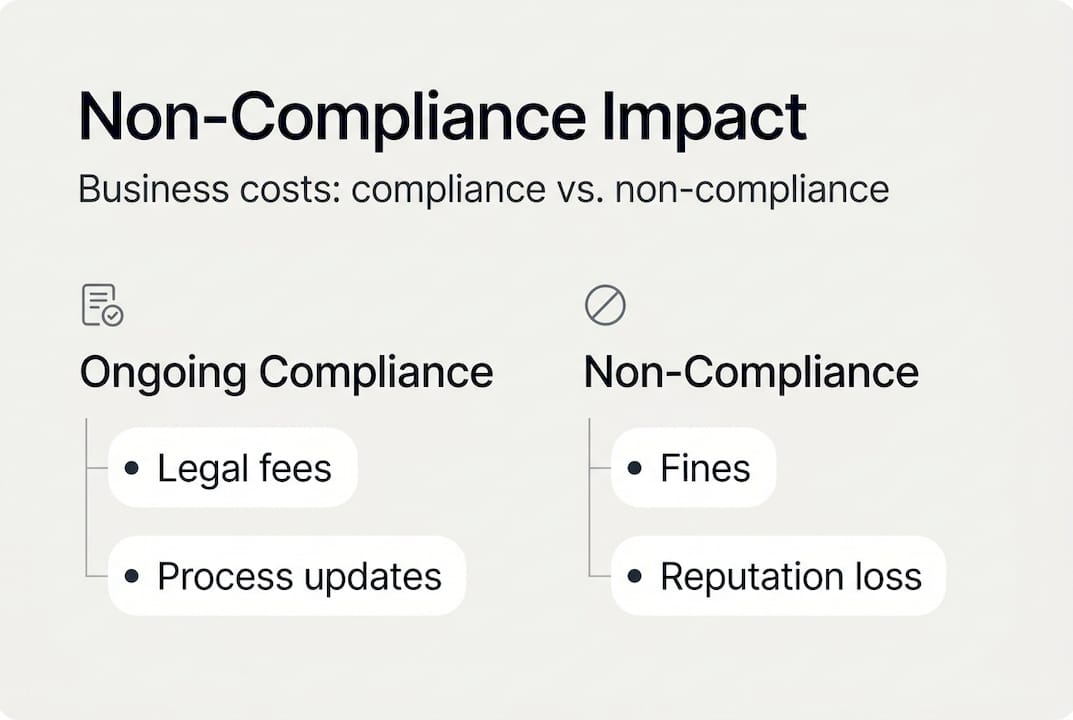
The financial consequences of non-compliance are well-documented and consistently underestimated by businesses at the planning stage. GDPR fines alone have exceeded €5 billion across the EU, and that figure does not account for the indirect costs of remediation, reputational damage, and operational disruption. Businesses that treat compliance as a secondary concern routinely discover that the cost of fixing problems far exceeds what proactive guidance would have required.
A critical benchmark for any decision-maker: the cost of non-compliance is, on average, 2.71 times greater than the cost of maintaining ongoing compliance. This ratio holds across sectors and company sizes, making it one of the most reliable figures in regulatory risk management.

Beyond GDPR, the EU's expanding regulatory agenda introduces additional exposure. The AI Act, DORA (Digital Operational Resilience Act), and NIS2 each carry significant penalty frameworks. Businesses operating in financial services, technology, or critical infrastructure face layered obligations that require specialist guidance to manage effectively. Review the 2026 compliance checklist to assess your current exposure.
The categories of loss from non-compliance break down as follows:
| Category | Examples | Business impact |
|---|---|---|
| Financial | Regulatory fines, legal fees, remediation costs | Direct cash outflow, budget disruption |
| Reputational | Media coverage, client attrition, partner withdrawal | Long-term revenue loss |
| Operational | Process shutdowns, system overhauls, staff retraining | Productivity and delivery delays |
| Strategic | Blocked acquisitions, failed market entry, lost funding | Reduced growth trajectory |
Each of these categories compounds the others. A regulatory fine triggers reputational scrutiny, which in turn affects investor confidence and future funding rounds. The interconnected nature of these risks is precisely why legal guidance must be embedded at the strategic level, not addressed reactively.
Legal guidance as a strategic advantage: beyond box-ticking
The distinction between compliance as a box-ticking exercise and compliance as a strategic tool is significant. Businesses that treat legal requirements as minimum thresholds to be met tend to incur higher costs, face more frequent disruptions, and miss the market opportunities that well-structured compliance can unlock. Those that integrate legal guidance into their operating model from the outset gain a measurable competitive advantage.
"Regulation, approached strategically, is not a constraint on growth. It is a foundation for it. Businesses that build compliance into their processes early move faster, attract better partners, and access markets that remain closed to less-prepared competitors."
The contrasting approaches to legal guidance are visible in how companies respond to new regulatory requirements. Some treat each new rule as an obstacle; others use it as a signal to refine their operating model and differentiate their offering.
| Approach | Characteristics | Typical outcome |
|---|---|---|
| Box-ticking compliance | Reactive, minimum effort, siloed | Higher fines risk, slower market entry |
| Strategic legal advisory | Proactive, integrated, cross-functional | Faster growth, stronger investor relations |
Practical examples illustrate the difference clearly. A company seeking to export sustainable products to EU markets must meet specific environmental and labelling standards. Businesses that engage legal counsel early can structure their supply chain and documentation to meet these requirements efficiently, turning compliance into a market access enabler. Those that address it late face costly restructuring and delayed entry.
Pro Tip: Integrate regulatory requirements into your product and process design from the earliest stage. Retrofitting compliance is consistently more expensive and disruptive than building it in from the start. Explore how pragmatic legal advisory can support this approach, and review the corporate law essentials relevant to your structure.
Meeting the challenge: compliance frameworks and effective methodologies
Understanding the value of legal guidance is only part of the equation. The more pressing question for most business leaders is how to operationalise it effectively. Best-practice compliance frameworks consistently point to a set of core methodological steps that distinguish high-performing compliance programmes from those that fail under pressure.
A structured approach to embedding compliance in your business follows this sequence:
- Horizon scanning: Monitor regulatory developments across all relevant jurisdictions on a continuous basis, not just at the point of a known deadline.
- Operating model clarity: Define which legal obligations apply to each business unit, product line, and geography, and assign clear ownership.
- Cross-functional committees: Establish a compliance committee that includes legal, finance, operations, and senior leadership to ensure decisions are informed by the full business context.
- Risk, audit and ESG convergence: Align compliance activity with your broader risk management and ESG reporting frameworks to avoid duplication and identify shared exposures.
- Standardised internal policies: Document compliance requirements in accessible, actionable policies that staff can apply consistently.
- Regular review cycles: Treat compliance as a continuous process, not a one-off exercise. Regulatory environments change, and your framework must change with them.
The most common pitfall is treating compliance as a project with a defined end date. Businesses that complete a compliance review and then move on without a maintenance structure in place are consistently the ones that face enforcement action when regulations evolve. Explore proactive legal advice as a model for ongoing support, and use the startup compliance checklist as a practical reference point.
Key recurring pitfalls to avoid:
- Treating compliance as the sole responsibility of a single department
- Failing to update policies when regulations change
- Underestimating the compliance implications of entering a new market or launching a new product
- Relying on informal legal advice rather than structured, documented guidance
Bosnia and Herzegovina's special context: integrity, transparency and EU readiness
Bosnia and Herzegovina presents a distinct set of challenges that make legal guidance particularly important for businesses operating in or entering the market. The country's lack of a comprehensive beneficial ownership register, combined with few fines for corporate offences and elevated corruption risks, creates an environment where business integrity cannot be assumed. It must be actively managed.
BiH's Corruption Perceptions Index ranking of 114 out of 180 reflects the practical difficulties businesses face in public procurement and regulatory dealings. Parallel institutions and overlapping jurisdictions create legal ambiguity that is difficult to resolve without specialist local knowledge.
| Integrity indicator | BiH status | Business implication |
|---|---|---|
| Beneficial ownership register | Incomplete | Elevated due diligence burden |
| Corporate fines (recent years) | Approximately 5 recorded | Weak deterrence, unpredictable enforcement |
| CPI ranking | 114/180 | High corruption risk in procurement |
| EU accession progress | Ongoing | Regulatory reform pressure increasing |
The key issues for businesses operating in BiH include:
- Absence of a reliable beneficial ownership register, complicating partner verification
- Ambiguity in public procurement processes, increasing the risk of disputes
- Ongoing reform pressures linked to EU accession, which will require businesses to adapt their compliance frameworks
- Inconsistent enforcement across state, entity, and cantonal levels
For businesses with EU market ambitions, BiH's accession trajectory is both a risk and an opportunity. Companies that align their compliance frameworks with EU standards now will be better positioned when harmonisation requirements take effect. The BiH business legal guide provides a detailed reference for navigating this environment.
Legal guidance in this context is not simply about meeting regulatory requirements. It is central to business credibility, partner trust, and long-term access to European markets.
Ready to make legal guidance your competitive edge?
The evidence is clear: businesses that invest in structured legal guidance consistently outperform those that treat compliance as an afterthought. Whether you are navigating BiH's layered regulatory environment, preparing for EU market entry, or managing cross-border transactions, the right legal partner makes the difference between exposure and advantage.
Vucic.legal provides strategic legal services tailored to growth-oriented businesses operating in Bosnia and Herzegovina and across European markets. From regulatory compliance and corporate structuring to cross-border transactions and risk management, the firm's approach is built on precision, discretion, and a clear understanding of business realities. Explore the corporate law guide for foundational insight, or review the Bosnia legal guide to understand the specific requirements of operating in this market. The next step is a conversation with advisers who understand both the legal landscape and your business objectives.
Frequently asked questions
What is the biggest legal challenge for expanding businesses in Bosnia and Herzegovina?
BiH's complex legal layering across state, entity, and cantonal levels, combined with corruption risks and weak enforcement, creates significant operational uncertainty that makes specialist legal guidance essential for any business seeking to expand.
How much can non-compliance cost a business in the EU?
Non-compliance costs average 2.71 times more than the cost of maintaining ongoing compliance, with GDPR fines alone exceeding €5 billion across the EU since 2018.
How can legal guidance help with EU market entry?
Specialist legal counsel ensures businesses meet the fragmented regulatory requirements of each EU member state, reducing friction, minimising delays, and preventing the costly restructuring that results from late-stage compliance gaps.
What are best practices for building compliance into business processes?
Best-practice compliance frameworks combine horizon scanning, cross-functional ownership, standardised internal policies, and regular review cycles to ensure compliance remains effective as regulations evolve.