
Most business leaders view legal advice as a necessary cost or risk control mechanism, yet research shows companies integrating legal into strategy see market valuations rise significantly. Strategic legal advice transforms legal functions from reactive compliance units into proactive growth enablers. This article explores how strategic legal advice accelerates business decisions, prevents costly risks, and delivers measurable competitive advantages for growth-focused companies navigating complex corporate matters across European and global markets.
Table of Contents
- The changing role of strategic legal advice in business growth
- Core frameworks and techniques of strategic legal advice
- Contrasting strategic and traditional legal approaches and cost optimisation
- Nuances and practical applications of strategic legal advice for growth companies
- Discover expert strategic legal services for business growth
- Frequently asked questions about strategic legal advice
Key takeaways
| Point | Details |
|---|---|
| Strategic advice accelerates growth | Legal integration into strategy increases enterprise value and speeds decision-making processes. |
| Five-step framework drives results | Audit alignment, set objectives, map risks, integrate technology, and measure success systematically. |
| Data-driven selection optimises outcomes | Outcome-based advisor selection outperforms prestige rankings in predicting litigation success. |
| Early counsel prevents scaling risks | Fractional general counsel and early structuring avoid fundraising red flags and IP ownership issues. |
| European firms benefit strategically | Proactive risk mapping with horizon scanning manages regulatory complexity and geopolitical volatility. |
The changing role of strategic legal advice in business growth
Legal teams are no longer confined to traditional compliance roles. They now act as catalysts for growth, driving strategic decisions that create measurable business value. Companies integrating legal into strategy see higher market valuations, with lawyer-directors rising from 24% to 43% over recent years. This shift reflects how business leaders increasingly recognise legal expertise as essential to competitive positioning.
Strategic legal advice accelerates business decisions by identifying opportunities and neutralising risks before they materialise. Rather than waiting for problems to emerge, proactive legal counsel anticipates challenges and enables faster execution of growth initiatives. This forward-looking approach prevents costly delays and protects enterprise value during critical business transitions.
The transformation from reactive to strategic legal support delivers tangible financial benefits:
- Higher market valuations through risk mitigation and opportunity identification
- Faster decision cycles enabling competitive responsiveness
- Prevention of costly legal issues that derail growth trajectories
- Enhanced credibility with investors and strategic partners
Businesses must align legal advice with overall business objectives to unlock this value creation potential. When legal counsel understands commercial priorities and participates in strategic planning, they contribute insights that shape better business outcomes. This alignment ensures legal resources support rather than constrain growth ambitions.
"Strategic legal advice transforms legal functions from cost centres into value creators, enabling businesses to navigate complexity whilst accelerating growth."
Growth-focused companies benefit most from this evolution. As regulatory environments grow more complex and business models become increasingly cross-border, the ability to navigate legal complexity strategically becomes a decisive competitive advantage. Strategic legal services tailored to business realities deliver this advantage by embedding legal thinking into core business processes.

Core frameworks and techniques of strategic legal advice
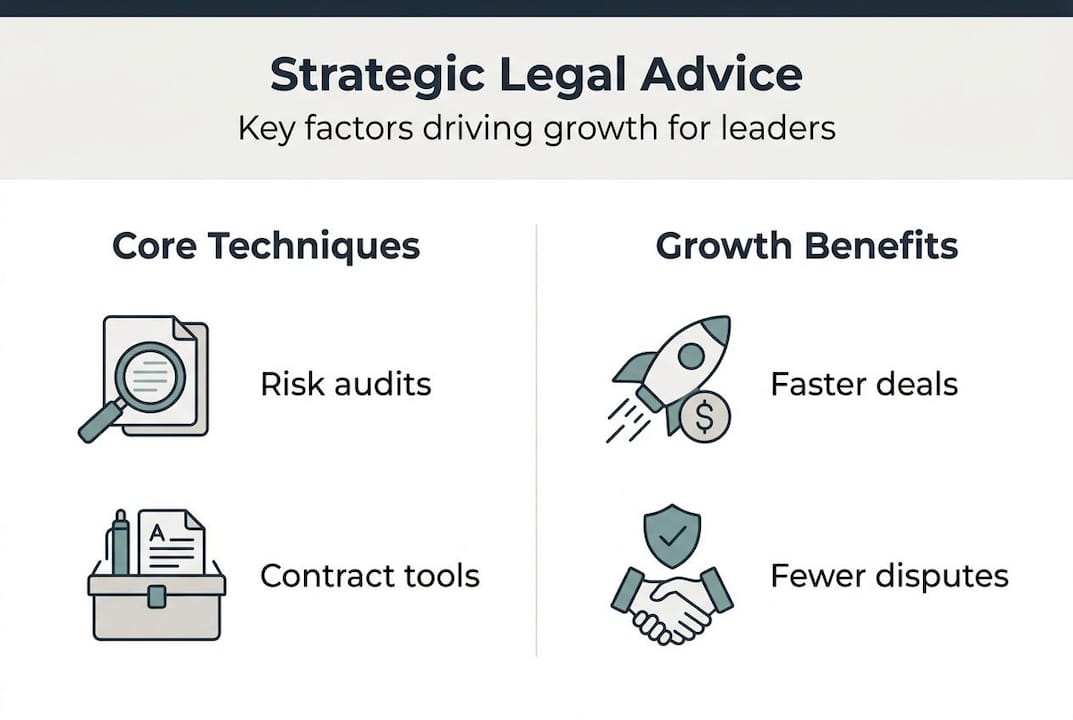
Implementing strategic legal advice requires systematic frameworks that connect legal capabilities to business outcomes. A proven five-step framework guides this transformation: audit legal function alignment, set clear objectives, mitigate risks proactively, integrate technology, and measure success. Each step builds organisational capability whilst delivering immediate value.
-
Audit legal function with business alignment to identify gaps between current legal capabilities and business needs. This diagnostic reveals where legal resources create value and where misalignment constrains growth. The audit examines processes, expertise, and decision patterns to surface improvement opportunities.
-
Set clear legal objectives that directly support business goals such as market expansion, fundraising readiness, or operational efficiency. Objectives must be specific, measurable, and time-bound to enable accountability and resource prioritisation.
-
Map risks proactively using scenario planning to anticipate volatility across regulatory, commercial, and operational domains. Risk mapping identifies both threats and opportunities, enabling strategic positioning rather than reactive responses.
-
Integrate technology such as artificial intelligence for document review, contract analytics, and predictive modelling. Technology amplifies legal team capacity whilst improving consistency and reducing turnaround times for routine matters.
-
Measure success through performance metrics tied to business outcomes, not just legal activity. Regular measurement enables iteration and continuous improvement of legal strategy effectiveness.
Pro Tip: Use contract lifecycle management tools to standardise contract processes, reduce negotiation cycles, and extract strategic insights from contract data that inform business decisions.
The following table illustrates how strategic techniques deliver measurable business impact:
| Technique | Business Impact | Timeframe |
|---|---|---|
| Proactive risk audits | Prevent 60-80% of potential disputes | Quarterly |
| Contract standardisation | Reduce negotiation time by 40% | 3-6 months |
| Technology integration | Increase legal team capacity by 30% | 6-12 months |
| Scenario planning | Enable faster strategic pivots | Ongoing |
These frameworks work best when tailored to specific business contexts. A technology startup navigating Series A fundraising needs different legal priorities than an established manufacturer entering new markets. Legal advisory insights help leaders identify which frameworks deliver maximum value for their situation.
Successful implementation requires executive sponsorship and cross-functional collaboration. Legal strategy cannot succeed in isolation. When legal counsel participates in business planning sessions and commercial teams understand legal implications early, organisations build the muscle memory for strategic legal thinking. This cultural shift multiplies the value of strategic legal services by embedding legal considerations throughout decision processes.
Contrasting strategic and traditional legal approaches and cost optimisation
Traditional legal functions operate as reactive cost centres, responding to problems after they emerge. This defensive posture limits growth by slowing decisions and framing legal input as obstacles rather than enablers. Strategic legal advice inverts this dynamic, positioning legal expertise as an accelerator and competitive advantage that shapes business strategy proactively.
The distinction manifests across multiple dimensions:
| Dimension | Traditional Approach | Strategic Approach |
|---|---|---|
| Timing | Reactive, post-problem | Proactive, pre-emptive |
| Focus | Risk avoidance | Risk management and opportunity |
| Metrics | Activity and compliance | Business outcomes and value |
| Integration | Siloed function | Embedded in strategy |
| Advisor selection | Prestige and reputation | Outcomes and fit |
Research reveals outcome-based firm rankings outperform prestige in predicting litigation success. Selecting advisors based on demonstrated results in similar matters delivers better outcomes than relying on general reputation. This data-driven approach applies equally to transactional work, where advisor experience with specific deal structures matters more than firm brand recognition.
Cost optimisation through strategic legal advice follows nuanced patterns. Insourcing high-value work reduces costs by bringing strategic matters in-house whilst outsourcing commodity work. However, savings are not linear to insourcing percentage. The optimal balance depends on matter complexity, volume, and internal expertise.
Pro Tip: Prioritise quality and outcome metrics over reputation alone when selecting legal counsel. Request case studies demonstrating results in situations similar to yours, and evaluate advisors on strategic thinking ability, not just technical competence.
Strategic legal advice delivers cost benefits beyond direct fee reduction:
- Prevention of expensive disputes through early risk identification
- Faster transaction closings that accelerate revenue realisation
- Better commercial terms negotiated with legal insight
- Reduced opportunity costs from delayed decisions
Data-driven rankings improve predictive accuracy over reputation-based selection by analysing actual case outcomes and advisor performance patterns. This analytical approach helps business leaders make informed choices about legal resources that align with strategic priorities.
For scaling technology companies facing legal risks, the difference between reactive and strategic approaches becomes stark. Reactive legal support addresses data breaches after they occur, whilst proactive legal advice implements privacy frameworks that prevent breaches whilst enabling data-driven business models. The strategic approach transforms legal from cost to competitive advantage.
Nuances and practical applications of strategic legal advice for growth companies
Strategic legal advice delivers greatest impact in specific scenarios where legal complexity intersects with business growth. Early-stage legal structuring prevents fundraising obstacles and intellectual property disputes that plague companies approaching Series A. Early structuring prevents fundraising red flags by establishing clean cap tables, proper IP assignment, and governance frameworks that investors expect.
Fractional general counsel arrangements support scaling without full-time overhead costs. This model provides strategic legal leadership on demand, enabling companies to access senior expertise during critical growth phases whilst maintaining cost flexibility. Fractional counsel integrates into executive teams, participating in strategic planning whilst managing external advisors for specialised matters.
Prevention litigation identifies and neutralises hidden risks before they escalate into disputes. This proactive approach examines contracts, relationships, and operational practices to surface latent liabilities. By addressing vulnerabilities early, companies avoid costly litigation that diverts management attention and damages relationships.
Practical applications include:
- Pre-transaction due diligence that uncovers deal risks before commitment
- Regulatory compliance audits preventing enforcement actions
- Employment practice reviews reducing wrongful termination exposure
- Intellectual property audits securing competitive advantages
Proactive risk mapping with horizon scanning manages geopolitical volatility and regulatory change across European markets. Horizon scanning monitors emerging regulations, enforcement trends, and political developments that could impact business operations. This forward-looking intelligence enables strategic positioning before changes take effect.
Scenario planning enhances agility in complex regulatory environments. By modelling multiple futures and preparing response strategies, companies reduce decision latency when changes materialise. This preparation proves especially valuable for businesses operating across multiple jurisdictions with divergent regulatory trajectories.
"Ignoring early legal strategy creates technical debt that compounds with growth, ultimately constraining the very expansion it was meant to enable."
For companies doing business in Bosnia and broader European markets, strategic legal advice navigates regional regulatory complexity whilst supporting international expansion. Understanding local business practices, regulatory expectations, and enforcement patterns enables compliant growth without sacrificing speed.
The startup legal checklist for 2026 illustrates how early strategic advice prevents common pitfalls. Founders addressing incorporation structure, founder agreements, IP protection, and regulatory compliance from inception avoid expensive corrections later. This preventive investment pays dividends throughout the company lifecycle.
Discover expert strategic legal services for business growth
Navigating complex legal challenges whilst accelerating growth requires counsel that understands both legal nuance and business reality. Franjo Vucic offers strategic legal services tailored to growth-focused companies facing sophisticated corporate matters across European and global markets. The practice combines deep legal expertise with pragmatic business thinking to deliver solutions that enable rather than constrain growth.
Services encompass risk mitigation, regulatory compliance, cross-border transactions, and growth-oriented counsel that aligns legal strategy with business objectives. Whether structuring for fundraising, navigating market entry, or managing operational complexity, the approach prioritises discretion, precision, and practical outcomes that support your strategic vision.
Cross-border business expertise proves especially valuable for companies expanding within Europe and beyond. Understanding regulatory frameworks, commercial practices, and enforcement patterns across jurisdictions enables compliant growth whilst minimising friction and delay.
Frequently asked questions about strategic legal advice
What distinguishes strategic legal advice from traditional legal support?
Strategic legal advice integrates legal thinking into business strategy proactively, focusing on growth enablement and value creation rather than purely reactive risk avoidance. Traditional support responds to problems after they emerge, whilst strategic counsel anticipates challenges and identifies opportunities before they materialise.
How can strategic legal advice impact my company's growth?
Strategic legal advice accelerates decision-making, prevents costly disputes, enhances market valuations, and enables faster execution of growth initiatives. Companies integrating legal into strategy see measurable improvements in transaction speed, investor confidence, and competitive positioning.
When should a business leader seek strategic legal advice?
Seek strategic legal advice during critical growth phases such as fundraising preparation, market expansion, significant transactions, or when facing complex regulatory environments. Early engagement delivers maximum value by preventing issues rather than correcting them.
What are the cost benefits of integrating legal strategy early?
Early integration prevents expensive corrections, reduces dispute costs, accelerates transactions, and improves commercial terms through informed negotiation. The preventive value typically exceeds direct legal costs by multiples, particularly for scaling companies.
How does strategic legal advice support cross-border business challenges?
Strategic advice navigates regulatory complexity across jurisdictions, identifies compliance requirements, structures transactions for tax efficiency, and manages geopolitical risks. This expertise enables confident expansion whilst maintaining legal and operational integrity. Explore strategic legal services to support your cross-border growth.