
TL;DR:
- Legal planning must precede market entry, serving as a foundational element for successful expansion and compliance.
- Overlooked legal complexities, especially in fragmented jurisdictions like Bosnia and Herzegovina, can lead to costly failures.
Expanding into a new market feels like a growth decision. In practice, it is a legal decision first. Only 7% of companies achieve full compliance during international expansion, yet most leadership teams treat legal planning as a formality to complete after the commercial strategy is set. That sequencing is where expansions fail. This article sets out why global expansion needs legal planning as the foundation of the strategy itself, with particular focus on what this means for companies entering Bosnia and Herzegovina and the broader European market.
Table of Contents
- Key takeaways
- The global regulatory environment is more complex than most expect
- Operational readiness: leadership, culture, and legal exposure
- Legal structuring for Bosnia and Herzegovina market entry
- Legal planning as a competitive advantage
- Practical steps for structuring a legal planning programme
- Why legal planning is not just compliance work
- How Vucic supports international market entry
- FAQ
Key takeaways
| Point | Details |
|---|---|
| Compliance rates are low | Only 7% of expanding companies achieve full compliance, making early legal planning a clear differentiator. |
| Regulatory complexity is accelerating | Overlapping frameworks such as DORA and AI regulations demand a centralised, integrated legal approach from the outset. |
| Leadership presence matters legally | Absent local leadership creates accountability gaps that directly increase compliance risk and slow execution. |
| Entity structure determines liability | The choice between a subsidiary and a branch in Bosnia and Herzegovina affects taxation, liability, and exit options. |
| Legal readiness builds investor trust | A clean compliance posture functions as a positive signal during fundraising and enterprise customer onboarding. |
The global regulatory environment is more complex than most expect
The scale of regulatory fragmentation companies face when expanding internationally is routinely underestimated. Jurisdictions do not simply have different rules. They have overlapping frameworks, inconsistent enforcement timelines, and conflicting obligations that a central legal team operating from headquarters is rarely equipped to manage alone.
Accelerating, overlapping regulations globally demand an integrated, centralised entity management approach to maintain operational control. Frameworks such as the Digital Operational Resilience Act (DORA) and incoming AI regulations require legal teams to track multiple compliance obligations simultaneously, each with its own territorial scope and enforcement body. A company that satisfies data protection requirements in Germany may still face obligations under different rules in Bosnia and Herzegovina, where local regulatory bodies apply their own interpretations and timelines.
Several practical consequences follow from this complexity:
- Non-compliance with data protection and security standards can trigger regulatory investigations, financial penalties, and reputational damage that takes years to correct.
- Operational disruption occurs when licences are not obtained on time, preventing companies from trading or hiring legally.
- 44% of General Counsel lack confidence in their data security compliance across borders, which signals a systemic rather than incidental problem.
- Corporate governance documentation, shareholder agreements, and local filings that appear procedural can become liabilities in disputes if they do not meet local standards.
The response cannot be reactive. 83% of organisations rely on multiple corporate service providers to manage global compliance, yet coordination between those providers often breaks down without a centralised oversight function. Legal planning must establish that function before the expansion begins, not after the first regulatory notice arrives.
Pro Tip: Build a regulatory mapping document before entering any new jurisdiction. List every applicable framework, its enforcement body, and the specific obligations that apply to your business model. Update it quarterly as new regulations come into effect.
Operational readiness: leadership, culture, and legal exposure
Legal structure alone does not determine whether an expansion succeeds. The human and organisational dimensions carry equal weight, and they directly affect legal exposure in ways that are frequently overlooked.
Consider the leadership gap. Only 32% of leaders feel prepared for geopolitical and operational uncertainties in new markets. When senior leadership is not physically present in a new jurisdiction, compliance responsibilities diffuse. Local employees lack the authority to make decisions. Central teams lack the context to make them accurately. The result is slow execution, missed filings, and regulatory exposure that compounds over time.
There is also the concept of psychic distance. Companies expanding into markets that feel culturally or linguistically familiar often apply lower levels of legal scrutiny, assuming that similar cultural norms mean similar legal requirements. This is a category error. Bosnia and Herzegovina operates under a distinct constitutional and regulatory framework. Assumptions borrowed from neighbouring EU member states can produce material compliance failures.
For companies structuring their expansion in this region, the following sequence of organisational decisions is worth addressing explicitly:
- Identify who holds legal accountability in the new jurisdiction from day one, not after incorporation.
- Define the decision-making framework that determines what local management can authorise versus what requires headquarters approval.
- Establish reporting lines for compliance obligations so that filings, renewals, and regulatory responses do not fall into a governance gap.
- Conduct leadership readiness assessments that include familiarity with local employment law, contract enforcement norms, and dispute resolution processes.
- Map cultural and operational differences between the home jurisdiction and the target market, paying specific attention to areas where legal assumptions may differ.
Pro Tip: Appoint a named compliance owner in each new jurisdiction before the entity is registered. The absence of that designation is one of the most common causes of missed deadlines and avoidable penalties.
Legal structuring for Bosnia and Herzegovina market entry
The importance of legal planning in expansion is particularly pronounced when entering Bosnia and Herzegovina, a jurisdiction with a unique constitutional structure, a developing regulatory environment, and distinct obligations that do not map neatly onto EU norms despite the country's EU candidate status.

The foundational decision is entity type. The choice between a subsidiary and a branch has direct consequences for liability, taxation, and exit options. The table below summarises the principal considerations for companies entering Bosnia and Herzegovina:
| Structure | Liability exposure | Tax treatment | Administrative burden | Suitable for |
|---|---|---|---|---|
| Limited liability company (d.o.o.) | Limited to entity assets | Separate corporate tax filing | Moderate | Long-term market presence |
| Joint stock company (d.d.) | Limited to share capital | Separate corporate tax filing | High | Companies planning share issuance |
| Branch office | Parent company exposed | Profits taxed in Bosnia | Lower | Short-term or testing phase |
| Representative office | No liability (non-commercial) | No tax on commercial activity | Minimal | Market research and liaison only |
Beyond entity selection, regulatory compliance requirements include employment contracts drafted under local labour law, sector-specific licensing from the relevant entity-level authorities (Bosnia and Herzegovina has two entities with separate regulatory bodies), tax registration, and commercial lease obligations where applicable. Due diligence at the outset reduces transaction risk and accelerates market entry because it surfaces contingent liabilities, encumbrances on property, and gaps in the target's corporate record before they become the acquirer's problem.
Shareholders' agreements and corporate governance documents must be prepared in compliance with local company law. Provisions that are standard in English or German law contexts may require adaptation to be enforceable in Bosnia and Herzegovina. Relying on template documents without local legal review is a recognised source of post-entry disputes. For a detailed overview of what this process involves, the regulatory compliance checklist for Bosnia and Herzegovina in 2026 is a practical starting point.
Legal planning as a competitive advantage
The standard framing of legal compliance is defensive. Avoid penalties, manage risk, satisfy auditors. That framing is accurate but incomplete. Legal foresight — the capacity to anticipate regulatory change and cross-border legal impacts — is a recognised differentiator for boards seeking strategic autonomy and resilience in volatile markets.
The era of globalisation without guardrails is ending. Sovereignty-driven regulatory reforms, reshoring trends, and fragmented data governance regimes are creating a world where legal readiness determines which companies can operate, grow, and raise capital across borders, and which cannot.
Consider the competitive dynamics at play:
- Compliance posture serves as a trust signal during enterprise customer procurement processes and investor due diligence, functioning as positive evidence of operational reliability.
- Clean corporate records reduce the cost and duration of M&A due diligence, which accelerates deal timelines and improves valuation outcomes.
- Proactive data protection compliance opens access to enterprise contracts in sectors where data governance requirements are contractually mandated.
- Companies with documented legal readiness programmes attract institutional investors who face their own regulatory obligations around portfolio company compliance.
The practical implication is that legal readiness should be reported to the board as a business development metric, not only as a risk management update. The companies that do this consistently position their compliance posture as a commercial asset during sales cycles and fundraising processes. For a deeper examination of how this works in practice, Vucic has published analysis on compliance as a growth driver that is relevant to leadership teams structuring their approach.
Practical steps for structuring a legal planning programme
Knowing that legal planning matters is different from knowing how to structure it effectively. The following framework is applicable to companies at the early stages of international expansion as well as those managing existing multi-jurisdictional operations.
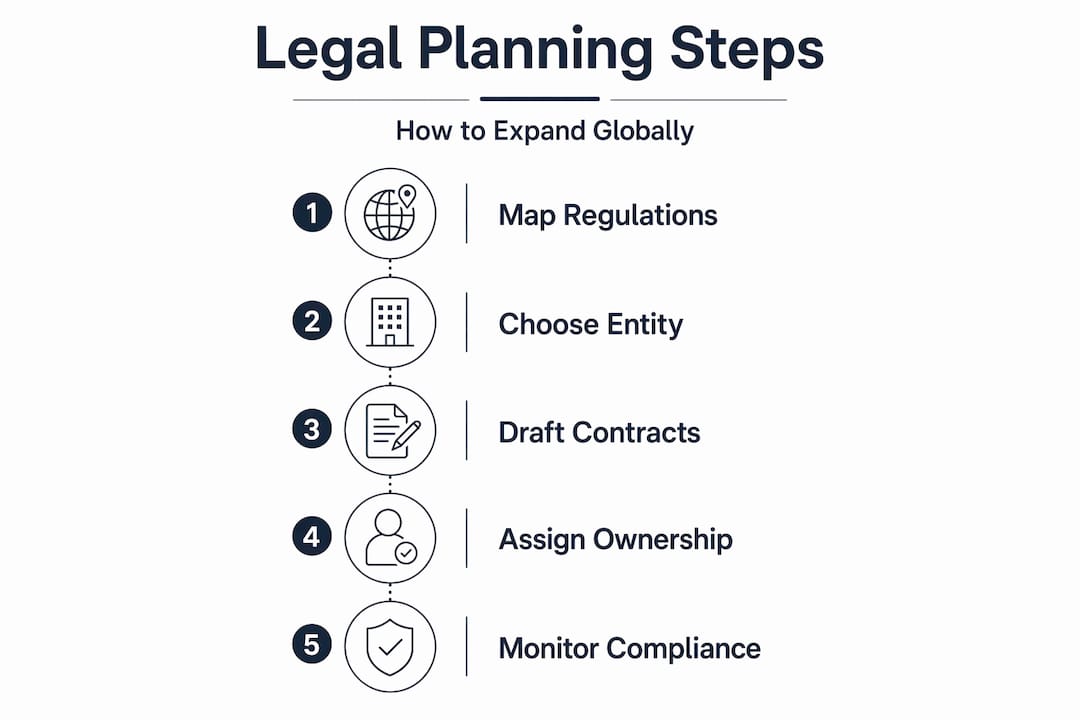
Create a single source of truth. Entity data, filing deadlines, regulatory registrations, and ownership structures across all jurisdictions should reside in one system with defined ownership. Without this, obligations fall through coordination gaps between internal legal teams and external providers. A centralised entity management platform can fulfil this function, and solutions such as enterprise entity management platforms are designed specifically for this purpose.
Balance internal and external expertise. Internal legal teams set strategy, manage relationships, and own outcomes. External service providers in each jurisdiction supply local knowledge, handle filings, and monitor regulatory developments. The division of responsibilities must be explicit. Ambiguity about who is responsible for a specific filing is how deadlines are missed.
Adopt technology with appropriate caution. 35% of legal teams use AI tools for compliance tasks, but 26% who are piloting such tools retain concerns about accuracy and regulatory acceptance. AI can support document review, deadline tracking, and regulatory monitoring. It should not replace professional legal judgement on jurisdiction-specific matters, particularly in markets with developing legal frameworks such as Bosnia and Herzegovina.
Set measurable compliance KPIs. Compliance programmes without defined timelines, assigned owners, and quantifiable metrics are declarations of intent, not operational programmes. Metrics might include filing completion rates, audit finding closure times, and the proportion of contracts with current legal review.
Pro Tip: Schedule a legal health check at six-month intervals for any new market entry. Review entity status, regulatory registrations, employment contracts, and data protection obligations. Identify gaps before they become enforcement matters.
The importance of legal planning in expansion does not diminish once market entry is complete. Regulatory environments evolve. An entity structure that was appropriate at entry may become suboptimal as the business scales or as local regulations change.
Why legal planning is not just compliance work
I have seen companies invest substantial resources into legal entity formation, only to encounter serious compliance failures within eighteen months of market entry. In almost every case, the legal documents were in order. The problem was that nobody in the new jurisdiction had the authority or the information to act on what those documents required.
In my experience, the gap between legal structure and legal compliance is an organisational problem as much as a legal one. Speed to market often exceeds organisational and legal readiness, and companies learn this expensively. The legal framework creates the conditions for compliance. Leadership, process, and accountability deliver it.
What I find particularly underestimated is the role of cultural and operational context. Clients entering Bosnia and Herzegovina often bring assumptions from Western European markets that do not translate cleanly. Local regulatory relationships, the dual-entity administrative structure, and the pace of regulatory development all require a different level of attentiveness than more familiar jurisdictions. Legal planning that accounts for this from the outset is categorically different from planning that treats the market as a variant of somewhere the client already knows.
My practical advice to leadership teams is to treat legal planning as a capability, not a transaction. Commission it early, maintain it continuously, and connect it directly to your commercial and governance objectives. The companies I observe doing this consistently report fewer disruptions, lower external legal costs over time, and materially better outcomes in fundraising and M&A processes.
— Franjo
How Vucic supports international market entry
For companies entering Bosnia and Herzegovina or expanding across European markets, Vucic provides strategic legal guidance tailored to the specific regulatory and commercial environment of each jurisdiction. The firm's work spans corporate law and governance, cross-border transactions, employment law, data protection compliance, and contract drafting, with particular depth in the Bosnian and regional legal framework.
Working with Vucic means engaging counsel that understands both the legal requirements and the business context behind them. Whether you are selecting an entity structure, preparing for regulatory filings, or reviewing contracts for enforceability under local law, the firm's approach is grounded in precision and practical utility. Visit Vucic's legal services to explore how the firm supports expansion programmes at each stage of development.
FAQ
Why do so few companies achieve full compliance during expansion?
Only 7% of expanding companies achieve full compliance because regulatory obligations across multiple jurisdictions are fragmented, overlapping, and change at pace. Without centralised legal oversight and local expertise, gaps accumulate quickly.
What legal entity should a foreign company use to enter Bosnia and Herzegovina?
The most common choice is a limited liability company (d.o.o.), which limits liability to entity assets and maintains a separate corporate tax position. A branch office is simpler to establish but exposes the parent company to local legal risk.
How does legal planning support investor relations?
A documented compliance posture and clean corporate records reduce due diligence complexity for investors. Legal readiness functions as a trust signal during fundraising and enterprise procurement, directly affecting valuation and deal timelines.
What is the biggest non-legal risk in international expansion?
The leadership gap. Only 32% of leaders report feeling prepared for the operational and geopolitical uncertainties of new markets, and the absence of senior local accountability is a primary cause of compliance failures and slow execution.
When should legal planning begin in an expansion process?
Legal planning should begin before the commercial strategy is finalised. Entity structure, regulatory mapping, and local counsel selection are all inputs to the market entry decision, not outputs that follow from it.