
TL;DR:
- Drafting international contracts requires selecting enforceable governing laws, precise commercial terms, and comprehensive dispute resolution clauses. It is essential to consider local legal systems, especially when dealing with civil law jurisdictions like Bosnia and Herzegovina and common law counterparts. Using modular clause libraries and clear notices procedures helps mitigate risks and ensures enforceability across diverse jurisdictions.
Drafting international contracts is the process of creating legally binding agreements tailored to cross-border business transactions, ensuring clarity and enforceability across diverse legal systems. For companies operating in or entering Bosnia and Herzegovina, the process carries additional complexity: the country operates under a civil law framework, yet its commercial partners frequently originate from common law jurisdictions such as the United Kingdom, the United States, or Australia. Knowing how to draft international contracts correctly, with precise governing law clauses, Incoterms 2020 delivery terms, and enforceable arbitration provisions, determines whether a dispute becomes a recoverable setback or an unresolvable liability.
What are the essential clauses when drafting international contracts?
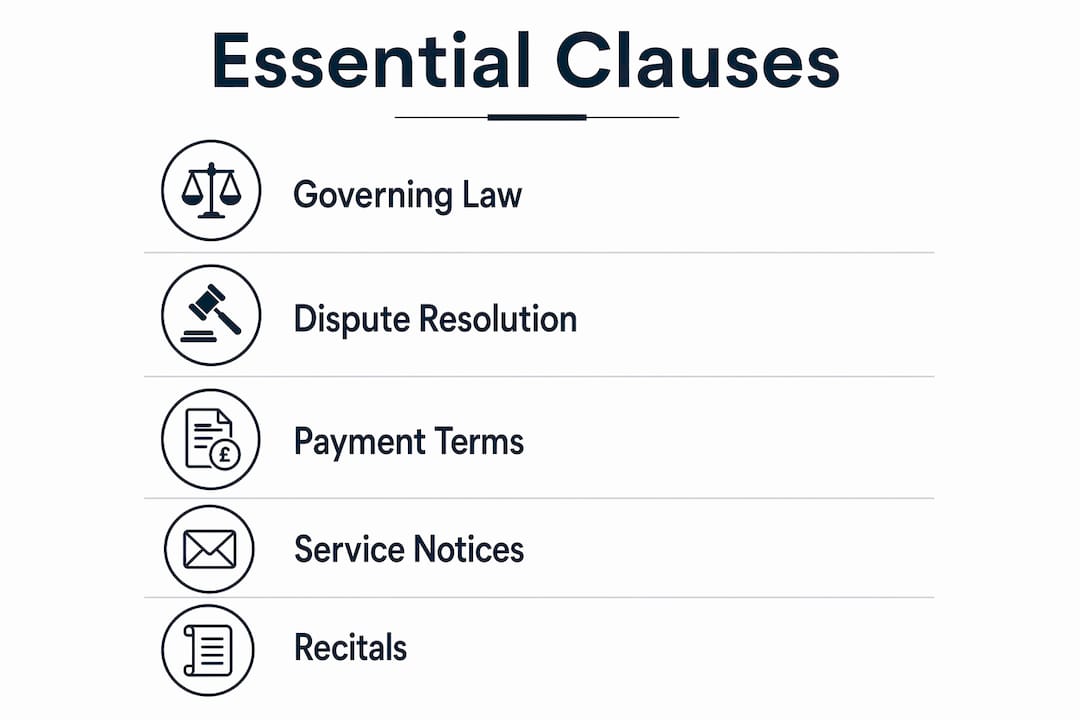
Governing law and dispute resolution clauses are the two most critical provisions in any cross-border agreement. Without them, conflicting national laws create procedural paralysis the moment a disagreement arises.
Governing law
The governing law clause specifies which country's legal system interprets the contract. Parties frequently select neutral jurisdictions such as England and Wales, Switzerland, or Singapore. Selecting a neutral seat is sound practice, but it is not sufficient on its own. Enforceability depends on asset location and local law, not merely on the clause itself.
Dispute resolution
A well-drafted arbitration clause must specify four elements: the number of arbitrators, the institutional rules applied (such as ICC, LCIA, or UNCITRAL), the language of proceedings, and the seat of arbitration. Omitting any one of these elements creates grounds for procedural challenge before proceedings even begin.
Payment terms and delivery
Ambiguous language such as "reasonable" or "timely" is a primary cause of contract disputes in international agreements. Replace vague terms with numerical thresholds. For payment defaults, specify late fees of 1.5–2% per month. For delivery obligations, incorporate Incoterms 2020 terms such as CIF, DAP, or DDP to allocate risk precisely between seller and buyer.

Service of notices
Service of notices clauses must specify accepted communication methods and formal addresses. Contracts should list registered mail, email with read receipts, and courier as valid service methods. Failing to define these channels causes procedural delays when a party needs to formally notify the other of a breach or termination.
Pro Tip: Always include a fallback notice method. If email is the primary channel, require a simultaneous copy by registered mail for any notice that triggers a contractual right or remedy.
How do civil law and common law systems affect contract drafting?
Bosnia and Herzegovina follows a civil law tradition, as do most of its regional neighbours in the Western Balkans. Many of its trading partners, particularly those from the United Kingdom or former Commonwealth jurisdictions, operate under common law. This distinction has direct consequences for cross-border contract drafting.
Under civil law, courts interpret contracts by reference to statutory codes and the presumed intent of the parties. Under common law, courts focus on the literal text of the agreement. A clause that appears complete under one system may be read as ambiguous under the other.
The following steps address this divergence systematically:
- Identify the counterparty's legal system before drafting begins. Confirm whether their jurisdiction is civil law, common law, or a hybrid system such as Scotland or South Africa.
- Build modular clause libraries sorted by legal system and language group. Categorising provisions by legal system ensures consistency and localisation across a portfolio of international agreements.
- Insert local law carve-outs for mandatory provisions that cannot be contracted out of, such as consumer protection rules or employment law minimums applicable in Bosnia and Herzegovina.
- Commission certified translations for any contract executed in two languages. Specify which language version prevails in the event of a conflict.
Pro Tip: When drafting for a civil law counterparty, include a recitals section that explains the commercial purpose of the agreement. Civil law courts use recitals as interpretive context. Common law courts largely disregard them, so their inclusion carries no downside risk.
What are the best practices for negotiating and finalising international contracts?
Clear and detailed statements of parties' obligations significantly reduce misunderstandings in international contracts. The drafting process should follow a structured workflow from initial due diligence through to execution and storage.
- Pre-drafting due diligence: Verify the legal identity, registration status, and authority of all contracting parties. Confirm that signatories hold the power to bind their respective entities under their home jurisdiction's corporate law.
- Scope and obligations: Define deliverables, timelines, and performance standards in measurable terms. Avoid reliance on implied terms, which vary significantly between legal systems.
- Intellectual property and confidentiality: Specify ownership of work product, licensing rights, and confidentiality obligations. Transaction insurance and confidentiality provisions protect all parties against disclosure risk and third-party claims.
- Risk controls: Include warranties, indemnities, and liability caps calibrated to the commercial value of the transaction. A liability cap set at the contract value is a widely accepted starting point in international commercial practice.
- Legal review: Hybrid drafting workflows that combine template drafting with Independent Legal Advice validation before signing balance speed with legal protection effectively.
- Execution and storage: Confirm signature requirements under each party's jurisdiction. Store executed originals securely and calendar key dates including renewal deadlines, notice periods, and payment milestones.
The table below summarises the drafting workflow by phase:
| Phase | Key Action | Output |
|---|---|---|
| Pre-drafting | Due diligence on parties and jurisdiction | Verified party details and authority confirmation |
| Drafting | Define scope, obligations, IP, and risk terms | First draft with tracked changes |
| Review | Independent Legal Advice and counterparty negotiation | Agreed redline version |
| Execution | Signature, witnessing, and notarisation where required | Executed original |
| Post-execution | Calendar key dates and store documents | Compliance and renewal schedule |
Which pitfalls must you avoid when writing international agreements?
The most frequent errors in international contract drafting are not exotic. They are structural omissions that experienced practitioners encounter repeatedly, particularly in agreements involving Bosnia and Herzegovina and its regional partners.
- Vague language: Terms such as "best efforts," "reasonable notice," or "prompt payment" carry different legal meanings across jurisdictions. Replace each with a defined standard or numerical threshold.
- Incomplete notice provisions: Contracts that omit clear service of notices formats and addresses cause significant procedural delays in disputes. A party that cannot formally serve notice may lose the right to terminate or claim damages.
- Unenforceable jurisdiction clauses: Selecting a governing law that has no connection to either party or the subject matter of the contract invites challenge. Courts in Bosnia and Herzegovina may decline to apply a foreign governing law that conflicts with domestic mandatory rules.
- Ignoring cultural and linguistic differences: A clause drafted in English and translated literally into Bosnian may produce a materially different legal obligation. Always have translations reviewed by a qualified legal professional in the target jurisdiction.
- Inadequate termination and force majeure provisions: Force majeure clauses must define the scope of triggering events and the remedies available, including suspension, price adjustment, or termination rights. Generic boilerplate clauses frequently fail to address international supply chain disruptions with sufficient specificity.
A contract that cannot be enforced in the jurisdiction where the counterparty holds assets is, in practical terms, not a contract at all. Governing law selection and enforcement strategy must be designed together, not separately.
How do advanced drafting practices improve enforceability?
A modular clause library is the single most effective tool for scaling international contract drafting across multiple jurisdictions. Categorising provisions by legal system and language group allows legal teams to assemble jurisdiction-specific agreements from pre-approved building blocks rather than drafting from scratch each time. This reduces error rates and accelerates review cycles.
The table below compares two common approaches to international contract drafting:
| Approach | Advantages | Limitations |
|---|---|---|
| Single master template | Consistent structure, faster initial drafting | Requires extensive local law carve-outs; higher risk of gaps |
| Modular clause library | Locally adapted, scalable across jurisdictions | Requires upfront investment in clause development and legal review |
Governing law clauses do not guarantee enforceability in jurisdictions where the counterparty holds assets. Even a clause designating a neutral seat such as London or Geneva may be overridden by local mandatory law when enforcement proceedings are brought in Bosnia and Herzegovina or another civil law jurisdiction. Practitioners should build dispute off-ramps into contracts, including tiered escalation mechanisms that move from negotiation to mediation to arbitration before litigation becomes necessary.
For guidance on the broader international contract law framework applicable to companies operating in Bosnia and Herzegovina, the legal compliance considerations extend well beyond the contract document itself.
Pro Tip: When drafting service of notices clauses for contracts involving Bosnian counterparties, specify the registered address of the entity as it appears in the court register. Notices sent to a trading address rather than the registered address may be challenged as invalid service.
Key takeaways
Effective international contract drafting requires governing law selection, precise commercial terms, and enforceable dispute resolution clauses designed together as a single compliance framework.
| Point | Details |
|---|---|
| Governing law and enforcement | Select governing law with enforcement strategy in mind; asset location determines practical enforceability. |
| Precise commercial terms | Replace vague language with numerical thresholds; use Incoterms 2020 for delivery risk allocation. |
| Dispute resolution clause | Specify arbitrators, institutional rules, language, and seat to avoid procedural challenge. |
| Modular clause libraries | Categorise provisions by legal system and language group to maintain consistency across jurisdictions. |
| Service of notices | Define accepted methods and formal addresses to preserve procedural rights in the event of a dispute. |
What experience teaches about cross-border contract drafting
Having worked on cross-border agreements involving Bosnia and Herzegovina, Western European counterparties, and international investors, the pattern of failure is remarkably consistent. The contracts that generate disputes are rarely the ones with the most complex commercial structures. They are the ones where the governing law clause was copied from a previous agreement without thought, where the notice provision listed a defunct email address, or where force majeure was a single sentence lifted from a template written for a domestic transaction.
The modular clause library approach is not merely a drafting convenience. It is a risk management discipline. When a legal team can pull a pre-approved arbitration clause for an ICC proceeding seated in Vienna, adapted for a civil law counterparty, they are not just saving time. They are applying institutional knowledge that has been tested and validated across prior transactions.
The harder lesson concerns governing law. Many practitioners treat the governing law clause as a formality. In practice, it is the clause that determines whether a favourable arbitral award can actually be converted into recovered assets. Choosing English law to govern a contract with a Bosnian counterparty whose assets are entirely in Bosnia and Herzegovina requires a clear-eyed assessment of enforcement pathways under Bosnian procedural law, not just confidence in the English legal system.
For companies entering Bosnia and Herzegovina, the local legal framework for business contracts adds a further layer of mandatory compliance that no governing law clause can override.
— Franjo
How Vucic supports international contract drafting
Vucic provides strategic legal advisory to growth-oriented companies and international investors operating in Bosnia and Herzegovina and across European markets. The firm's work on cross-border transactions covers governing law selection, dispute resolution structuring, and the full drafting lifecycle from template design through to execution. For companies that need legally sound, jurisdiction-specific agreements without the procedural delays that generic templates create, Vucic offers the combination of local regulatory knowledge and international commercial law experience that complex transactions require. Contact Vucic to discuss your cross-border contract requirements and compliance obligations.
FAQ
What governing law should an international contract specify?
Select a governing law with a genuine connection to the transaction or one of the parties, such as English law or Swiss law for neutral commercial agreements. Enforceability in the jurisdiction where assets are held must be assessed separately from the governing law choice.
How does incoterms 2020 affect international contract drafting?
Incoterms 2020 terms such as CIF, DAP, and DDP allocate delivery risk and cost obligations between buyer and seller with precision. Incorporating the correct Incoterm eliminates ambiguity over who bears risk of loss during transit in cross-border supply contracts.
What must an arbitration clause include to be enforceable?
A valid arbitration clause must specify the number of arbitrators, the institutional rules applied (such as ICC or UNCITRAL), the language of proceedings, and the seat of arbitration. Omitting any of these elements creates grounds for procedural challenge.
Why is a modular clause library useful for international contracts?
A modular clause library categorises pre-approved provisions by legal system and language group, allowing legal teams to assemble jurisdiction-specific contracts consistently and efficiently. This reduces drafting errors and accelerates the review process across multiple transactions.
How should service of notices be drafted for cross-border agreements?
Service of notices clauses should specify accepted methods including registered mail, email with read receipts, and courier, alongside the formal registered address of each party. Notices sent to an unspecified or informal address may be challenged as procedurally invalid.