
TL;DR:
- International trade law, governed by WTO agreements, significantly influences company operations, market access, and costs.
- Effective compliance requires managing layered obligations at both international and national levels to prevent delays and penalties.
Many business leaders assume international trade law is the exclusive domain of governments, diplomats, and legal academics. This assumption is costly. The rules that govern how goods and services cross borders directly shape pricing, market access, contract enforceability, and operational risk for every company engaged in cross-border activity. Global trade rules administered through the WTO multilateral system affect private sector decisions daily, whether or not leadership teams recognise it. This guide provides a structured, practical overview of international trade law, its compliance layers, enforcement realities, and what growth-oriented companies must do to operate effectively across borders.
Table of Contents
- What is international trade law? Foundations and scope
- Layers of business compliance: Beyond trade agreements
- WTO dispute settlement: Enforcement, risks, and business implications
- The cost of compliance: Tariffs, non-tariff measures, and border realities
- Building effective trade compliance in your organisation
- Our take: What most business leaders miss about trade law in practice
- How our expertise supports your cross-border ambitions
- Frequently asked questions
Key Takeaways
| Point | Details |
|---|---|
| Rule layers matter | Business must consider both trade agreements and country-specific border controls for true compliance. |
| WTO drives global trade | The WTO system forms the backbone of legal commitments that shape most international trade flows. |
| Non-tariff costs are high | Non-tariff measures like technical rules often create bigger compliance costs than tariffs alone. |
| Dispute enforcement shifts risk | The effectiveness of WTO dispute settlement directly impacts business risk and legal strategies. |
| Internal controls build advantage | Strong classification and documentation systems support compliance and business reputation. |
What is international trade law? Foundations and scope
International trade law is not a single document or statute. It is a body of rules and frameworks that governs how countries, and the private parties operating within them, buy and sell goods and services across borders. As the WTO describes it, these are the "global rules of trade" administered through a multilateral system designed to ensure predictability, fairness, and transparency in global commerce.
The actors involved span multiple levels. At the international level, sovereign states negotiate and ratify trade agreements. At the national level, customs authorities, regulatory agencies, and courts implement those commitments. Private companies, however, are the ones that must navigate the resulting legal environment every time they import a product, export a service, or enter a cross-border contract.
The backbone of international trade law consists of several key agreement types:
- Goods trade agreements, such as the General Agreement on Tariffs and Trade (GATT), which govern tariff schedules and market access for physical products
- Services trade agreements, such as the General Agreement on Trade in Services (GATS), which establish rules for cross-border service provision
- Intellectual property frameworks, such as the TRIPS Agreement, which set minimum standards for IP protection across member states
- Technical and sanitary measures, including the TBT and SPS Agreements, which regulate how countries may impose product standards without creating unjustified trade barriers
"At the WTO level, international trade law is largely built on negotiated WTO agreements that function like binding legal commitments between member governments, establishing trade rights and obligations and requiring transparency and predictability in Members' trade policies."
The following table summarises the primary WTO agreements and their scope:
| Agreement | Scope | Key obligation |
|---|---|---|
| GATT | Goods | Tariff bindings, non-discrimination |
| GATS | Services | Market access, national treatment |
| TRIPS | Intellectual property | Minimum IP protection standards |
| TBT Agreement | Technical regulations | Avoid unnecessary trade barriers |
| SPS Agreement | Food safety, animal/plant health | Science-based measures only |
For business leaders, understanding international contract law foundations is a practical starting point, because many trade obligations filter down into how contracts are structured, what warranties are required, and how disputes are resolved.
Layers of business compliance: Beyond trade agreements
Understanding that international trade law exists is one thing. Knowing how it applies operationally is another. Compliance is not a single act. It is a layered obligation that operates simultaneously at the supranational and national levels.
Business compliance must be treated as layered: companies typically need to manage market-access and tariff measures under trade agreements and operational border requirements such as customs processes and export and import licensing rules enforced by national authorities. A trade agreement may reduce tariffs between two countries, but that does not eliminate the need to comply with each country's customs procedures, documentation requirements, and product certification rules.

The distinction matters enormously in practice. Consider a company exporting industrial components from Bosnia and Herzegovina to an EU member state. A bilateral or regional trade agreement may grant preferential tariff treatment. However, the exporter must still obtain the correct customs classification, provide accurate valuation documentation, and satisfy any applicable technical standards under EU product regulations. Failure at any one of these steps can result in shipment delays, penalties, or market access denial.
The comparison below illustrates how the two compliance layers differ:
| Compliance layer | Governed by | Business impact |
|---|---|---|
| Supranational (WTO/agreements) | Trade agreements, WTO rules | Tariff rates, market access rights |
| National (border/customs) | Domestic law, customs agencies | Licensing, documentation, inspections |
| Product-specific regulations | Sector regulators | Certification, labelling, standards |
A structured approach to compliance setup involves the following steps:
- Identify all relevant markets and map the applicable trade agreements between your home jurisdiction and each target market
- Determine tariff classifications for your goods or services under the Harmonised System (HS) codes
- Review national border requirements for each market, including import licences, customs procedures, and product certification obligations
- Assess non-tariff measures such as technical standards, labelling requirements, and sanitary or phytosanitary rules
- Establish internal documentation controls to ensure all customs declarations, invoices, and certificates of origin are accurate and consistent
- Appoint a responsible compliance officer or engage external legal counsel to maintain ongoing oversight
Pro Tip: Even where a trade agreement appears to cover your product category fully, always verify national-level controls independently. Regulatory agencies in individual countries often impose additional requirements that are not visible in the text of the agreement itself. Reviewing trade compliance for business growth strategies can help leaders understand how to leverage compliance strategically as a competitive advantage rather than merely a cost centre.
WTO dispute settlement: Enforcement, risks, and business implications
Legal frameworks only function when there is a credible enforcement mechanism. In international trade law, that mechanism is the WTO dispute settlement system. It provides a structured process through which member governments can challenge measures they believe violate agreed rules, seek rulings, and ultimately obtain authorisation to impose countermeasures if the offending party fails to comply.
WTO dispute settlement is a critical component of the international trade law system because it supports predictability and enforcement of commitments, enabling countries to challenge measures alleged to violate agreed rules. For businesses, this matters because dispute outcomes can alter tariff schedules, invalidate subsidies, or force regulatory changes that affect entire sectors.
However, the system has faced significant strain. The WTO Appellate Body, which functions as the appellate review mechanism for dispute rulings, has been unable to operate at full capacity since 2019 due to the blocking of new appointments. This has created a situation where first-instance rulings can be appealed into a procedural void, leaving enforcement outcomes uncertain for extended periods.
The operational consequences for businesses include:
- Prolonged uncertainty in sectors where disputes are pending, making it difficult to price contracts or plan market entry
- Increased exposure to unilateral measures that may not be promptly challenged or resolved
- Greater reliance on bilateral or regional mechanisms as alternatives to WTO dispute resolution
- Elevated importance of contractual risk allocation, since systemic enforcement gaps push more risk management responsibility onto private parties
"WTO dispute settlement provides a mechanism for countries to challenge measures alleged to violate agreed rules, supporting predictability and enforcement of commitments."
Businesses can take several practical steps to manage dispute-related risk. First, monitor ongoing WTO disputes in your sector through official WTO databases and trade counsel updates. Second, include force majeure and regulatory change clauses in cross-border contracts to allocate risk if a dispute outcome alters the legal environment. Third, consider managing international dispute risks proactively by engaging legal advisers who track enforcement trends in your target markets.
The cost of compliance: Tariffs, non-tariff measures, and border realities
Tariffs are the most visible element of trade costs. They are also, increasingly, not the most significant one. Non-tariff measures and policy volatility materially shape the real-world cost of compliance and the practical operating environment for international trade. Business legal decisions must account for both the formal rulebook and the implementation realities on the ground.
Non-tariff measures (NTMs) include a broad range of policy instruments that affect trade without taking the form of a customs duty. The most common categories relevant to business compliance include:
- Technical barriers to trade (TBT): Product standards, testing requirements, and certification procedures that goods must satisfy before market entry
- Sanitary and phytosanitary (SPS) measures: Health and safety requirements for food products, agricultural goods, and related items
- Import licensing requirements: Administrative procedures that must be completed before goods can enter a market
- Rules of origin requirements: Documentation proving where goods were produced, which determines eligibility for preferential tariff treatment
- Customs valuation disputes: Disagreements between exporters and customs authorities over the declared value of goods, which affect the duty base
- Policy volatility: Frequent regulatory changes that increase compliance costs and create uncertainty for long-term investment decisions
The cumulative effect of these measures on business operations is substantial. A company exporting food products to multiple markets may face different labelling standards, different maximum residue limits for agricultural inputs, and different shelf-life documentation requirements in each jurisdiction. Each of these imposes a direct compliance cost, and none of them appears in a tariff schedule.
Pro Tip: Prioritise compliance resources where technical and border measures have the greatest operational impact, not simply where tariff rates are highest. In many sectors, the administrative burden of NTM compliance exceeds the financial cost of the tariff itself. Understanding how to use compliance as a growth lever enables leadership teams to allocate legal and operational resources more effectively.
Building effective trade compliance in your organisation
Knowing the legal landscape is necessary. Acting on it systematically is what protects the business. Effective trade compliance is not a one-time exercise. It requires structured processes, clear accountability, and regular review.
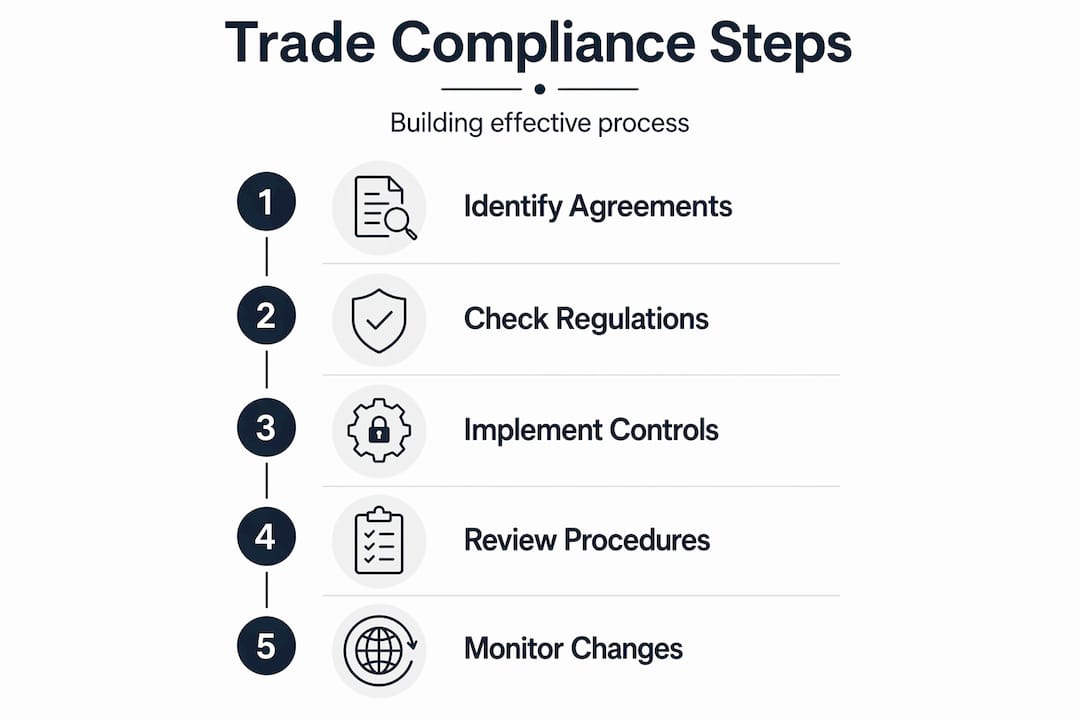
A key compliance methodology involves classification, documentation, and process controls, because many trade obligations hinge on how goods are characterised through HS codes, valued, and documented for customs and regulatory purposes. Errors in any of these areas can trigger penalties, shipment holds, or post-clearance audits that are far more costly than the initial compliance investment.
The following sequential steps provide a practical framework for building trade compliance controls within a growth company:
- Conduct a trade compliance audit to identify all current cross-border activities, the jurisdictions involved, and the applicable legal obligations
- Establish a tariff classification protocol using the Harmonised System and verify classifications with customs counsel before shipment
- Create a documentation library covering standard forms: commercial invoices, packing lists, certificates of origin, and any sector-specific certificates required by destination markets
- Implement a customs valuation policy that ensures consistent and accurate declaration of transaction values across all shipments
- Set up a regulatory monitoring process to track changes in trade policy, NTMs, and border requirements in key markets
- Integrate compliance into contract drafting, ensuring that cross-border agreements allocate responsibility for customs duties, import licences, and regulatory compliance clearly between parties
- Schedule periodic internal reviews and external legal audits to verify that processes remain current and effective
Pro Tip: Regulatory change is constant in international trade. Schedule quarterly reviews of compliance procedures and ensure that team training is updated whenever new measures are introduced in key markets. Accessing legal guidance for compliance at the outset of market entry is significantly less costly than remedying compliance failures after the fact. A structured regulatory compliance checklist tailored to your jurisdiction provides a reliable starting point.
Our take: What most business leaders miss about trade law in practice
The most common gap in how business leaders approach international trade law is not a lack of awareness that rules exist. It is the assumption that understanding the treaty framework is sufficient. In practice, the distance between what a trade agreement says and what happens at a border crossing, in a customs office, or in a regulatory inspection can be considerable.
Many well-resourced companies invest in mapping their obligations under regional trade agreements, then encounter unexpected delays or compliance failures because national-level implementation diverges from the agreement text. Customs authorities exercise discretion. Regulatory agencies apply standards inconsistently. Policy changes are introduced with limited notice. These realities are not captured in treaty texts, and they are not visible to leaders who focus exclusively on the legal framework without monitoring implementation.
The businesses that manage cross-border operations most effectively treat compliance as a living process rather than a legal checklist. They maintain ongoing relationships with counsel who track enforcement trends. They build flexibility into contracts to accommodate regulatory change. They invest in staff training that goes beyond procedural knowledge to include market-specific intelligence.
There is also a strategic dimension that is frequently overlooked. Robust compliance is not merely a cost of doing business. It is a differentiator. Companies that demonstrate consistent, well-documented compliance practices are better positioned to access preferential trade arrangements, win government procurement contracts, and attract institutional investors. Reviewing how business growth through trade compliance operates in practice illustrates why the most growth-oriented firms treat legal compliance as a strategic asset, not a regulatory burden.
The enforcement gap in the WTO Appellate Body is a useful illustration of this broader point. Leaders who understand that the formal dispute settlement mechanism is currently constrained will make different contractual and market-entry decisions than those who assume the system operates as designed. That kind of nuanced, implementation-aware legal intelligence is what separates reactive compliance from strategic legal management.
How our expertise supports your cross-border ambitions
Navigating international trade law requires more than a reading of WTO agreements. It demands practical knowledge of how rules operate across jurisdictions, where enforcement gaps exist, and how compliance obligations interact with business strategy. Growth companies operating in Bosnia and Herzegovina and across European and global markets face a complex, multi-layered legal environment that rewards preparation and penalises assumptions.
At Vucic.legal, our strategic legal services are designed to bridge the gap between legal frameworks and operational reality. Whether you are structuring a cross-border transaction, entering a new market, or reviewing your compliance controls, our team provides precise, commercially grounded guidance. From corporate law guidance to international contract law support, we work with leadership teams to ensure that legal strategy supports business objectives rather than constraining them. Contact us to discuss how proactive trade compliance can become a competitive advantage for your organisation.
Frequently asked questions
Which organisations set global rules for international trade law?
The World Trade Organization is the primary body establishing and administering the global rules of trade, with 164 member governments bound by its agreements.
Do companies have to follow both WTO agreements and national trade regulations?
Yes. Companies must comply with both international trade agreements and each country's border controls, customs procedures, and import or export licensing requirements simultaneously.
How do non-tariff measures impact the cost of international trade?
Non-tariff measures such as technical standards, certification requirements, and licensing obligations often raise compliance costs significantly beyond what tariffs alone would impose, particularly for companies exporting to multiple markets.
What is WTO dispute settlement and why does it matter?
WTO dispute settlement is the mechanism through which member countries challenge violations of trade rules, providing the enforcement foundation that makes international trade commitments credible and predictable for businesses planning cross-border operations.