
TL;DR:
- International trade compliance is a vital strategic discipline that protects revenue, streamlines market access, and enhances trust. Failure to adhere to regulations can result in severe penalties, supply chain disruptions, and reputational damage, especially as protectionism increases globally. Embedding compliance across the value chain and obtaining recognized frameworks like AEO create competitive advantages that support sustainable international growth.
International trade compliance is frequently treated as an administrative burden, a set of forms to complete before goods cross a border. That perception is costly. Non-compliance can trigger severe financial penalties, supply chain shutdowns, and lasting reputational damage at a time when protectionism is rising sharply across major trading blocs. For growth-oriented companies operating across European and global markets, compliance is not a back-office function. It is a strategic discipline that determines whether a business can sustain market access, win institutional trust, and compete on fair terms internationally.
Table of Contents
- What is international trade compliance and why does it matter?
- The real risks: Penalties, supply chain shocks, and binding mistakes
- How compliance frameworks and AEO status build competitive advantage
- Integrating compliance across the value chain: Where most firms go wrong
- Most experts focus on rules, real advantage lies in value chain mindset
- Find expert support for international compliance success
- Frequently asked questions
Key Takeaways
| Point | Details |
|---|---|
| Compliance prevents major risks | International trade compliance protects against penalties, lost shipments, and reputation loss. |
| Certification brings advantages | Status like AEO offers smoother customs, international recognition, and partnership trust. |
| Mistakes are expensive | Even small errors in documents or classification can cost businesses tens of thousands per incident. |
| Embed compliance early | Integrating compliance into the whole value chain secures market access and supports growth. |
What is international trade compliance and why does it matter?
International trade compliance refers to the full body of laws, regulations, and procedures that govern how goods, services, technology, and capital move across borders. It encompasses import and export controls, tariff classification, customs valuation, sanctions screening, licensing requirements, and product standards. Far from being a narrow legal task, compliance touches every function within an organisation.
The practical scope is broader than most leaders anticipate. A product's technical specifications determine its tariff code. Marketing materials can trigger export control reviews. Sales terms affect customs valuations. Logistics decisions alter which regulations apply. Understanding this breadth is the starting point for effective compliance management.
Trade compliance failures produce three categories of harm that compound rapidly:
- Financial penalties: Customs authorities in major jurisdictions impose fines, duties, and interest charges that can reach millions of euros or dollars per incident.
- Supply chain disruption: Shipments can be detained, seized, or denied entry, halting production lines and breaking delivery commitments to customers.
- Reputational damage: Sanctions violations and repeat customs offences become public record, affecting relationships with banks, insurers, and institutional buyers.
"Compliance must be embedded across the value chain, from product design to after-sales service. It is no longer sufficient to treat trade compliance as a customs or legal team issue."
Rising protectionism has added significant complexity to this landscape. New tariff regimes, expanded sanctions lists, and tightening export controls mean that rules which applied last year may no longer be valid today. Companies trading under cross-border contract law frameworks must ensure their agreements reflect current regulatory realities, not assumptions carried forward from earlier operating environments.
The fundamental shift to understand is this: compliance is not a cost centre. Managed well, it protects revenue, accelerates market entry, and builds institutional credibility that competitors without structured programmes simply cannot replicate.
The real risks: Penalties, supply chain shocks, and binding mistakes
Understanding the scale of penalties is essential for calibrating how seriously compliance deserves to be treated within a business. Abstract warnings about "significant fines" are less instructive than specific data.
Common violations include incorrect Harmonised System (HS) tariff classification, undervaluation of goods for customs purposes, and breaches of sanctions regulations. Real enforcement cases illustrate the stakes:

| Company | Violation type | Penalty |
|---|---|---|
| Ford | Export control breach | $3.5 million |
| Satisloh | Sanctions-related violation | $3.3 million |
| Average incident | Quotation/document error | $18,500 per incident |
These figures are not outliers. They represent routine enforcement actions in a landscape where regulators have significantly increased scrutiny of cross-border transactions. For a mid-sized company, even a single incident at the average penalty level can absorb months of profit.
One area that surprises many businesses is the legal weight of export documentation. Export quotations become binding compliance documents when they reference Incoterms, include HS codes, or are submitted to or cited in customs declarations. A quotation prepared by a sales team member without compliance training can inadvertently lock the company into representations that customs authorities will treat as official. The average penalty for such document-related errors is $18,500 per incident.
The typical sequence of a compliance failure follows a recognisable pattern:
- An error occurs at the operational level, often in documentation, classification, or valuation, without awareness that a rule has been breached.
- The shipment is flagged by customs authorities, triggering a review or detention that disrupts delivery schedules and forces internal crisis management.
- Regulatory investigation follows, resulting in financial penalties, demands for corrective procedures, and sometimes heightened scrutiny on all future shipments.
This sequence is preventable. The relationship between compliance and growth is direct: businesses that invest in structured compliance programmes avoid these disruptions, allowing management to focus on commercial priorities rather than regulatory firefighting.
Pro Tip: Maintain a compliance audit trail for every shipment. Retain classification decisions, valuation workings, and licence determinations in a retrievable format. Regulators treat poor record-keeping as evidence of systemic non-compliance, which escalates penalties substantially. Clear legal guidance for compliance on documentation standards is an early investment that pays dividends during any regulatory review.
Good compliance best practices require that audit trails are not just kept but actively reviewed. Periodic internal audits surface errors before regulators do, enabling voluntary self-disclosure which typically results in significantly reduced penalties compared to enforcement-initiated investigations.
How compliance frameworks and AEO status build competitive advantage
Moving from defensive risk management to proactive advantage requires structured frameworks. The most recognised formal mechanism within European trade is Authorised Economic Operator (AEO) status.
AEO status, granted by EU customs authorities under the WCO SAFE Framework, certifies that a business operates to high standards of customs compliance, financial solvency, and supply chain security. Certified operators receive measurable trade facilitation benefits, including fewer physical inspections, priority processing at borders, and recognition in partner countries with mutual AEO recognition agreements.
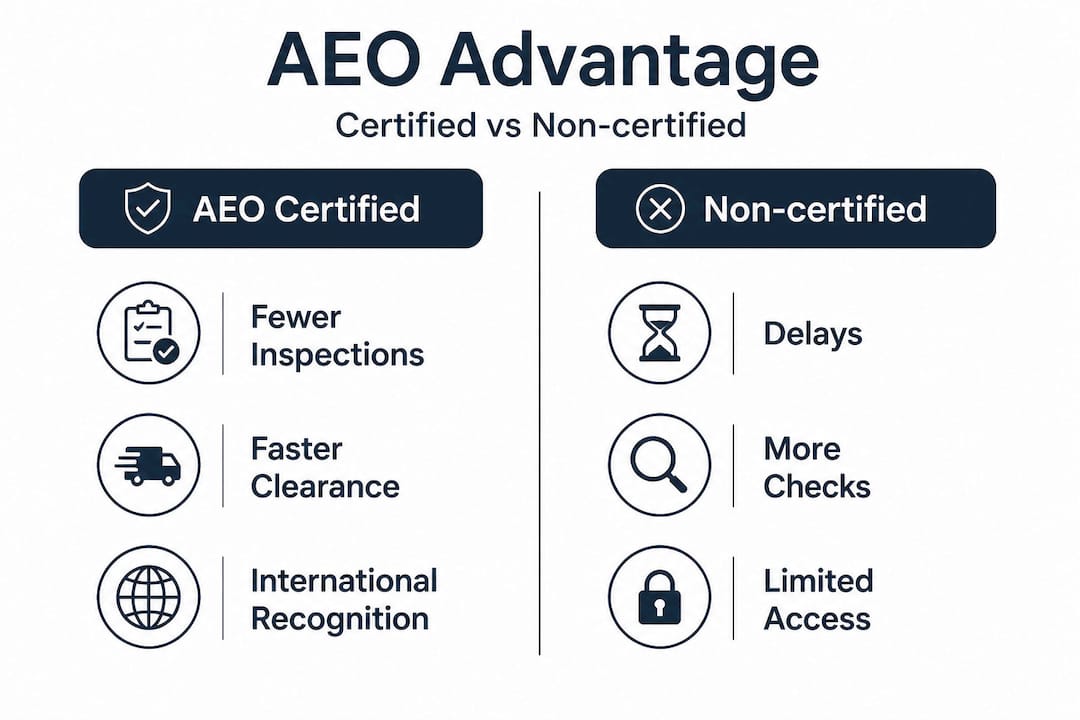
The practical difference between certified and non-certified firms is significant:
| Factor | AEO-certified company | Non-certified company |
|---|---|---|
| Border inspection rate | Substantially reduced | Standard or elevated |
| Customs clearance speed | Priority processing | Standard queue |
| International recognition | Mutual recognition agreements | Case-by-case treatment |
| Customer confidence | Demonstrably high | Unverified |
| Regulatory relationship | Collaborative | Transactional |
Beyond the operational efficiencies, AEO status carries important intangible value. Institutional buyers in regulated industries, financial institutions, and government procurement bodies treat AEO certification as a credibility signal. It demonstrates that a company's internal controls meet rigorous external standards. This trust translates into commercial opportunity, particularly when entering new markets where a track record has not yet been established.
AEO status does carry ongoing obligations. Maintaining certification requires continuous compliance with standards across customs procedures, record-keeping, financial health criteria, and physical security of supply chains. Any material change to business operations must be reported to the certifying authority. These obligations are manageable for a company with integrated compliance processes, but they demand structured attention rather than periodic review.
- Build internal compliance systems before applying for AEO to ensure ongoing obligations are sustainable.
- Assign clear ownership of AEO maintenance responsibilities across the business, not exclusively within the legal or customs team.
- Use AEO as a differentiator in client-facing materials and procurement responses where appropriate.
Pro Tip: AEO preparation exercises are valuable even for companies not yet ready to apply. The gap analysis typically required reveals classification, documentation, and process weaknesses that, once remedied, reduce compliance risk materially regardless of formal certification. Using compliance for growth in this way converts a regulatory requirement into an operational improvement programme.
Integrating compliance across the value chain: Where most firms go wrong
Most companies assign compliance responsibility to legal or customs teams and consider the matter resolved. This organisational structure is where the majority of failures originate. Compliance is not a checkpoint at the point of shipment; it is a discipline that must be embedded from the earliest stages of product development.
Consider where compliance touchpoints actually appear across a business:
- Product design: The technical specifications of a product determine its HS classification, applicable export controls, and whether dual-use regulations apply. Design decisions made without compliance input can create classification problems that are difficult and expensive to correct retroactively.
- Procurement and sourcing: Country of origin rules affect preferential tariff access under trade agreements. Sourcing decisions that ignore origin requirements can disqualify products from tariff benefits that would otherwise reduce landed costs significantly.
- Sales and contracting: Payment terms, Incoterms, and pricing structures in sales agreements affect customs valuations and determine regulatory obligations. Sales teams that negotiate these terms without compliance awareness create documents that carry unintended legal weight.
- Logistics and operations: Carrier selection, routing decisions, and documentation preparation are all compliance-relevant. Errors at this stage are often the most visible because they trigger immediate customs intervention.
- After-sales and support: Technology transfers, software updates delivered across borders, and technical assistance provided to foreign customers may require export licences. Post-sale activity is frequently overlooked in compliance programmes.
Compliance embedded across the value chain, from design through to after-sales service, mitigates top-line risks including market exclusions that extend well beyond tariff impacts.
"Businesses that treat compliance as a cross-functional discipline rather than a legal team responsibility report materially fewer enforcement incidents and recover faster when issues arise."
The three most recurring integration failures are straightforward to identify. First, compliance training does not reach sales, procurement, or design teams, leaving staff unaware that their decisions carry regulatory consequence. Second, compliance review is treated as a final approval step rather than an input to decision-making, meaning that problematic choices are identified too late to correct without commercial disruption. Third, documentation standards are inconsistent across business units, creating gaps that regulators treat as evidence of systemic weakness rather than isolated error.
Protecting commercially sensitive information through this process matters. Confidentiality in compliance is particularly important when compliance reviews involve product specifications, pricing strategies, or supply chain structures that represent genuine competitive advantage. Legal frameworks for protecting this information should be considered alongside the compliance programme itself.
Most experts focus on rules, real advantage lies in value chain mindset
The prevailing approach to trade compliance guidance centres on avoiding penalties. That framing is understandable, but it creates a ceiling on what compliance programmes actually deliver. Businesses that treat compliance as a risk avoidance exercise will design systems to satisfy regulators. Businesses that treat compliance as a strategic capability will design systems that enable growth.
The distinction matters in practical terms. A company that embeds compliance understanding into product development can launch into regulated markets faster because classification, licensing, and documentation requirements have been addressed during development rather than discovered at the point of import. A company that integrates compliance into its procurement process can access preferential tariff rates that directly reduce cost of goods. These are commercial advantages, not administrative efficiencies.
Conventional wisdom suggests that compliance becomes a priority when a company is large enough to warrant dedicated resources. The evidence suggests the opposite. Companies that build compliance frameworks early, before scale makes remediation expensive, consistently achieve lower total compliance costs and encounter fewer enforcement incidents. The cost of retrofitting compliance into an established organisation, including retraining staff, reclassifying products, and renegotiating contract terms, routinely exceeds the investment required to build it correctly from the outset.
A proactive approach also positions a company differently in regulatory relationships. Authorities distinguish between businesses that engage constructively and those that respond only when compelled. That distinction affects how enforcement discretion is exercised when issues arise. Compliance as a strategic growth lever is not a theoretical concept; it is a posture that produces measurable differences in regulatory outcomes and market access timelines.
The most important insight, and the one most frequently absent from compliance guidance, is that the value chain perspective makes compliance a source of competitive differentiation rather than a cost. Businesses that understand this early operate with structural advantages that their competitors, focused narrowly on rule-following, do not replicate easily.
Find expert support for international compliance success
Navigating international trade compliance requires precise, current expertise across multiple regulatory regimes simultaneously. The regulatory landscape evolves continuously, and the cost of operating on outdated assumptions is substantial.
Vucic.legal provides legal services for international business that help growth-oriented companies build compliance frameworks aligned with their commercial strategy. From interpreting current export control requirements to structuring trade agreements that withstand regulatory scrutiny, the firm brings the depth of expertise that complex cross-border operations demand. Understanding the foundations of corporate law essentials is the starting point for any company operating across jurisdictions. For businesses entering new markets or restructuring their international operations, dedicated cross-border legal advice ensures that compliance is built into strategy from the outset, not retrofitted under pressure.
Frequently asked questions
What are the most common international trade compliance mistakes?
The most common mistakes include incorrect HS classification, undervaluation of goods for customs purposes, and breaches of sanctions rules, all of which have led to multi-million dollar penalties in documented enforcement cases.
How does Authorised Economic Operator (AEO) status help my business?
AEO status provides certified businesses with fewer customs inspections, faster border clearance, and international recognition under mutual recognition agreements, translating directly into lower operational costs and stronger credibility with institutional partners.
Can an export quotation be legally binding for compliance purposes?
Yes. An export quotation becomes binding under trade compliance rules when it includes Incoterms or HS codes, or when it is referenced in customs documentation, making errors in commercially-prepared quotes a source of direct regulatory liability.
Why is international trade compliance more important today?
Rising protectionism and rapidly changing regulatory frameworks mean that businesses face greater exposure to market access restrictions, penalties, and supply chain disruption than at any point in recent decades, making structured compliance programmes a business necessity rather than a discretionary investment.