
TL;DR:
- The company secretary is a legal officer responsible for compliance, governance, and board support. Failure to appoint or maintain statutory duties risks fines, liabilities, and regulatory issues. Properly managing secretarial functions helps protect directors and ensures legal and regulatory adherence.
The company secretary is a statutory officer responsible for ensuring a company's compliance with legal and regulatory obligations while supporting effective governance and board operations. In jurisdictions governed by the Companies Act 2006, this role carries defined legal weight. The company secretary acts as the primary liaison among the board of directors, shareholders, and regulatory authorities such as Companies House. For business owners and corporate executives operating across borders, including in Bosnia and Herzegovina, understanding the role of company secretary is not optional. It is a compliance baseline.
What are the legal requirements for appointing a company secretary?
The appointment obligation differs sharply between company types. UK private limited companies are not legally required to appoint a company secretary unless their articles of association specify otherwise. Public limited companies face a mandatory requirement and must appoint a secretary with the requisite qualifications and experience.
Under the Companies Act 2006, section 273, directors of a public company must satisfy themselves that the appointed secretary holds appropriate qualifications, evidenced by membership of a recognised professional body or prior experience in a comparable role. This is a statutory duty, not a discretionary one.
The appointment process follows a defined procedure:
- The board passes a formal resolution to appoint the company secretary.
- Notification to Companies House must occur within 14 days of appointment, using the prescribed statutory forms.
- The secretary's details are recorded in the company's statutory registers and made available for public inspection.
- Any change of secretary requires equivalent notification within the same 14-day window.
Failure to comply carries financial consequences. Penalties up to £5,000 apply for failure to maintain accurate statutory registers under UK law. That figure applies per default, not per company, which means cumulative exposure grows quickly for businesses with multiple entities.
Pro Tip: Even where appointment is not legally mandatory, private companies operating in regulated sectors or preparing for investment rounds benefit significantly from appointing a company secretary before due diligence begins.
What are the core responsibilities and duties of a company secretary?
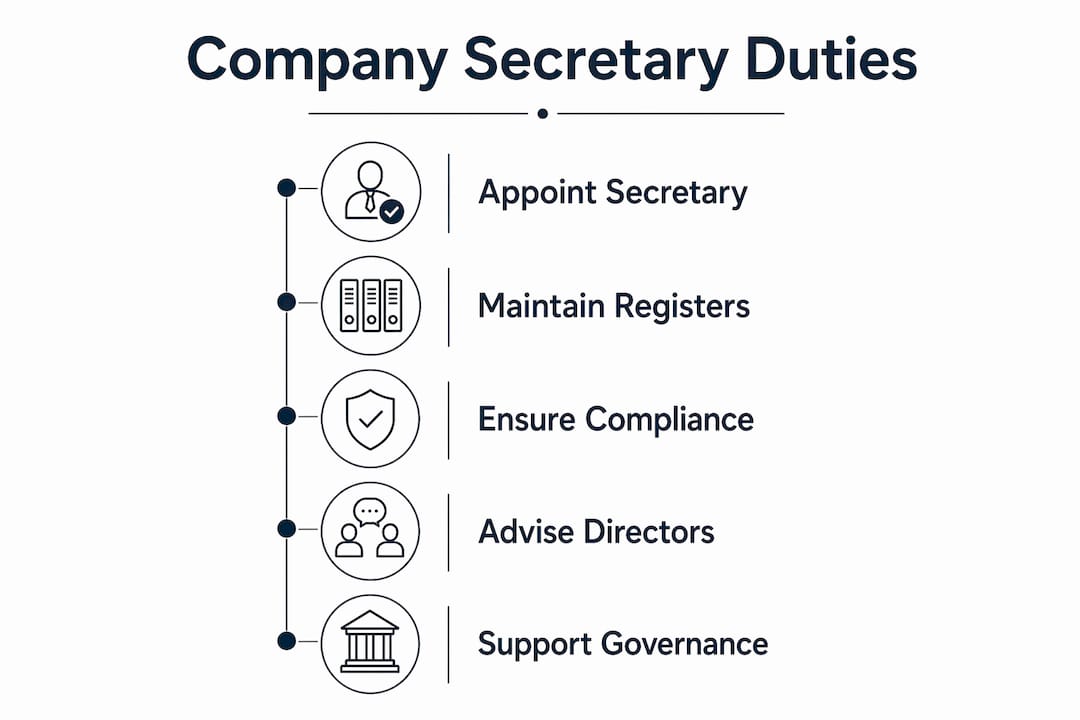
The functions of a company secretary span four broad areas: statutory record-keeping, regulatory filings, board administration, and shareholder relations. Each carries its own compliance obligations and deadlines.
-
Maintaining statutory registers. The company secretary maintains the register of members, register of directors, register of persons with significant control, and other statutory books. Accurate record-keeping is not merely good practice. Errors or omissions expose the company to fines and complicate audits or corporate transactions.
-
Managing regulatory filings. Annual confirmation statements, accounts, and event-driven filings must reach Companies House within statutory deadlines. The company secretary tracks these deadlines and prepares the required documentation. Missing a filing date triggers automatic penalties and, in serious cases, can result in the company being struck off the register.
-
Administering board and shareholder meetings. The company secretary prepares agendas, circulates board papers, records minutes, and issues meeting notices. Notice periods of 7–21 days apply depending on the meeting type and the company's articles. Minutes must accurately reflect decisions taken and be signed by the chair.
-
Advising directors on legal duties. The company secretary briefs directors on their statutory obligations, including disclosure of conflicts of interest and restrictions on insider trading. A well-prepared company secretary enables informed decision-making aligned with the company's constitution and applicable law.
-
Managing shareholder communications and share administration. Company secretary duties include managing share certificates, coordinating dividend payments, and handling shareholder correspondence. These functions support orderly shareholder relations and reduce the risk of disputes arising from administrative errors.
Pro Tip: Maintain a compliance calendar that maps every statutory deadline across all group entities. A single missed filing in one subsidiary can trigger regulatory scrutiny across the entire group.
Understanding regulatory compliance obligations in full is a prerequisite for any company secretary operating across multiple jurisdictions.

How does the company secretary contribute to corporate governance?
The company secretary occupies a position that goes well beyond administration. Governance experts describe the role as the conscience of the business, a term that captures the secretary's obligation to hold the board accountable to legal and ethical standards even when that creates internal friction.
"The company secretary acts as the conscience of the business, liaising between the board, shareholders, and regulators, ensuring board decisions comply with law and protecting company reputation. They advise directors on statutory duties to mitigate risks of non-compliance, conflicts of interest, and insider trading."
This governance function has grown in scope. The modern company secretary advances governance frameworks by integrating best practices for ethics, environmental, social, and governance (ESG) transparency. Boards that treat the secretary as a passive administrator miss the risk management value the role provides. Governance failures, when they occur, frequently trace back to inadequate secretarial oversight rather than deliberate misconduct.
The company secretary also protects directors personally. Directors who rely on the secretary's guidance on procedural compliance reduce their exposure to personal liability claims. Where the secretary identifies a proposed board decision that conflicts with the company's articles or applicable law, raising that conflict before the decision is made is far less costly than remedying a breach afterwards.
The role of the compliance officer intersects closely with the company secretary function, particularly in regulated industries where governance and compliance obligations overlap significantly.
What are the practical implications for business owners and executives?
Directors bear the consequences when secretarial functions are neglected. In the absence of a company secretary, directors assume full responsibility for secretarial duties, creating an administrative burden that diverts attention from business operations and growth. The practical risks are concrete:
- Statutory registers fall out of date, creating problems during due diligence for investment or acquisition.
- Filing deadlines are missed, resulting in automatic penalties and potential director disqualification in serious cases.
- Board minutes are inadequate or absent, leaving the company unable to demonstrate that decisions were properly authorised.
- Shareholder communications are delayed or incorrect, increasing the risk of disputes and regulatory complaints.
The solution for most private companies is either a dedicated internal appointment or outsourcing the function to a qualified professional. Outsourcing is particularly common among growth companies that need the governance infrastructure without the overhead of a full-time hire. The key requirement is that whoever performs the function has the knowledge and authority to do so effectively.
Company secretaries may face personal liability for company defaults, including failing to file statutory documents on time. This liability risk applies whether the secretary is an employee or an external service provider. Business owners who appoint a secretary must therefore ensure that person has the resources and access to information needed to meet their obligations.
For companies operating in Bosnia and Herzegovina or entering European markets, the governance expectations of international investors and regulators align closely with UK standards. Understanding corporate law frameworks applicable across jurisdictions is a prerequisite for structuring governance correctly from the outset.
Key takeaways
The company secretary is a legally defined governance officer whose absence creates direct compliance risk and personal liability exposure for directors.
| Point | Details |
|---|---|
| Statutory appointment rules | Public companies must appoint a qualified secretary; private companies should assess their articles and governance needs. |
| Filing and record obligations | Appointment must be notified to Companies House within 14 days; register failures carry fines up to £5,000. |
| Board administration duties | The secretary prepares agendas, minutes, and meeting notices, ensuring procedural compliance at every board meeting. |
| Governance and risk function | The secretary advises directors on legal duties, conflicts of interest, and ESG standards, reducing personal liability risk. |
| Director burden without a secretary | Directors absorb all secretarial duties when no appointment is made, diverting focus from business operations. |
The role is not what most executives think it is
Most executives I encounter treat the company secretary as a back-office function. They delegate it to an office manager or leave it entirely to their accountant. That approach works until it does not, and when it fails, the consequences arrive at the worst possible moment: during a funding round, a regulatory audit, or a corporate sale.
The misconception is understandable. The title sounds administrative. The reality is that the company secretary carries fiduciary responsibility and, in some circumstances, personal liability. A secretary who allows a statutory register to fall out of date or misses a Companies House deadline is not simply making an administrative error. They are creating a legal exposure that the directors will ultimately own.
My recommendation to business owners is direct. Treat the appointment of a company secretary with the same seriousness as appointing a financial director. Define the role clearly, give the secretary access to board papers and legal counsel, and review their work as part of your governance cycle. Companies that do this consistently avoid the compliance surprises that derail transactions and damage reputations.
— Franjo
Corporate governance support from Vucic

Vucic provides corporate legal advisory services to international companies, investors, and growth businesses operating in Bosnia and Herzegovina and across European markets. The firm advises on corporate structuring, governance frameworks, and the full range of company secretarial obligations that directors and business owners face when establishing or expanding operations. For companies that need to build compliant governance infrastructure without a dedicated in-house legal team, Vucic offers practical, jurisdiction-specific guidance on statutory compliance, board administration, and regulatory risk. Executives seeking to understand their obligations under applicable corporate law frameworks can access detailed guidance through Vucic's corporate law resources or contact the firm directly for a consultation.
FAQ
Is a company secretary legally required for all companies?
UK private limited companies are not legally required to appoint a company secretary unless their articles specify otherwise. Public limited companies must appoint one with the qualifications required under the Companies Act 2006.
What qualifications does a company secretary need?
For public companies, the Companies Act 2006, section 273, requires the secretary to hold recognised professional qualifications or demonstrate prior experience in a comparable role. Private company secretaries face no statutory qualification requirement.
Can directors act as company secretary?
A sole director of a private company cannot also serve as company secretary. Where a company has multiple directors, one may take on secretarial duties, though this arrangement increases the administrative burden on that individual.
What happens if statutory registers are not maintained?
Failure to maintain accurate registers can result in penalties up to £5,000 under UK law. Inaccurate records also create significant complications during audits, investment due diligence, and corporate transactions.
Can the company secretary function be outsourced?
The function can be outsourced to a qualified professional or legal advisory firm. Outsourcing is common among private companies that require governance compliance without the cost of a full-time appointment, provided the appointed provider has adequate access and authority to fulfil the statutory obligations.