
TL;DR:
- Compliance officers are responsible for ensuring organizations comply with laws, regulations, and policies through risk monitoring and oversight. They report directly to the board, shaping organizational culture and mitigating regulatory risks while facing personal liability under frameworks like SM&CR. Effective compliance involves proactive risk assessment, detailed documentation, and strong governance to maintain organizational integrity and regulatory standing.
The role of compliance officer is defined as the organisational function responsible for ensuring that a company adheres to all applicable laws, regulations, and internal policies through systematic risk identification, advisory input to leadership, and the implementation of controls. Recognised in formal governance literature as the Chief Compliance Officer (CCO) at senior level, this function sits at the intersection of legal obligation and operational conduct. Regulatory bodies including the Financial Conduct Authority (FCA) and the United States Department of Justice (DOJ) have made clear that compliance is not a peripheral administrative task. It is a board-level governance priority with direct consequences for personal liability, organisational integrity, and regulatory standing.
What does a compliance officer do day to day?
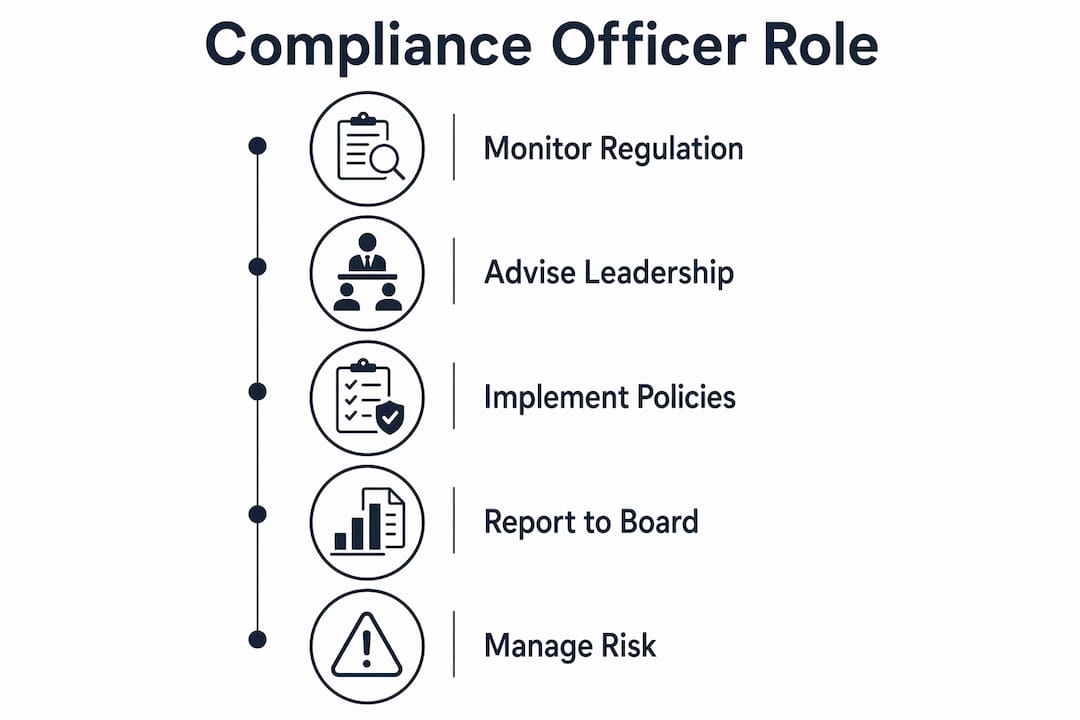
The core daily responsibilities of a compliance officer encompass monitoring regulatory changes, advising leadership, implementing policies, conducting audits, investigating violations, and delivering staff training. Purdue Global frames the overarching goal as ensuring the organisation operates with honesty, transparency, and within the law. That framing is accurate, but it understates the operational complexity involved.
In practice, the compliance officer's daily work divides across several distinct functions:
- Regulatory monitoring: Tracking legislative and regulatory developments across relevant jurisdictions, including updates from the FCA, the European Banking Authority (EBA), and sector-specific bodies.
- Policy development: Drafting and maintaining internal policies and procedures that translate legal requirements into operational rules staff can follow.
- Auditing and risk assessment: Conducting periodic compliance audits to identify control gaps and assess whether existing procedures are functioning as intended.
- Investigations: Examining potential violations reported through whistleblowing channels or identified through monitoring, and escalating findings appropriately.
- Training and awareness: Designing and delivering compliance training programmes to embed regulatory understanding across business units.
- Regulatory examination support: Preparing for regulatory examinations, including document requests, management briefings, and policy reviews, often across cycles lasting 2–4 weeks.
Pro Tip: Keep a live regulatory change log updated at least fortnightly. Compliance officers who track changes reactively, rather than proactively, consistently find themselves behind when examination cycles begin.
One distinction worth clarifying: compliance officers typically operate as technical specialists executing detailed compliance activities, while compliance managers set strategy and oversee the broader programme. In larger financial institutions, these roles are formally separated. In smaller organisations, one individual often performs both functions, which increases personal accountability exposure considerably.

How does board reporting shape the compliance officer's role?
Regulators treat board-level compliance oversight as a defining indicator of programme quality. The DOJ's Evaluation of Corporate Compliance Programmes (ECCP) identifies board-level oversight as a key factor in assessing whether a compliance programme is genuinely effective. That assessment directly affects prosecutorial decisions in enforcement actions.
Effective governance structures for compliance officers typically include the following elements:
- Direct reporting lines to the board or audit committee, without filtering through the general counsel or chief executive, to preserve independence.
- Regular board reporting cycles, typically quarterly, covering risk exposure, control gaps, remediation progress, and emerging regulatory issues.
- Executive sessions with the board, conducted without management present, to allow candid discussion of compliance concerns.
- Evidence-based reporting, meaning reports that map identified risks to specific controls, assign remediation owners, and document testing outcomes.
- Documented escalation protocols, ensuring that material compliance issues reach the board within defined timeframes.
"Defensible records and audit trails validate regulatory compliance and remediation efforts." — Securities Mastery, CCO Board Reporting
The compliance officer's contribution to organisational culture operates through this governance channel. Board engagement and direct reporting shape the values and conduct standards that filter down through management to frontline staff. Organisations where compliance reporting is treated as a formality, rather than a substantive governance input, consistently show weaker ethical cultures and higher regulatory risk. For companies operating across borders, including those entering markets in Bosnia and Herzegovina, this governance architecture is equally relevant, as the EU's regulatory expectations increasingly align with FCA and DOJ standards on board accountability.
What accountability regimes apply to compliance officers?
Personal liability for compliance failures is a concrete risk, not a theoretical one. Under the FCA's Senior Managers and Certification Regime (SM&CR), compliance officers holding a Senior Management Function (SMF) face personal liability for failures unless they can demonstrate that reasonable steps were taken to prevent the breach. The regime places the burden of proof on the individual, not the regulator.
The following table summarises the key accountability dimensions compliance officers must manage under SM&CR and comparable frameworks:
| Accountability Element | Requirement | Practical Implication |
|---|---|---|
| Statements of Responsibilities | Document all areas of personal accountability | No gaps or overlaps with other senior managers |
| Duty of Responsibility | Demonstrate reasonable steps taken | Contemporaneous records are essential |
| Escalation Protocols | Define and test escalation channels | Undocumented escalations carry no evidential weight |
| Certification Regime | Annual fitness and propriety assessment | Applies to staff in significant harm functions |
| Regulatory References | Provide accurate references on departure | Compliance history follows individuals across firms |
Mapping responsibilities clearly, with no gaps or overlaps, and maintaining documented escalation channels are critical requirements under SM&CR. EXE Capital's best practice guidance treats this mapping as an integral risk management tool, not an administrative exercise. That distinction matters: compliance officers who treat their Statements of Responsibilities as paperwork, rather than as live governance documents, expose themselves to significant personal risk.
Pro Tip: Review your Statement of Responsibilities every time your organisation undergoes a structural change, a new regulatory requirement is introduced, or a senior manager departs. Outdated statements are a common source of accountability gaps identified during FCA supervisory visits.
The DOJ's ECCP applies a comparable logic in the United States context, assessing whether compliance officers have sufficient authority, resources, and access to information to perform their functions. For organisations operating across multiple jurisdictions, understanding how these regimes interact is a prerequisite for sound compliance governance. Vucic's guidance on EU compliance obligations addresses how these accountability standards translate into practice for companies operating in European markets.
How do compliance officers identify and mitigate risk?
Risk identification and mitigation represent the operational core of the compliance function. Compliance officers design and run programme systems that convert complex legal requirements into practical policies, controls, and training. VComply's analysis confirms that monitoring adherence, tracking evidence, conducting investigations, and escalating issues to leadership are all integral to this function.
The risk management process typically follows a structured sequence:
- Compliance risk assessment: Identifying applicable regulatory requirements, mapping them to business activities, and scoring residual risk after existing controls are applied.
- Gap analysis: Comparing the current control environment against regulatory expectations to identify areas requiring remediation.
- Programme design: Creating policies, procedures, and training content that address identified gaps and embed compliance requirements into daily operations.
- Monitoring and testing: Using compliance monitoring tools and evidence tracking systems to verify that controls are operating effectively over time.
- Interaction with legal and risk functions: Coordinating with in-house legal counsel, the risk function, and internal audit to avoid duplication and to ensure that compliance findings feed into the broader risk management framework.
- Issue investigation and escalation: Investigating potential violations, documenting findings, and escalating material issues through defined channels to senior management and the board.
The importance of compliance officers in this risk management cycle extends beyond regulatory adherence. Organisations that treat compliance as a risk management discipline, rather than a reporting obligation, consistently demonstrate stronger governance outcomes and lower enforcement exposure. For growth-oriented companies entering new markets, this distinction between compliance as a control function and compliance as a strategic risk tool is particularly significant.
Key takeaways
The compliance officer function is the primary mechanism through which organisations translate regulatory obligations into operational conduct, governance accountability, and documented risk management.
| Point | Details |
|---|---|
| Core function | Compliance officers monitor regulation, advise leadership, and implement controls across the organisation. |
| Board reporting | Direct, evidence-based reporting to the board is a regulatory expectation under both FCA SM&CR and DOJ ECCP. |
| Personal liability | Under SM&CR, compliance officers holding senior management functions face personal accountability for failures without documented reasonable steps. |
| Risk management | Compliance risk assessments, gap analyses, and monitoring programmes form the operational backbone of the compliance function. |
| Governance culture | Active board engagement shapes organisational values and reduces enforcement exposure across all sectors. |
The compliance officer role is more exposed than most leaders realise
The most common mistake I observe in organisations is treating the compliance officer as a filter rather than an adviser. Leadership teams route decisions through compliance to get sign-off, rather than engaging the compliance function early enough to shape those decisions. By the time a compliance officer is reviewing a transaction or a product launch, the commercial momentum is already set. Changing course at that stage is politically difficult and operationally costly.
The second issue is documentation discipline. Compliance officers who take reasonable steps but fail to record them contemporaneously are, from a regulatory standpoint, in the same position as those who took no steps at all. The FCA's SM&CR has made this concrete: the burden of proof sits with the individual. I have seen capable, diligent compliance professionals face significant regulatory scrutiny because their file notes were incomplete, not because their judgement was wrong.
Emerging regulatory trends are compounding this pressure. Data protection obligations under the GDPR, which Vucic has addressed in the context of board-level data governance, are increasingly intersecting with traditional compliance functions. Compliance officers in 2026 are expected to hold working knowledge of technology regulation, sanctions regimes, ESG disclosure requirements, and sector-specific rules simultaneously. The breadth of that mandate requires both strong legal grounding and a clear escalation culture within the organisation.
The compliance officer role is not a back-office function. It is a governance-critical position that requires board access, documented authority, and the organisational standing to raise concerns without fear of commercial pushback. Organisations that understand this build compliance programmes that hold up under scrutiny. Those that do not tend to find out the hard way.
— Franjo
How Vucic supports compliance governance and risk management
Compliance professionals and business leaders operating in complex regulatory environments require legal counsel that understands both the technical requirements and the governance structures that make compliance programmes credible.
Vucic provides strategic legal advisory services to growth-oriented companies navigating regulatory compliance, corporate governance, and cross-border risk management. The firm's work spans compliance programme design, board reporting frameworks, regulatory risk assessment, and governance structuring for companies entering European and Bosnian markets. For organisations seeking a structured starting point, Vucic's regulatory compliance checklist for Bosnia and Herzegovina provides a practical framework for assessing current compliance obligations. For a broader foundation in the legal structures that underpin compliance governance, the firm's corporate law guide for leaders is a substantive reference point.
FAQ
What is the primary role of a compliance officer?
The compliance officer is responsible for ensuring that an organisation adheres to applicable laws, regulations, and internal policies by monitoring regulatory developments, advising leadership, implementing controls, and reporting to the board. Purdue Global defines the core goal as ensuring the organisation operates with honesty, transparency, and within the law.
What are the key skills for compliance officers in 2026?
Compliance officers require a combination of legal and regulatory knowledge, risk assessment capability, written communication skills for board reporting, and the professional standing to escalate concerns to senior management. Familiarity with accountability regimes such as SM&CR and data protection frameworks including GDPR is increasingly expected across regulated sectors.
How does sm&cr affect compliance officer responsibilities?
Under the FCA's SM&CR, compliance officers holding a Senior Management Function face personal liability for compliance failures unless they can demonstrate that reasonable steps were taken. This requires contemporaneous documentation of decisions, escalations, and the rationale behind compliance judgements.
What is the difference between a compliance officer and a compliance manager?
A compliance officer typically operates as a technical specialist executing detailed compliance activities, while a compliance manager sets programme strategy and oversees the broader function. In smaller organisations, one individual performs both roles, which increases personal accountability exposure under regulatory frameworks such as SM&CR.
Why is board reporting central to the compliance officer's function?
Direct board reporting preserves compliance officer independence and meets regulatory expectations set by bodies including the FCA and DOJ. Evidence-based reports that map risks to controls, assign remediation owners, and document testing outcomes are the standard against which compliance programmes are assessed during regulatory examinations.