
TL;DR:
- Legal experts in global markets play a critical role in ensuring compliance and shaping strategic decisions amid increasing international complexity.
- Their role has shifted from reactive review to proactive counsel, involving early market entry and ongoing risk management.
- Specialist knowledge in regulation, trade law, and cross-border issues is essential to prevent costly penalties and operational disruptions.
The role of legal expert in global markets is to ensure businesses operate within international laws and regulations while minimising financial risk and maximising strategic advantage. This function extends well beyond routine compliance. Legal experts act as advisers who shape commercial decisions, anticipate regulatory shifts, and protect businesses from costly exposure across multiple jurisdictions. For business leaders and corporate strategists operating across borders, particularly in complex environments such as Bosnia and Herzegovina and the broader European market, qualified legal counsel is not a support function. It is a core operational requirement.
How has the role of legal experts evolved in global business?
Legal counsel has shifted from a reactive compliance function to a proactive, decision-shaping role at the centre of corporate strategy. The 2026 Lex Mundi General Counsel Summit Report confirms that corporate diplomacy is now a key capability for General Counsels, who are expected to anticipate policy shifts and manage stakeholder relationships before problems arise. This transition reflects the reality that geopolitical volatility, trade fragmentation, and AI-driven disruption have made legal risk a board-level concern.
The practical implication is significant. Legal advisers who once reviewed contracts after negotiations concluded now sit at the table during deal structuring. They assess jurisdictional exposure, identify regulatory triggers, and quantify legal risk in commercial terms that boards can act upon. Abstract legal cautions have given way to concrete financial impact assessments.
Several forces are accelerating this evolution:
- Geopolitical volatility. Trade sanctions, export controls, and shifting bilateral agreements require legal teams to monitor policy in real time, not just at contract renewal.
- AI and technology disruption. Legal counsel is increasingly viewed as a key part of leadership in navigating AI-driven disruption, particularly around data governance, liability, and intellectual property.
- Regulatory fragmentation. Diverging standards between jurisdictions, such as the EU's regulatory framework versus emerging market rules, demand advisers who understand both local law and international norms.
- Corporate diplomacy. Legal leaders now manage relationships with regulators, government bodies, and international counterparts as part of their standard remit.
Pro Tip: Involve legal counsel at the earliest stage of any new market entry, not after the commercial term sheet is signed. The cost of restructuring a deal post-signature is consistently higher than the cost of front-loading legal review.
What specialised expertise do legal experts need in global markets?
Generalist legal advice carries measurable risk in international trade. Industry-specific legal knowledge is essential because failure to employ specialised counsel can result in severe financial penalties. Healthcare companies operating across borders must comply with frameworks such as HIPAA in the United States and equivalent data protection regimes in the EU. Technology businesses face GDPR obligations that carry fines of up to 4% of global annual turnover. Financial services firms must navigate anti-money laundering directives, MiFID II requirements, and jurisdiction-specific licensing rules simultaneously.

The risks are not limited to regulated industries. Incoterms rules, the ICC's standardised legal framework governing global trade risk for over 80 years, are routinely misunderstood by businesses without specialist trade law support. A misclassification of delivery terms can shift liability for lost or damaged goods, expose a company to unexpected customs duties, or void insurance coverage entirely.
The table below illustrates the difference between generalist and specialist legal support across key risk areas:
| Risk area | Generalist legal support | Specialist legal support |
|---|---|---|
| Cross-border contracts | Standard template review | Jurisdiction-specific drafting, Incoterms alignment |
| Regulatory compliance | General awareness | Sector-specific frameworks, GDPR, HIPAA, MiFID II |
| Trade tariffs | Basic tariff identification | Anti-dumping defence, tariff classification strategy |
| Dispute resolution | Domestic litigation guidance | International arbitration, enforcement across jurisdictions |
| Market entry structuring | Generic corporate advice | Local law integration, regulatory pre-approval |
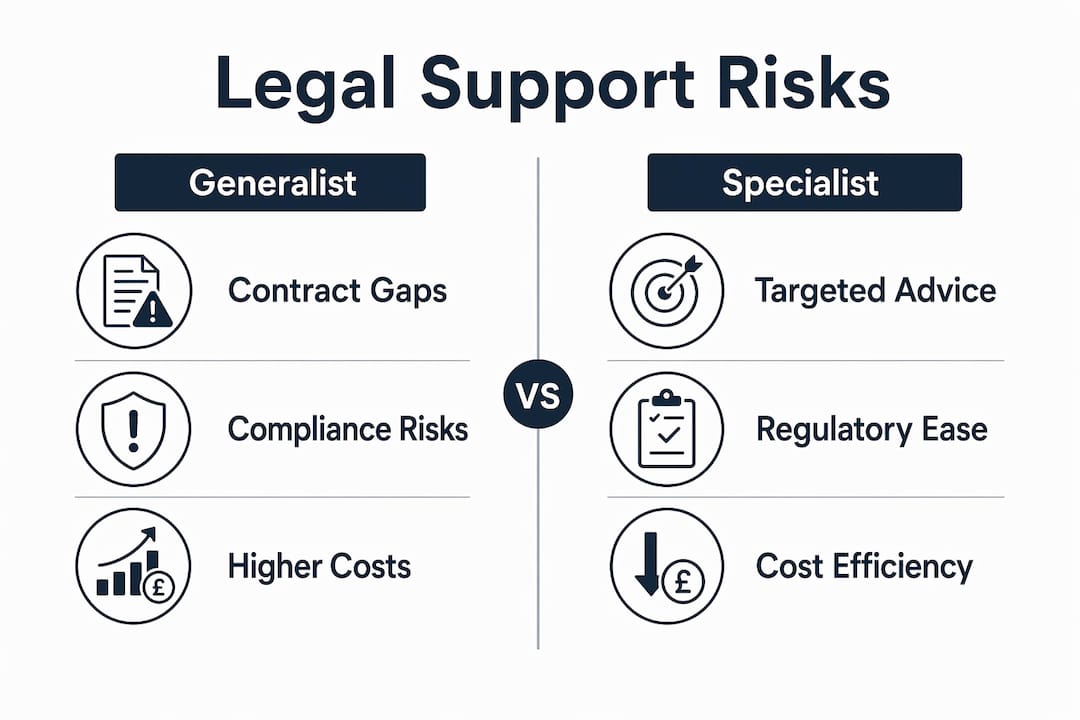
Large-scale legal networks reflect the complexity of this demand. Global legal platforms deploy networks exceeding 3,600 legal professionals across 80 or more jurisdictions to support contractual governance and trade compliance. That scale exists because no single generalist can hold the jurisdictional depth required for multinational operations.
Building long-term relationships with specialists in target markets also provides a structural advantage. Local counsel who understand the regulatory culture, enforcement patterns, and judicial temperament of a jurisdiction deliver insight that no international framework document can replicate. For companies entering Bosnia and Herzegovina or expanding within the Western Balkans, this local knowledge is particularly valuable given the region's distinct regulatory environment and EU accession trajectory.
What practical steps can businesses take to integrate legal expertise?
Businesses that treat legal services as a commodity procurement item consistently underperform those that treat counsel as a long-term partner. Treating legal services as routine procurement often means losing disputes before they reach a courtroom, because the groundwork for a defensible position was never laid.
The following steps reflect best practice for integrating legal expertise into business operations:
-
Establish legal relationships during stable periods. Engaging legal counsel during calm periods boosts response efficiency by 50–70% when crises occur. Advisers who already understand your business structure, contracts, and risk profile act faster and more accurately under pressure.
-
Front-load the legal budget. Allocating legal spend to the early stages of a transaction or market entry prevents costly restructuring later. A contract negotiated with specialist input from the outset costs less to defend than one renegotiated after a dispute arises.
-
Involve legal counsel in contract negotiation, not just review. Legal advisers who participate in commercial negotiations identify risk clauses, jurisdictional conflicts, and enforcement gaps that a post-negotiation review will miss entirely.
-
Require commercial risk quantification. Legal advisers are most effective when they quantify risk commercially rather than issue abstract cautions. Boards make better decisions when legal risk is expressed in terms of cash flow impact, operational delay, or reputational exposure, not legal probability alone.
-
Build a legal compliance calendar. Map all regulatory reporting deadlines, licence renewals, and contractual review dates into a single operational calendar. This prevents inadvertent non-compliance and ensures legal counsel has adequate preparation time.
Pro Tip: When briefing legal counsel, provide full commercial context, not just the legal question. Advisers who understand the business objective behind a transaction structure their advice around outcomes, not just risk avoidance.
What financial risks does expert legal guidance mitigate?
The financial consequences of inadequate legal strategy in cross-border trade are concrete and quantifiable. Tariff impacts in anti-dumping cases can range from 0% to 35%, depending entirely on the quality of legal preparation and defence. That differential represents a material cost that no procurement saving on legal fees can offset.
Beyond tariffs, businesses without specialist legal support face a range of operational and financial exposures:
| Risk category | Potential impact | Legal mitigation |
|---|---|---|
| Anti-dumping tariffs | 0%–35% additional duty | Specialist trade law defence and tariff classification |
| Sanctions non-compliance | Contract voidance, criminal liability | Sanctions screening, jurisdictional legal review |
| Payment disputes | Delayed or lost receivables | Enforceable contract drafting, dispute resolution clauses |
| Regulatory penalties | Fines, licence revocation | Proactive compliance monitoring, sector-specific counsel |
| Supply chain disruption | Operational delay, reputational damage | Trade compliance frameworks, force majeure provisions |
Working capital is particularly vulnerable in international trade. A shipment held at customs due to incorrect documentation, a payment blocked due to sanctions exposure, or a contract voided due to jurisdictional non-compliance each create immediate cash flow consequences. Legal counsel who understand cross-border law prevent these outcomes by structuring transactions correctly from the outset.
Reputation compounds the financial risk. A business found non-compliant in one jurisdiction faces heightened scrutiny in others. Regulatory bodies share enforcement intelligence across borders, and a compliance failure in one market can trigger audits, licence reviews, or counterparty withdrawal in markets where the business has no direct issue.
Key takeaways
Legal experts in global markets function as strategic advisers who prevent financial loss, manage regulatory exposure, and shape commercial decisions across jurisdictions.
| Point | Details |
|---|---|
| Legal counsel is now strategic | General Counsels act as corporate diplomats, shaping decisions rather than reviewing them after the fact. |
| Specialist knowledge prevents penalties | Sector-specific expertise in GDPR, HIPAA, and Incoterms prevents fines and contract failures. |
| Early engagement reduces crisis cost | Building legal relationships during stable periods improves crisis response efficiency by 50–70%. |
| Tariff exposure is legally manageable | Anti-dumping tariffs can range from 0% to 35%; legal preparation determines which end of that range applies. |
| Commercial risk quantification enables decisions | Boards act on legal advice expressed in financial terms, not abstract legal probability. |
Legal expertise as a strategic asset: a practitioner's view
Having advised growth companies and cross-border investors across the European and Balkan markets, I have observed a consistent pattern. The businesses that encounter the most damaging legal problems are rarely those that ignored legal advice entirely. They are the ones that engaged counsel too late, too narrowly, or too cheaply for the complexity of what they were attempting.
The expectation that a generalist adviser can cover trade law, data protection, corporate structuring, and dispute resolution simultaneously is unrealistic. Each of those disciplines has its own regulatory logic, its own enforcement culture, and its own body of case law. Treating them as interchangeable is the equivalent of asking a cardiologist to perform orthopaedic surgery. The professional qualification is shared; the expertise is not.
What I find most underused is the role of legal counsel in business innovation. When a company enters a new market, restructures its supply chain, or adopts a new technology platform, the legal implications are not a footnote. They are a design constraint. Counsel who understand this can shape the structure of a transaction so that it is both commercially viable and legally defensible from the outset. That is a different function from reviewing a contract after the commercial team has finished negotiating it.
The regulatory complexity of 2026 makes this more pressing, not less. Geopolitical fragmentation, AI governance frameworks, and evolving EU accession requirements in the Western Balkans all create conditions where the cost of legal error is rising. The businesses that will perform best are those that treat legal strategy as a core input to commercial planning, not a cost to be minimised after the strategy is set.
— Franjo
Vucic Legal: strategic legal counsel for global markets
Vucic provides specialist legal advisory services for growth companies, investors, and leadership teams operating across Bosnia and Herzegovina and the broader European market. The firm's focus is on corporate and commercial law, cross-border transactions, regulatory compliance, and dispute management, with an emphasis on practical guidance aligned to business objectives.
For business leaders who need legal counsel that understands the commercial context behind every decision, Vucic offers the depth of corporate law expertise and the jurisdictional knowledge required for complex international operations. Whether you are structuring a market entry, managing a cross-border transaction, or addressing a regulatory compliance challenge, Vucic's strategic legal services are built around your specific business requirements. Contact Vucic to discuss how specialist legal counsel can support your next phase of growth.
FAQ
What is the primary role of a legal expert in global markets?
The primary role is to ensure businesses comply with international laws and regulations while minimising financial and operational risk. Legal experts also shape commercial decisions by quantifying legal risk in terms that boards and leadership teams can act upon.
Why is specialised legal knowledge important in international trade?
Generalist advice is insufficient for complex cross-border operations. Sector-specific frameworks such as GDPR, HIPAA, and Incoterms rules require specialist knowledge; misapplication of these frameworks can result in severe financial penalties, contract voidance, or regulatory sanctions.
How early should businesses engage legal counsel in a new market entry?
Legal counsel should be engaged at the earliest stage of market entry planning, before commercial terms are agreed. Engaging counsel during stable periods improves crisis response efficiency by 50–70% and prevents costly restructuring after deals are structured.
What financial risks can legal experts help businesses avoid?
Legal experts mitigate tariff exposure in anti-dumping cases, sanctions non-compliance, payment disputes, regulatory penalties, and supply chain disruption. In anti-dumping cases alone, tariff rates can vary from 0% to 35% depending on the quality of legal preparation.
How does legal compliance support long-term business growth?
Proactive regulatory compliance protects business reputation, maintains counterparty confidence, and prevents enforcement actions that can disrupt operations across multiple markets simultaneously. Compliance failures in one jurisdiction frequently trigger scrutiny in others.